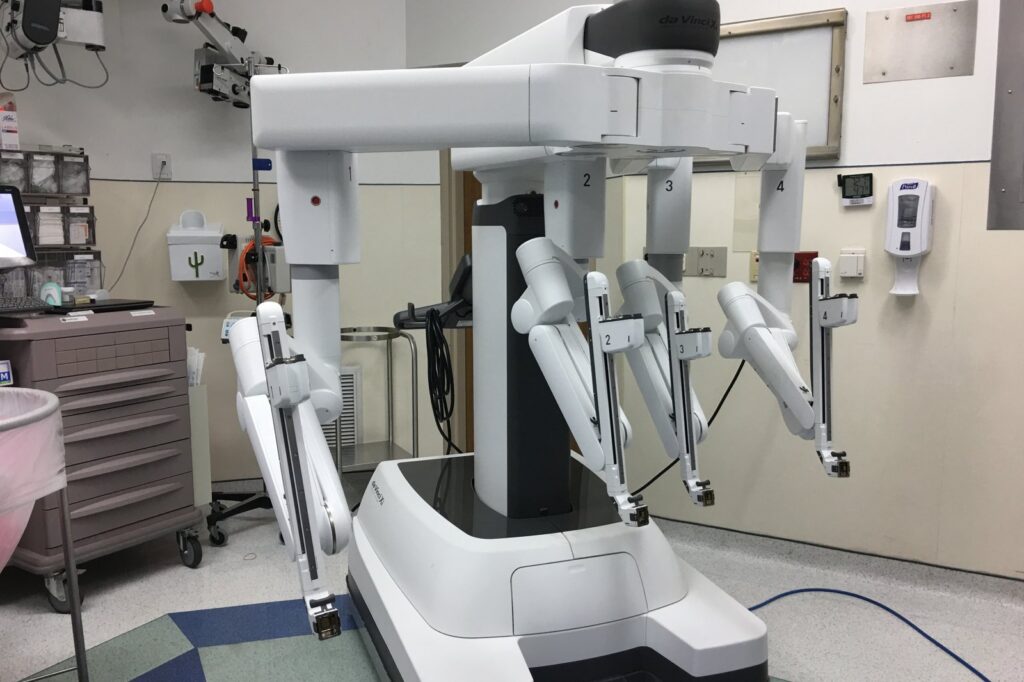
Beilinson Hospital has completed a lung transplant using the da Vinci surgical robot, connecting the donor lung through small incisions rather than opening the chest extensively and spreading the ribs.
The operation took place last month in Petah Tikva. Doctors hope the technique will reduce pain and help selected patients breathe, cough and clear lung secretions more easily during recovery.
What the robot changed
Robotic instruments helped the surgical team connect blood vessels and the airway to the donor lung. In plain terms, the surgical team still performs the transplant, but the robotic instruments allow those connections through much smaller openings.
Beilinson’s thoracic surgery director, Dr. Yuri Peisakhovich, led the operation. He described it as an Israeli turning point for lung transplantation. Within five years, the team hopes this approach can become standard practice without opening the chest widely.
Worldwide, hospitals have performed about 20 such robotic transplants, according to Beilinson. The first took place in Spain three years ago.
Planning for restricted access
The robotic arms created a particular safety challenge: they can obstruct immediate physical access to the patient. Dr. Shai Fine, who directs anesthesiology and operating rooms, said the team had to plan around that limitation.
The dozens of specialists included intensive care staff, pulmonologists, heart-lung machine operators, nurses, anesthesiologists, surgeons and tissue-typing laboratory workers.
Before the operation, they rehearsed in a dedicated simulation. Simulation exercises beforehand covered emergency responses, circulation management, monitoring and ventilation.
The patient was connected to a heart-lung machine beforehand as a precaution, Fine said.
Experience from an earlier operation
About a month earlier, Beilinson surgeons had performed a different minimally invasive transplant. They used two small openings, in the chest and above the abdomen, rather than a large conventional incision.
According to the hospital, that case prepared the team for the robotic transplant.
Dr. Osnat Livne-Straichman, director of the Institute of Pulmonary Diseases and Allergy, also pointed to Beilinson’s record of more than 1,000 lung transplants. She credited that experience and the multidisciplinary team with making the new technique available to eligible patients in Israel.
One patient’s early recovery
Reducing postoperative pain was a central objective, according to Dr. Dan Gurfiel, director of the cardiac and thoracic surgery intensive care unit. Pain can interfere with the deep breathing and coughing needed to clear secretions after transplantation.
Gurfiel said this patient recovered better than the team expected, requiring almost no pain medication beyond paracetamol. The patient’s intensive-care and total hospital stays were also shorter, Gurfiel said.
That account applies to one patient. Beilinson did not provide comparative outcome data, so it does not establish that robotic transplantation generally shortens hospital stays or reduces medication needs.
The immediate result is a completed robotic transplant through small incisions, backed by simulation, a large specialist team and the hospital’s previous transplant experience. Wider use remains an aim rather than a demonstrated standard of care.
Sources
- Beilinson performs ground breaking robotic lung transplant in bid to ease recovery – i24NEWS
- Beilinson performs ground breaking robotic lung transplant in bid to ease recovery – i24NEWS
Photo: Alvarogarciamd (CC BY-SA 4.0)