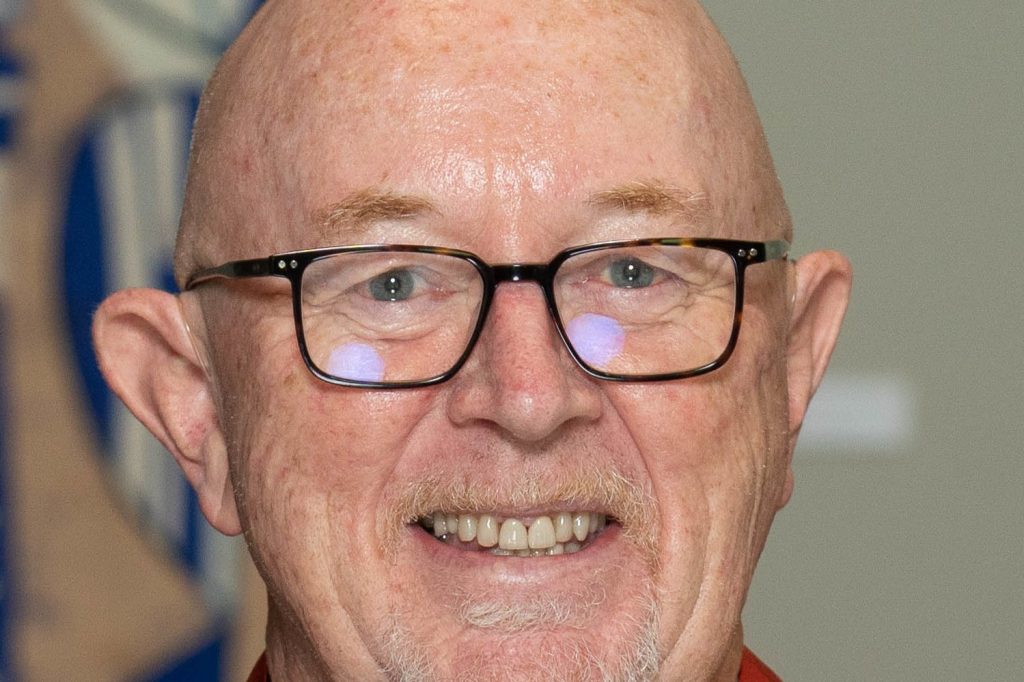
Sir Dave Dobbyn’s studio sits at the end of his garden. No windows. Curved orange and beige brick walls.
Inside, guitars hang from the ceiling, gold records lean against a worn piano. It is a cocoon, not a cave.
This is where the 69-year-old New Zealand music icon keeps working, even after a Parkinson’s diagnosis in 2022, even after prostate cancer, even after breathing problems. That studio matters. It tells you something about what happens when a career artist faces the body failing.
Dobbyn’s home is jammed full of life — books line the lounge, a doorframe near the fridge carries colour scribbles mapping his family’s growth. A three-legged orange cat lounges on the back step, then demands to be carried upstairs.
The place is warm, chaotic, lived in. The studio is different. Dark.
Separate. A deliberate space built for one thing. Dobbyn told journalist Bridget Jones that retirement “doesn’t sit well with me.” He said he thought there would be an off-ramp.
There isn’t. And he wouldn’t take it if there was.
“I’d miss it too much,” he said. “As they say, it keeps you young, it keeps you excited to be alive.” This is the core of the story, and it is not sentimental. Parkinson’s is a progressive neurological disorder.
It steals motor control, slowly. For a musician, that is a direct threat.
Fingers that strum. Lungs that push air through a vocal cord. Posture that holds a guitar.
Dobbyn faces this, and his answer is not resignation. It is a windowless studio at the end of a garden. What drives that?
Not optimism, exactly. Not stubbornness in the cheap sense.
Dobbyn is 69. He has been a public figure in New Zealand music for decades. He has seen the industry change, seen peers slow down, seen the natural arc of a career.
He knows the statistics. He knows what Parkinson’s does.
The choice to keep making music is not ignorance. It is a calculation: the cost of stopping is higher than the cost of continuing. That calculation has a practical shape.
The studio predates the family buying the house. It was already there. Dobbyn claimed it, filled it with trinkets and mementos from a life lived large.
It is not a shrine. It is a workshop.
A place where the physical limitations of the day can be set aside, for a few hours, because the work itself is the point. This is where the analysis lands. Parkinson’s is not a single blow.
It is a slow erosion. The body becomes unreliable.
The things that once came easily — walking, speaking, holding a pick — become deliberate acts. Dobbyn’s response is to double down on the one thing that remains fully his: the decision to make music. He controls that.
The disease controls the rest. Look at the detail of his home. A doorframe stained with children’s height marks.
A three-legged cat. A family that is not tall, the story notes.
These are not decorative details. They are evidence of a life built around connection, around small rituals, around persistence. The studio is the same thing, just louder.
Dobbyn will not retire. That is the headline.
But the real news is the infrastructure he has built to make that possible. The dark room. The instruments.
The routine. He is not pretending the disease is not there. He is building around it.
For other artists facing similar diagnoses, this is a template. Not a medical one.
A practical one. You cannot stop the disease. You can control your environment.
You can decide what matters. Dobbyn decided.
The studio is the proof.