
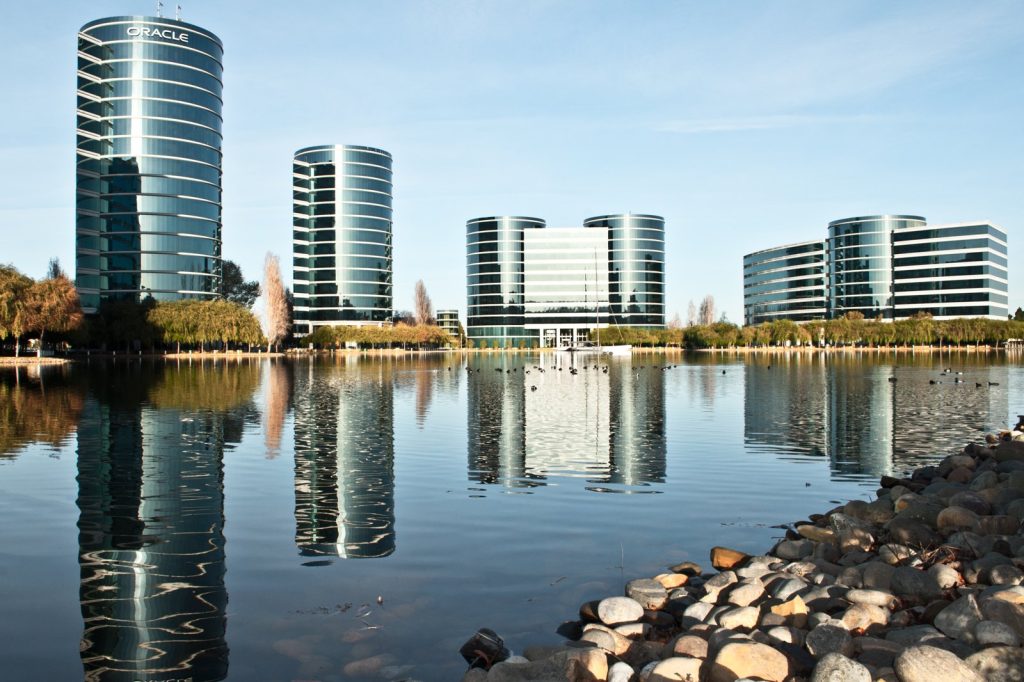
Oracle is sitting on a $553 billion backlog. That is the figure for its remaining performance obligations in the third quarter of fiscal 2026, up 325% from a year earlier, and most of it comes from multi-year contracts to train AI models.
The company that once defined itself by relational databases now calls itself the world’s fourth hyperscaler, after Amazon Web Services, Microsoft Azure and Google Cloud. Whether it can turn that backlog into cash is the question investors are asking as of mid-April 2026.
How a database company got here
Larry Ellison, Bob Miner and Ed Oates founded the company in 1977 as Software Development Laboratories, built around a CIA-funded effort to create a relational database. It took the name Oracle Systems Corporation in 1982. Acquisitions followed in the 1990s and 2000s, among them PeopleSoft, Siebel Systems and Sun Microsystems. The Sun deal in 2010 brought Java and hardware.
The cloud came late. Oracle was slow to move, but its second-generation Oracle Cloud Infrastructure eventually let it compete with the established players on performance and price.
Where the AI business comes from
Oracle offers high-performance “Superclusters” tuned for AI training. It adopted liquid cooling and Nvidia’s Blackwell platform early, and the company counts OpenAI and Meta among its customers. Demand for top-end GPUs has outrun supply, and Oracle’s success in securing large quantities of them has made it a way around the bottleneck for AI startups.
It also plays nicely with rivals. By placing Oracle databases inside Azure and Google Cloud data centers, it has blunted much of the lock-in fight. Its sovereign cloud and “Dedicated Region” products, sold to countries that want data kept inside their borders, have drawn interest in the Middle East and Europe.
The leadership changed in September 2025. Safra Catz, CEO since 2014, became executive vice chair. Clay Magouyrk, the former head of OCI, and Mike Sicilia, who ran Oracle Industries, now serve as co-CEOs. Ellison, 81, stays on as chairman and chief technology officer.
The money side
Oracle reported $57.4 billion in revenue for fiscal 2025 and has guided toward roughly $67 billion for fiscal 2026. Non-GAAP operating margins sit around 40%. Spending is the sore point: the company has projected $50 billion in capital expenditure for fiscal 2026, which has squeezed near-term free cash flow.
The stock shows the strain. It peaked near $346 in September 2025, then fell hard as investors worried about debt and capital spending. Since March 2026 it has recovered to about $156 a share, up roughly 13% for the month as of mid-April.
Analysts at Goldman Sachs and J.P. Morgan have praised the backlog growth but are wary of the gap between spending and revenue. Some large hedge funds have bought back in, seeing the $140 to $150 range as a reasonable entry point.
Risks on the list
A class-action suit, Barrows v. Oracle, was filed in February 2026. It alleges the company misled investors about whether its AI spending plan was feasible. The Cerner health-records integration has run slower than expected, and the Veterans Affairs contract, which resumed in early 2026, is under close Congressional oversight. A large share of growth also rides on a few huge AI contracts, OpenAI’s among them.
Oracle is targeting about $90 billion in revenue for fiscal 2027, as new data centers come online in late 2026.