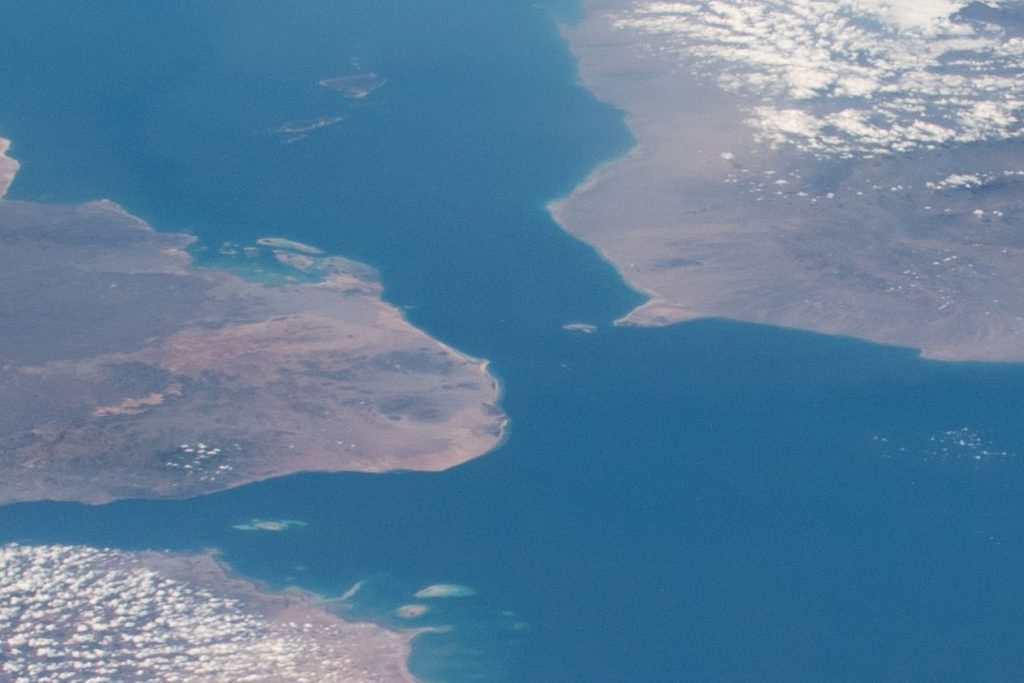
The Houthis say they have closed the Bab El Mandeb Strait to Saudi-linked shipping, and they claim six ships turned back on Tuesday. Nobody has confirmed that independently.
The group calls the move retaliation for the Saudi blockade of Yemen and for an attack on the airport in Sanaa, the rebel-held capital. It was announced as the Iran war already strains oil and trade flows.
Why the strait matters
Bab El Mandeb sits at the southern tip of the Arabian Peninsula and links the Red Sea to the Gulf of Arabia. Around 12 percent of world trade passes through it, including a fourth of global container traffic moving between Europe and Asia by way of the Suez Canal.
Saudi Arabia leans on it more than it used to. With shipping out of the Arabian Gulf badly limited by the disruption at the Strait of Hormuz, the kingdom has been sending some 4 million barrels of oil a day out of its Red Sea port of Yanbu. Allison Minor, director of the Atlantic Council’s Project for Middle East Integration, wrote that more than 7 million barrels of petroleum a day went through Bab El Mandeb in June, against about 4 million before the Iran war.
What the Houthis say they will do
Three Houthi officials told the AP on Tuesday that the group has spent months planning how to disrupt traffic in the strait. They spoke anonymously because they were not authorized to brief the media. Their list: naval mines, explosive-laden boats, drones, and helicopters that would let fighters board ships. Vessels would get a warning first, they said, and force would follow only if ships crossed designated boundaries.
The group says it will stop only ships tied to Saudi Arabia or its Red Sea ports. Its record argues for caution. During the earlier blockade announced against Israel over the Gaza war, the rebels attacked many vessels with little or no link to that conflict, and they hit more than 100 ships at the peak before a US and Israeli air campaign ended the attacks in early 2025.
The Houthis do not hold the Yemeni coastline along the strait, which belongs to their opponents in the civil war. Their territory starts less than 100 kilometres away.
Reaction
“So far, it hasn’t happened,” President Donald Trump told reporters in the Oval Office on Tuesday. “I think that if there is something like that, we’ll just have to take care of business.”
Saudi military spokesperson Maj. Gen. Turki Al Malki said any Houthi threat to transiting vessels would be “dealt with swiftly and firmly” and called such threats acts of maritime piracy. The Saudi military says it will keep the strait open.
Clionadh Raleigh, founder of the conflict monitor ACLED, pointed to the double exposure. “If Bab El Mandeb comes under pressure at the same time as shipping in the Gulf, you have disruption around two of the world’s most important maritime routes at once,” she said. Iran has shown at Hormuz that sporadic attacks alone can effectively close a waterway by pushing up risk and insurance premiums, and the threat by itself could keep shippers away from the Red Sea route.
Ahmed Nagi, a senior Yemen analyst at the International Crisis Group, said the blockade also helps Iran, the Houthis’ ally, while the US has resumed daily airstrikes. “The Houthis provide Tehran with influence over one of the world’s most important maritime chokepoints,” he said.
Background to the flare-up
Yemen’s civil war began in 2014, when the Houthis seized Sanaa and much of the north and forced the government into exile. A Saudi-led coalition has fought them and imposed an air and sea blockade on Houthi-held areas, which had eased in recent years. Major fighting ended with a truce in 2022.
The Houthis say Saudi Arabia struck Sanaa airport earlier this month to stop a flight carrying Houthi leaders home from Iran, where they had attended the funeral of Supreme Leader Ayatollah Ali Khamenei. The plane landed safely at another airport. The Houthis then fired missiles and drones at Abha International Airport in Saudi Arabia, the most significant confrontation in years.
Saudi crude has other routes. Up to 2.5 million barrels a day could cross the Red Sea to Egypt and travel by the SUMED pipeline to the Mediterranean, and another 1 million barrels a day could go through the Suez Canal. Other shippers could detour around the Cape of Good Hope, as they did during the Gaza war. That adds one or two weeks to a voyage and raises the cost.
Sources
- Houthi threat puts another global shipping route at risk
- Houthi Red Sea Attacks Threaten Global Trade Routes