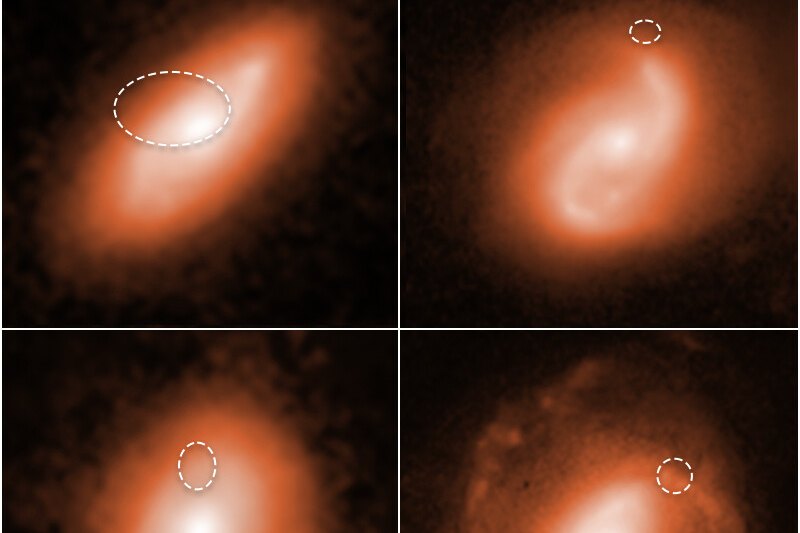
A radio flash that left its home galaxy some eight billion years ago has become the most distant fast radio burst astronomers have been able to pin to a source. The paper, published in Science on 19 October 2023, was led by Dr Stuart Ryder of Macquarie University and Associate Professor Ryan Shannon of Swinburne University of Technology. It beats the team’s own previous record by 50%.
The burst, catalogued as FRB 20220610A, was picked up on 10 June 2022 by CSIRO’s ASKAP radio telescope in Western Australia. In a few milliseconds it released as much energy as our Sun puts out in 30 years. Notably, ASKAP did more than catch it: the telescope fixed its position precisely enough for the European Southern Observatory’s Very Large Telescope in Chile to go looking for the host.
That search turned up not one galaxy but a group of two or three, apparently in the middle of merging. This fits current thinking about what sets off such bursts. The team also concluded that eight billion years is about as far back as present telescopes can reasonably expect to locate them.
Weighing the missing matter
The radio and optical data do different jobs. “Radio observations give us key information that allows us to measure the turbulent magnetised interstellar and intergalactic medium between us and the host galaxy,” said Dr Hao Qiu, a postdoctoral fellow at the SKA Observatory and an author of the paper. Optical observations, he added, give the distance to the host and a picture of the surroundings along the line of sight.
The paper also confirms that FRBs are common in the cosmos, which matters because they can be used to account for matter that has gone missing. Shannon put the problem plainly: count up the ordinary matter in the Universe, the atoms we are made of, and more than half of what ought to be there is absent. The suspicion is that it sits between galaxies, perhaps too hot and diffuse to see by normal methods. Fast radio bursts, he said, sense the ionised material, and even in nearly empty space they can pick up the electrons, which lets astronomers measure how much lies between galaxies.
What comes next
For now ASKAP remains the best radio telescope for detecting and locating FRBs. The SKA telescopes, under construction in Australia and South Africa, should change that. “The SKA telescopes will be even more sensitive, which means we will be able to search for fainter FRBs from further distances,” Qiu said. He also pointed to the need for larger optical and infrared telescopes to identify the distant host galaxies.
The ASKAP dish sits at the CSIRO Murchison Radio-astronomy Observatory, on Wajarri Yamaji Country in Western Australia, and is a precursor to the SKA project.