
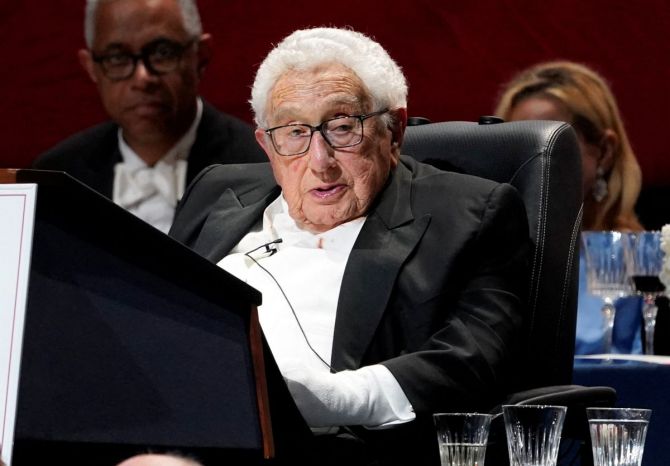
As of November 28, 2023, Henry Kissinger, the renowned American diplomat, political scientist, and politician, is nearing the end of his life. With a career spanning multiple decades, Kissinger has left an indelible mark on the world of geopolitics. Born on May 27, 1923, in Germany, Kissinger emigrated to the United States in 1938 as a Jewish refugee fleeing Nazi persecution, an experience that would shape his worldview and inform his future diplomatic endeavors.
Kissinger’s academic and professional career is a testament to his intellectual prowess and dedication to public service. After serving in the U.S. Army during World War II, he attended Harvard University, where he excelled academically.
He later became a professor of government at the university, earning an international reputation as an expert on nuclear weapons and foreign policy. His expertise and experience led to consulting work with government agencies, think tanks, and presidential campaigns, including those of Nelson Rockefeller and Richard Nixon. Kissinger’s entry into high-level politics came when he was appointed as the 7th national security advisor by President Nixon in 1969, a position he held until 1975.
He later served as the 56th United States secretary of state from 1973 to 1977, under both Presidents Nixon and Gerald Ford. During his tenure, Kissinger pioneered the policy of détente with the Soviet Union and orchestrated an opening of relations with China, demonstrating his commitment to a pragmatic approach to geopolitics, known as Realpolitik.
One of Kissinger’s most notable diplomatic achievements was his engagement in “shuttle diplomacy” in the Middle East, aimed at ending the conflict in the region. This approach, which involved direct negotiations with leaders from opposing sides, showcased Kissinger’s ability to navigate complex geopolitical situations and find creative solutions to seemingly intractable problems. His efforts in the Middle East, while not always successful, demonstrated a willingness to engage with adversaries and seek common ground, a hallmark of his diplomatic style.
Throughout his career, Kissinger has been a proponent of Realpolitik, an approach to international relations that emphasizes pragmatism and a focus on national interests. This philosophy has guided his decision-making and informed his interactions with world leaders. While his approach has been subject to criticism and debate, it is undeniable that Kissinger has played a significant role in shaping the modern geopolitical landscape.
As the world continues to evolve and new challenges emerge, Kissinger’s legacy serves as a reminder of the importance of diplomatic engagement and strategic thinking in international relations. As we look to the future, it is clear that the impact of Kissinger’s work will continue to be felt for years to come.
As the international community navigates an increasingly complex and interconnected world, the principles of diplomacy and statecraft that Kissinger embodied will remain essential. In the days and weeks ahead, we can expect to see a renewed focus on Kissinger’s life and legacy, with scholars, policymakers, and diplomats reflecting on his contributions to the field of international relations.
As we consider the lessons of Kissinger’s career, we would do well to remember the importance of pragmatism, creativity, and a commitment to engagement in the pursuit of peace and stability in a rapidly changing world.




