
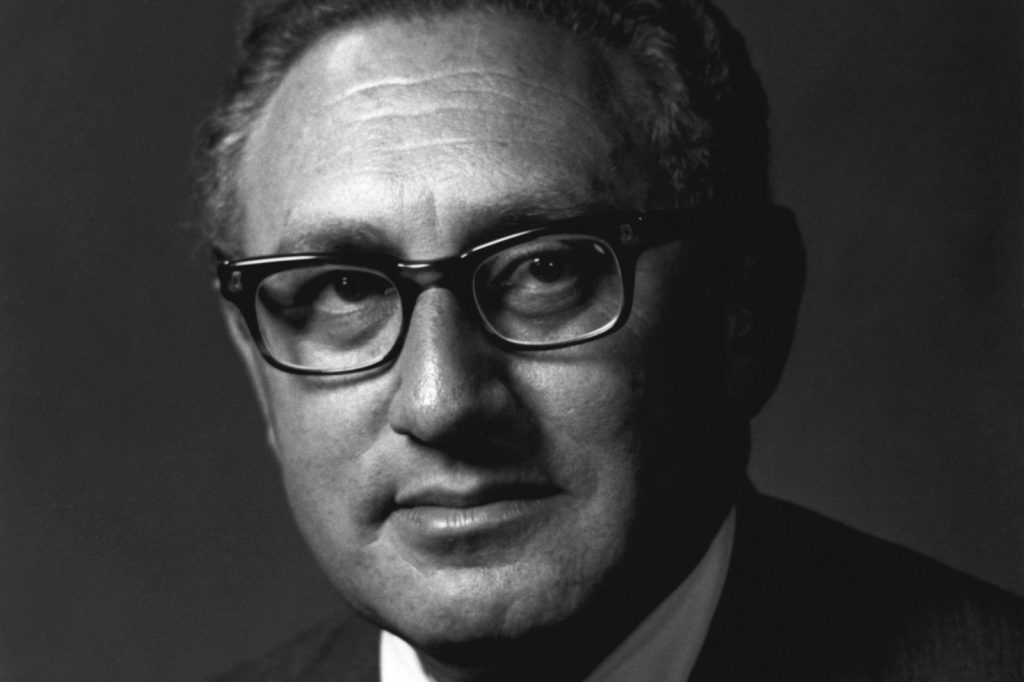
Henry Kissinger, the former U.S. secretary of state and national security advisor who reshaped American foreign policy during the Cold War, is nearing the end of his life at age 100. His career was defined by a belief in power as the primary driver of international relations. Born Heinz Kissinger in Fürth, Germany, on May 27, 1923, he fled Nazi persecution with his family in 1938.
After serving in the U.S. Army during World War II, he attended Harvard University, where he later became a professor and wrote extensively on nuclear strategy and the Congress of Vienna. This academic background provided a framework for his later policymaking.
At age 46, Kissinger was appointed national security advisor by President Richard Nixon in 1969, a position he held until 1975. He also served as secretary of state from 1973 to 1977 under Nixon and President Gerald Ford. His worldview was shaped by the collapse of Weimar Germany and the nuclear standoff with the Soviet Union, leading him to prioritize hard calculations over sentimentality in diplomacy. Kissinger’s approach, known as Realpolitik, produced several landmark achievements.
He secretly opened relations with China, ending decades of mutual hostility between Washington and Beijing since 1949. This move created a new strategic triangle involving the United States, China, and the Soviet Union.
He also pursued détente with the Soviet Union through arms control talks and summit meetings, aiming to manage the rivalry without direct conflict. Critics argued he was too lenient on the Kremlin, while supporters credited him with preventing a nuclear exchange. In the Middle East, Kissinger invented shuttle diplomacy after the 1973 Yom Kippur War, flying between Jerusalem, Cairo, and Damascus to negotiate directly with opposing leaders.
While he did not resolve the Palestinian question, he secured disengagement agreements that halted open warfare for several years. His goal was progress rather than perfection.
Kissinger’s legacy remains deeply contested. Some view him as a war criminal, while others see a statesman who preserved peace. The record shows he pursued a pragmatic line, treating national interest as the guiding principle rather than humanitarian ideals.
He was more a calculator than a crusader. In his final years, Kissinger watched the international order he helped construct unravel.
The Soviet Union collapsed. China evolved from a partner into a rival. The Middle East remained volatile.
His brand of realism has few defenders in an era of democratic crusading and great-power competition. Yet the questions he posed endure: How to manage a nuclear-armed world, when to negotiate with enemies, and what price is acceptable for stability.
Kissinger continued writing and advising into his old age, giving interviews at 100. He observed the United States and China drift toward confrontation and a new arms race begin. His funeral is expected to be a state occasion, but arguments about his record will persist long after.




