
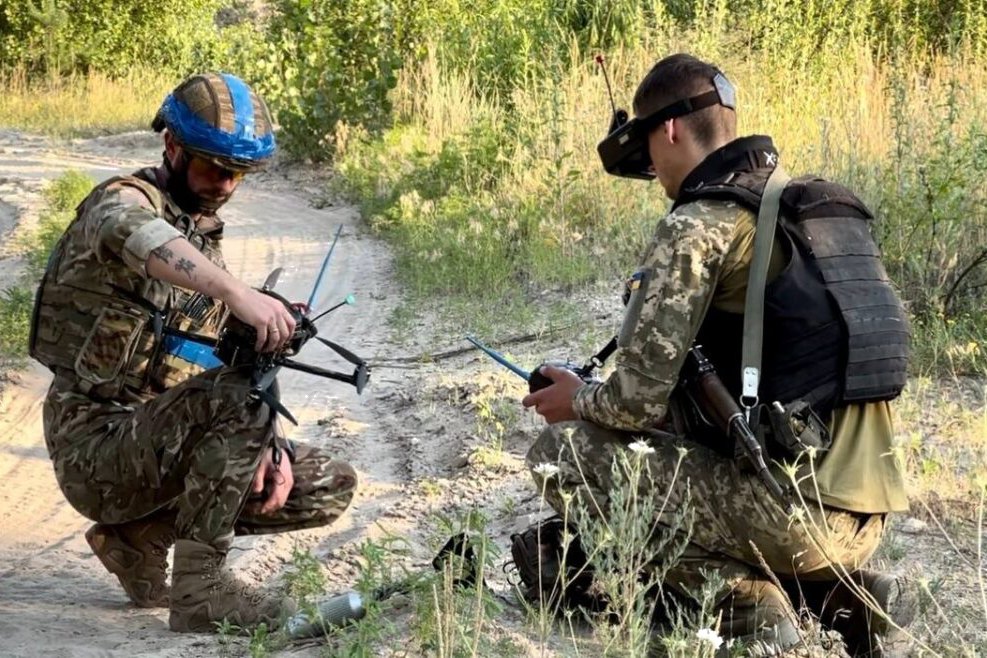
Germany has financed the acquisition of 50,000 strike drones for Ukraine, according to available records, marking a significant infusion of precision-strike capability. These systems are expected to be loitering munitions or small unmanned combat aerial vehicles (UCAVs) designed to engage targets at ranges up to 50 kilometers.
The delivery underscores how Western allies increasingly view unmanned platforms as a scalable, cost-effective answer to Russia’s artillery advantage.
A Cost-Effective Arsenal
Strike drones have been a critical component of the war in Ukraine since 2022. Both Turkish Bayraktar TB2 drones and various first-person view (FPV) systems are used for reconnaissance, artillery spotting, and precision strikes on Russian armor, logistics, and personnel.
The cost of each drone ranges from $500 to $50,000, according to officials, a price point that has fundamentally reshaped battlefield tactics. The lower cost of precision strikes compared to traditional missiles has shifted emphasis toward speed and surveillance over heavier, more expensive munitions. Drones have proven effective in disrupting Russian supply lines and countering artillery, creating persistent pressure on enemy positions. However, the technological fight is not one-sided.
Both sides are employing electronic warfare to jam drone signals, a constant duel that determines which systems remain operational on any given day. This technological race has forced continuous adaptation as each side seeks to neutralize the other’s unmanned advantage.
Strategic Implications and Domestic Production
The German commitment of 50,000 units reflects a broader strategic calculation among Western allies. The systems funded by Berlin are designed to strike at ranges that keep Ukrainian operators behind safer lines while still reaching forward Russian positions.
By providing a reliable stream of low-cost, precision-guided drones, Western partners aim to offset Russia’s numerical superiority in artillery and armor. Ukraine has not relied solely on foreign supplies. Its own drone industry has grown in response to battlefield demand, producing models such as the R18 and the Baba Yaga.
This domestic capacity reduces dependence on foreign suppliers for certain types of drones and allows faster adaptation to Russian electronic warfare tactics, as Ukrainian engineers can modify software and hardware without waiting for foreign approvals. The combination of foreign donations and local production has created a flexible, responsive drone ecosystem.
The war has demonstrated that drones are no longer a niche technology but a central pillar of modern combined-arms warfare. Their ability to loiter over a target and strike only when confirmation is obtained has made them a preferred tool for disrupting enemy movements and defenses. Unmanned combat aerial vehicles trace their development from early reconnaissance roles to armed systems capable of precision strikes. Turkey’s use of armed drones in conflicts during the 2010s demonstrated their effectiveness, prompting wider adoption.
Other nations integrated similar capabilities into their militaries, and the conflict in Ukraine has accelerated that trend. The growing reliance on these systems reflects a broader shift in military strategy, where unmanned platforms reduce risk to personnel while maintaining offensive pressure.
This evolution has forced adversaries to adapt, investing in electronic warfare and counter-drone systems as an escalating technological competition runs parallel to the conventional fight. Both sides continue to invest heavily in drone production, electronic countermeasures, and counter-drone systems, ensuring that the battle for control of the air—whether manned or unmanned—remains a decisive factor on the battlefield.




