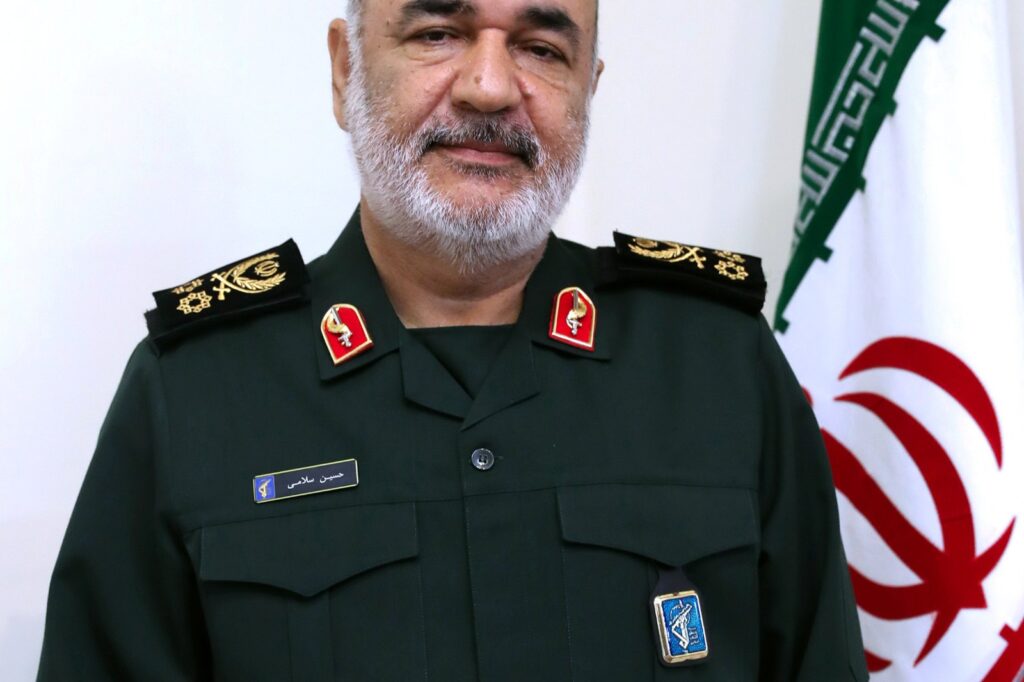
Early on June 13, 2025, an Israeli airstrike killed Hossein Salami, the commander-in-chief of Iran’s Islamic Revolutionary Guard Corps. The strikes opened what became known as the Twelve-Day War, and they also hit Iran’s nuclear facilities and military installations. Other top commanders died with him.
Salami was born in 1960 in Golpayegan, in Isfahan province. He was a college student in 1980 when the Iran-Iraq War began, and he joined the Guards. After the war he went back to his studies and earned a master’s degree in defense management. Later he picked up a doctorate in national defense management and took missile courses at Malek-Ashtar University.
Up through the ranks
His career ran through the missile force. From 1999 to 2008 he was deputy commander of the Guards’ Aerospace Force, where he supervised ballistic projects including the Shahab-3 and Qadr missiles. Under his command, one of them reached 2,000 kilometers. He then led the Guards’ air force, and from 2009 to 2019 served as deputy commander of the whole corps.
On April 21, 2019, Supreme Leader Ali Khamenei named him commander-in-chief, replacing Mohammad Ali Jafari, who had held the post since September 2007. Salami was a longtime confidant of Khamenei.
The speeches
Among Guards commanders, Salami was the one known for fiery speeches. In 2019 he said on Iranian television: “We are planning to break America, Israel, and their partners and allies.” In January that year he put it more broadly: “Our war is not a local war. We have plans to defeat the world powers.”
After the US killed Qasem Soleimani near Baghdad airport, Salami spoke at the funeral. “We will take revenge,” he said, promising a revenge that would be “tough, strong, decisive and finishing.”
He could also admit fault. On January 13, 2020, five days after Guards missiles shot down Ukraine International Airlines Flight PS752 and killed 176 people, he went before Iran’s parliament. “We did make a mistake,” he said. “In my all lifetime I haven’t been as sorry as much as now.”
Sanctions and reach
The United Nations Security Council sanctioned Salami over Iran’s ballistic missile program, and Washington sanctioned the Guards and affiliated individuals in April 2019. Canada listed him in October 2022 after the crackdown on protests that followed the death of Mahsa Amini. The European Union sanctioned him in 2021 over the November 2019 protests, and again in 2023 over the supply of Iranian drones to Russia for use in Ukraine.
During his tenure, Iran’s network of allied groups across the region grew, including Hezbollah, the Houthis in Yemen and Shia groups in Iraq, according to Al Jazeera.
Aftermath
The Guards mourned him in a statement carried by the Iranian news agency IRNA, calling Salami “one of the most distinguished commanders of the Islamic Revolution.” Ahmad Vahidi was named his temporary successor.
Iran answered by firing ballistic missiles at Israel, the weapon Salami had helped build. Reza H Akbari of the Institute for War and Peace Reporting told Al Jazeera that killing such men leaves gaps in knowledge, since they have personal networks and standing in the chain of command. Even so, he said, “it’s difficult to destroy an existing structure.”