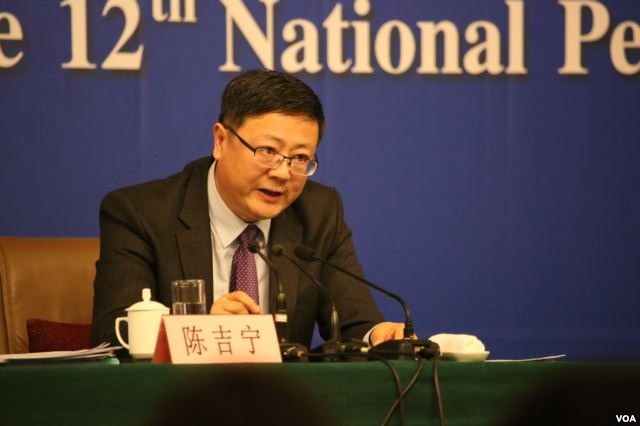
BEIJING, November 28, 2026 — China’s anti-corruption watchdog announced on Tuesday that Shanghai party secretary Chen Jining is under investigation for suspected serious violations of discipline and law. The move removes a Politburo member from one of the country’s most politically significant posts less than a year before the 21st Party Congress.
Watchdog Announces Probe
The official Xinhua News Agency reported the investigation on Tuesday, stating that Chen, 62, is suspected of serious violations of discipline and law, the standard phrasing for corruption inquiries. The announcement did not specify the nature of the alleged wrongdoing.
Shanghai Leadership Backs Decision
The Standing Committee of the Shanghai Municipal Party Committee convened a meeting the same night, stating it firmly supports the central leadership’s decision to investigate Chen. The committee stressed the need to strictly observe political discipline, maintain a zero-tolerance approach to corruption, and remain absolutely loyal to the party. The following day, the party leadership groups of the municipal government, the Standing Committee of the Shanghai Municipal People’s Congress, and the Shanghai Municipal Committee of the Chinese People’s Political Consultative Conference also expressed their support.
Chairing a meeting of the municipal government’s party leadership group, Shanghai Mayor Zhu Zhongming said the investigation sent a clear signal that the anti-corruption campaign would have no forbidden zones and cover all sectors. He called on officials to strengthen party discipline and uphold integrity in public office.
A Post With Historical Weight
The position of Shanghai party secretary has long functioned as a primary stepping stone to the Politburo Standing Committee, the apex of political power in China. According to historical data, eight of the ten officials appointed to the post since 1987 went on to join the Standing Committee. That list includes Jiang Zemin, Zhu Rongji, Wu Bangguo, Huang Ju, Xi Jinping, Yu Zhengsheng, Han Zheng, and Li Qiang. Two became paramount leader, and two became premier.
By comparison, the Beijing party secretary post has yielded a lower promotion rate over the same period. Of the seven Beijing party secretaries who have left office since the late 1980s, three — Wei Jianxing, Jia Qinglin, and Cai Qi — advanced to the Standing Committee, a rate of roughly 43 percent.
Echoes of the Chen Liangyu Case
The investigation revives memories of 2006, when then-Shanghai party secretary Chen Liangyu was removed from office and placed under investigation. That case involved the improper use of social security funds and the trading of power for money. Chen Liangyu was eventually sentenced to 18 years in prison in 2008. Following his removal, then-mayor Han Zheng served as acting party secretary for several months before Xi Jinping assumed the post in March 2007. Xi held the position for only seven months before his elevation to the Politburo Standing Committee later that year.
Analysts note that while the surname and the post are the same, the specifics of Chen Jining’s case have not been disclosed, making direct comparison difficult. Kerry Brown, director of the Lau China Institute at King’s College London, suggested the investigation may reflect a political dynamic in which visibility as a potential successor becomes a liability. “I think one of the golden rules in Chinese politics, now and in the past, is never ever be in a position where you look like you might be a potential successor to the top job,” Brown said.
Implications for the 21st Party Congress
The vacancy arrives with less than a year until the 21st National Congress of the Chinese Communist Party, where a major leadership reshuffle is anticipated. President Xi Jinping is widely expected to secure a further term. The downfall of Chen Jining, once viewed as a rising technocrat with a decade of study and work experience in Britain, including at Imperial College London, creates an opening for another candidate.
Daria Impiombato, a senior analyst at the Berlin-based think tank MERICS, said the promotion trajectory for whoever assumes the Shanghai post is not predetermined. “The path forward for whoever takes Chen Jining’s spot is not set in stone,” she said. She noted that the supreme military command has also been depleted by purges of top generals, adding that Xi has not shown hesitation in leaving gaps in his leadership until his plans have fully played out.
Potential Successors
Shanghai Mayor Zhu Zhongming, 54, appointed in September following the resignation of his predecessor Gong Zheng, is now the city’s highest-ranking active official. His position places him in a prominent spot should the central leadership look internally for an acting secretary or a permanent replacement. The investigation also fuels speculation regarding personnel networks associated with Chen’s previous posts, including Tsinghua University, the former Ministry of Environmental Protection, and the political establishments of Beijing and Shanghai, though no reliable public information substantiates claims implicating specific individuals or family members.
Sources
- Shanghai party chief Chen Jining’s downfall deepens uncertainty in China’s elite politics
- Downfall of Shanghai Party chief opens route to pinnacle of politics
- Xi probes Shanghai boss, widening biggest shakeup in decades
Photo: VOA (Public domain)