
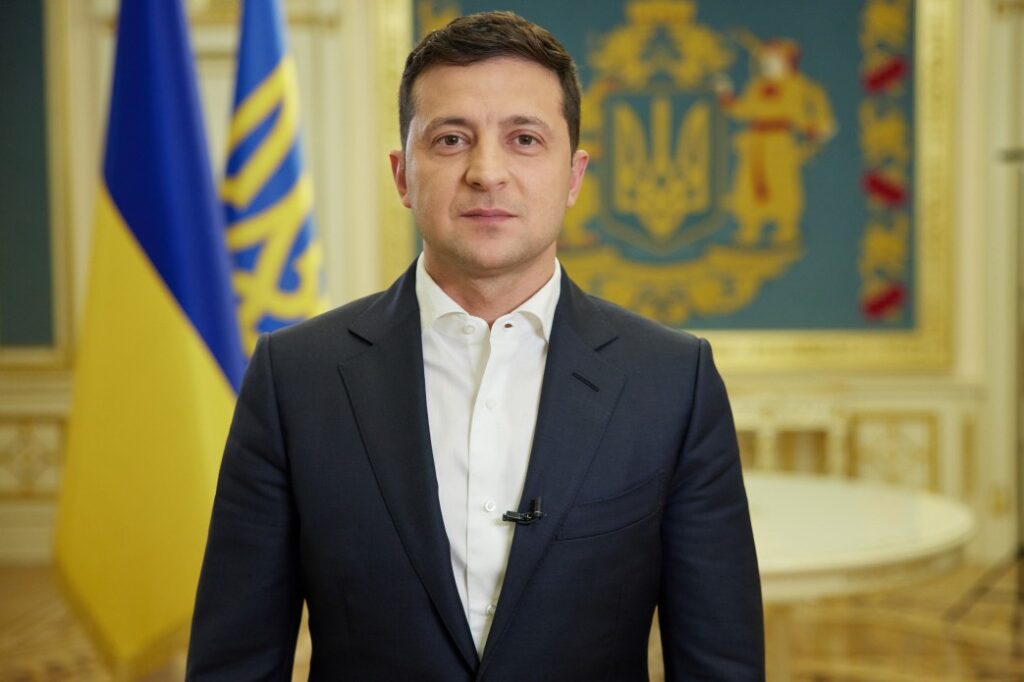
Volodymyr Zelenskyy’s ascension to the Ukrainian presidency followed a path that few could have predicted. Born on January 25, 1978, in the industrial city of Kryvyi Rih, he built a career as a comedian, actor and producer before entering politics. From 2015 to 2019, he starred in the television series “Servant of the People,” a comedy about an ordinary schoolteacher who is unexpectedly elected president.
That fictional premise turned into a self-fulfilling prophecy: Zelenskyy won the real presidency in a landslide victory on April 21, 2019, and took office on May 20 of the same year. His political party, also named Servant of the People after the show, went on to capture a majority in the parliamentary elections that followed.
The fiction, however, would soon be overtaken by a far grimmer reality.
From Comedian to Wartime Leader
On February 24, 2022, Russia launched a full-scale invasion of Ukraine, fundamentally altering Zelenskyy’s role. He was transformed from a domestic political figure into an international symbol of Ukrainian resistance.
In the months that followed, he addressed the US Congress, the European Parliament and other legislative bodies, pressing for military aid and diplomatic isolation of Moscow. Time magazine named him Person of the Year for 2022. By early 2023, his approval rating inside Ukraine had shot above 80 percent.
Billions of dollars in military aid from the United States and Europe flowed into Ukraine, with Zelenskyy serving as the principal demandeur for that support. He has consistently demanded the withdrawal of Russian forces from all Ukrainian territory, including Crimea, which Russia annexed in 2014.
He has also pushed for NATO membership as a long-term security guarantee.
A Shifting Political Landscape
But the political calculus has shifted since the peak of the 2023 approval rating. That figure has declined, though the source material does not specify the current number.
One of the most contentious domestic issues has been the postponement of presidential elections. They were scheduled for 2024, but Zelenskyy delayed them under martial law, which was imposed after the invasion. Critics argue that the delay concentrates power in the presidency without a renewal of the electoral mandate.
The parliamentary arithmetic has also evolved. The Servant of the People party, which held a majority after the 2019 elections, has seen its cohesion tested by the stresses of war.
What to watch next: the trajectory of the approval rating as the war enters its fifth year. The billions in military aid from the United States and Europe are not automatic; they require continued political will in Washington and European capitals. And the domestic pressure to hold elections, even under martial law, is unlikely to disappear.
Historical Context and Stakes
Ukraine, a country in Eastern Europe, borders Russia to the east and northeast. The region was once the center of East Slavic culture under Kievan Rus’ before falling to the Mongols in the 13th century. For several centuries, various external powers fought for control of the land.
The area eventually became part of the Russian Empire and later the Soviet Union. During the early 1930s, a man-made famine killed a large number of people.
Ukraine gained independence in 1991 after the Soviet Union dissolved. Political shifts continued with the Orange Revolution in 2004. Later, mass demonstrations in 2014 led to a revolution. Russia responded by occupying and annexing Crimea that same year.
These events set the stage for the full-scale invasion in 2022. The current conflict affects global security and international law.
It has forced a shift in European defense strategies and created a massive humanitarian crisis. The outcome will determine the future borders and sovereignty of the nation.




