
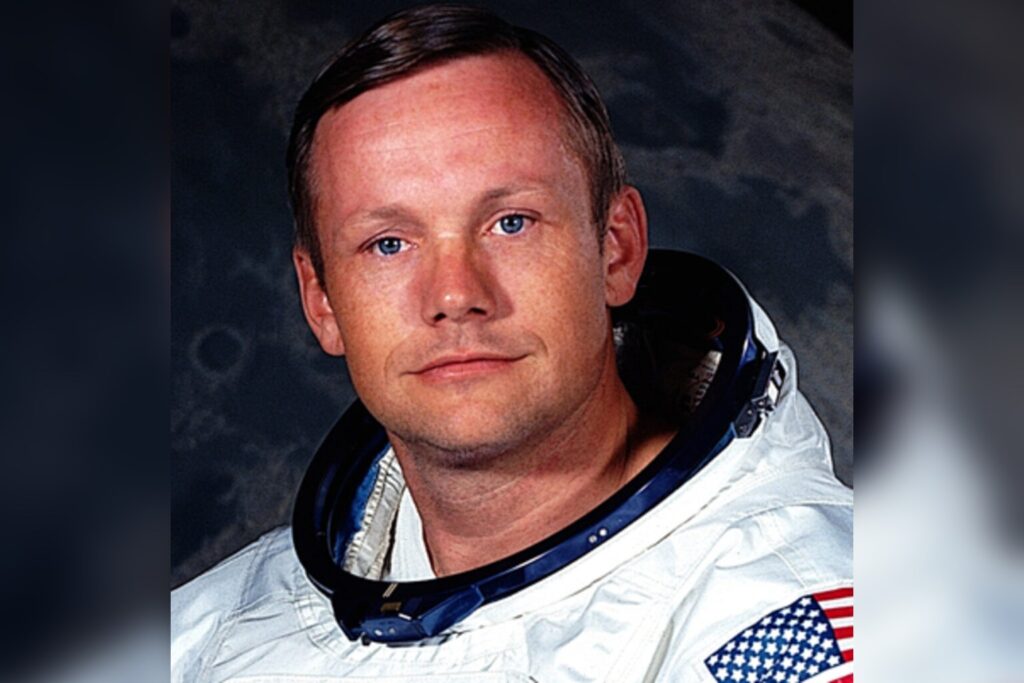
Neil Armstrong was flying 500 feet above Korea at 350 mph on September 3, 1951, when his wing hit a cable strung across the hills as a booby trap. About six feet of it was torn off. He was 21 years old.
He got the Panther fighter back over friendly ground. With the aileron gone, ejecting was the only safe choice. He had hoped to bail out over water and wait for a Navy helicopter, but the wind blew his parachute back over land, and a roommate from flight school came and picked him up in a jeep.
From Ohio farm country to the Navy
Armstrong was born on August 5, 1930, near Wapakoneta, Ohio. His father audited for the state, and the family lived in 16 towns in 14 years. He took his first plane ride at five or six, in a Ford Trimotor called the Tin Goose. He earned a student flight certificate on his 16th birthday and soloed that August, before he had a driver’s license.
The Navy paid his tuition at Purdue, where he began studying aeronautical engineering in 1947, and called him up in 1949. He was qualified as a naval aviator in August 1950. In Korea he flew 78 missions from the carrier USS Essex, about 121 hours in the air, with the last on March 5, 1952. He won the Air Medal and two gold stars.
After the war he finished his degree at Purdue and became a test pilot at the National Advisory Committee for Aeronautics High-Speed Flight Station at Edwards Air Force Base in California. He flew the X-15 seven times.
Gemini and Apollo
NASA picked him for its second astronaut group in 1962. In March 1966 he commanded Gemini 8 with David Scott and made the first docking of two spacecraft. A stuck thruster then sent the craft into a dangerous roll. Armstrong burned part of his re-entry control fuel to steady it, and the mission was aborted. He was NASA’s first civilian astronaut to fly in space.
Training for Apollo 11 nearly killed him. He ejected from the Lunar Landing Research Vehicle seconds before it crashed.
On July 20, 1969, he and Buzz Aldrin landed the lunar module Eagle in the Sea of Tranquility while Michael Collins stayed in orbit aboard Columbia. In the last minutes, Armstrong flew the module by hand to avoid a crater about 180 meters across, and the craft set down roughly 6 km from the planned site. He stepped out and said: “That’s one small step for [a] man, one giant leap for mankind.” The Smithsonian estimates 650 million people watched. In the United States, 93 percent of televisions were tuned in.
The two men spent about two and a half hours outside. The crew splashed down in Hawaii on July 24 and then spent three weeks in quarantine.
After the Moon
Armstrong resigned from NASA in 1971 and taught aerospace engineering at the University of Cincinnati until 1979. He sat on the Apollo 13 accident investigation and later on the Rogers Commission, which looked into the Challenger disaster. Nixon awarded the Apollo 11 crew the Presidential Medal of Freedom, and Congress gave them its Gold Medal in 2009.
He died on August 25, 2012, at 82, of complications from heart bypass surgery.
Sources
- Neil Armstrong – Wikipedia
- Apollo 11: The Moon Landing
- Photos: Neil Armstrong – American Icon Remembered




