
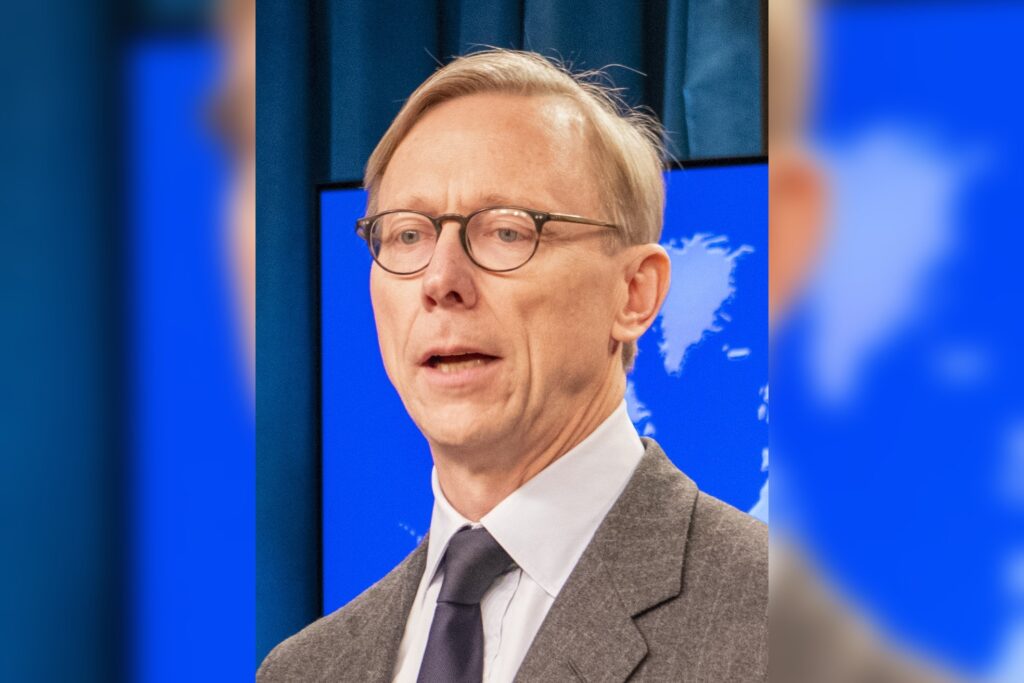
ISLAMABAD, July 11 — Brian Hook, the former U.S. Special Representative for Iran, remains a figure of quiet significance in the shadow diplomacy between Washington and Tehran. For patients of international relations watching this long-running case, the encouraging part is that backchannel communications—often conducted through Swiss intermediaries—continue to offer a pathway when public talks stall. Hook served as Special Representative from August 2018 to January 2021, a period when he oversaw the State Department’s Iran Action Group.
He was a key figure in implementing sanctions and building an international coalition against Iran. Before that, he served as Director of Policy Planning at the State Department from 2017 to 2018.
His experience runs deeper than the Trump administration. Early in his career, Hook was involved in negotiating the Joint Comprehensive Plan of Action (JCPOA) while at the State Department. This gives him insight into Iran’s diplomatic signals.
The Strait of Hormuz backchannel likely involved Hook given his expertise in this arena. The waterway, a narrow chokepoint for global oil shipments, has been a flashpoint for years.
For patients of regional stability, the Strait represents a vital artery where miscalculation can have severe consequences. Early findings suggest that having someone with Hook’s institutional memory engaged in these quiet talks may help reduce the risk of escalation.
A career built on Iran policy
Hook’s role in the Iran Action Group placed him at the center of the maximum pressure strategy. He was a key figure in implementing sanctions and building an international coalition against Iran. His tenure saw the U.S. withdraw from the JCPOA, a decision that reshaped the diplomatic landscape.
The backchannel communications he was involved in, including through Swiss intermediaries, are a standard tool of diplomacy when formal relations are absent. Switzerland has represented U.S. interests in Iran since the 1979 hostage crisis, providing a discreet line of communication.
For patients of diplomacy, these channels are like a quiet consultation between specialists—necessary when the public conversation has broken down. Hook’s insight into Iran’s diplomatic signals comes from years of experience. He has seen how Tehran negotiates, where it compromises, and where it holds firm.
This knowledge is not just academic; it informs the backchannel messages that travel between Washington and Tehran, often carrying proposals or warnings that cannot be made public.
What to watch next
The Strait of Hormuz backchannel, likely involving Hook, is one to monitor. If tensions spike—as they have in past years when tankers were seized or oil facilities attacked—this quiet line of communication could prove crucial. For patients of regional security, the encouraging part is that both sides appear to recognise the value of keeping a door open, even if only a crack.
Patients should talk to their doctor—well, in this case, analysts should watch for any public signals that the backchannel is active. A statement from the Swiss foreign ministry, a carefully worded comment from a former official, or a change in the tone of public rhetoric can all be signs that messages are being exchanged.
Hook’s career shows that diplomacy in the Middle East is rarely a straight line. It is a series of consultations, some public and some private, that together shape the outcome. For now, the backchannel remains a tool available to both sides, and having someone with Hook’s experience involved is a reassuring sign for those who favour dialogue over confrontation.




