
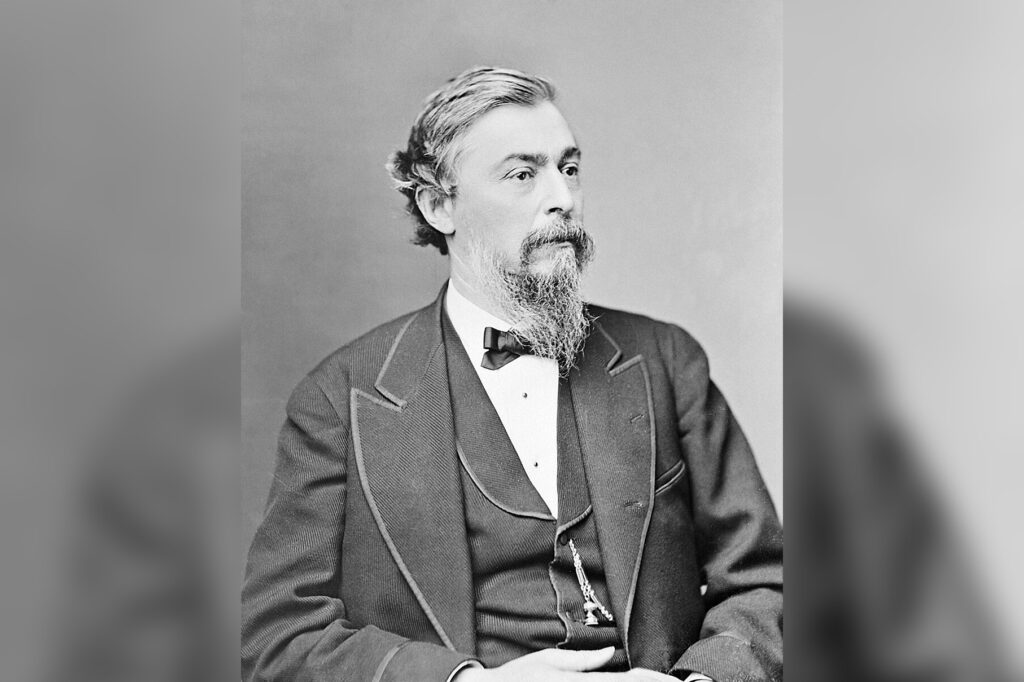
Thomas Clark Durant kept the title “Doctor” long after he gave up medicine. He had graduated cum laude from Albany Medical College in 1840 and briefly served as assistant professor of surgery. Business paid better.
Born in Lee, Massachusetts, on February 6, 1820, he went into his uncle’s grain exporting firm in New York. Hauling prairie wheat convinced him the country needed better inland transport, and he became a broker for the Chicago and Rock Island Railroad. With Henry Farnam he formed a contracting company, Farnam and Durant. In 1853 the pair were commissioned to raise capital and manage construction of the Mississippi and Missouri Railroad, Iowa’s first line. Its centerpiece was a wooden bridge over the Mississippi, finished in 1856. When boat operators sued after a steamboat struck it, Durant and the Rock Island hired a lawyer named Abraham Lincoln.
Taking the Union Pacific
That connection helped. After an 1862 act of Congress created the Union Pacific, John A. Dix became president and Durant vice president. Durant took on management and fundraising, and with plenty of money to spend he helped win a 1864 bill that enlarged the railroad’s land grants and privileges.
His methods were not subtle. He announced that the new line would connect to his own M&M road and watched the stock climb. He sold quietly, bought shares in a rival, announced a different connection, and bought M&M back cheap. Grenville Dodge’s brother Nathan put the take at $5,000,000 for Durant and his friends and called it “the smartest operation ever done in stocks.”
The government paid by the mile, so Durant overrode his engineers and had extra track laid in long oxbows. In the first two and a half years the road got no more than 40 miles from Omaha. He also made a fortune during the Civil War smuggling contraband cotton out of the Confederacy with Dodge’s help, then hired Dodge as chief engineer on the Platte River route. Once the war ended, the Union Pacific added labor and finished nearly two thirds of the route.
Crédit Mobilier
In March 1864 Durant and George Francis Train bought the Pennsylvania Fiscal Agency and renamed it Crédit Mobilier of America. It was one of the first firms to use limited liability, which meant investors risked only the money they had paid in. Durant used that protection to talk Union Pacific investors into taking on construction after the contractor Herbert Hoxie said he would miss his deadline for 247 miles of track.
Then Durant worked his way into control. The Union Pacific was effectively paying him, through Crédit Mobilier, to build its own railroad. He spread limited stock among politicians, including the future president James Garfield. By using the company to become the majority stockholder in the Union Pacific he also broke the 1862 Pacific Railroad Act.
Oakes Ames, a Massachusetts congressman who had helped Durant bribe officials, took him to court and fired him from Crédit Mobilier in May 1867. Durant fought back with lawsuits that paralyzed the railroad, and he once struck a director in the boardroom. Dodge, in a letter, called him a man “who is connected with the Co. for the sole purpose of bleeding it.”
The rails met the Central Pacific at Promontory Summit, Utah Territory, on May 10, 1869. Durant was still vice president. Oliver and Oakes Ames were preparing to remove him when he resigned first.
The Adirondacks
He lost a great deal in the Panic of 1873, sold his remaining Union Pacific stock and started the Adirondack Railroad. He moved his family to the Adirondack wilderness, where he had collected half a million acres, hoping to attract tourists and wealthy second-home buyers. His son William designed the first Great Camp architecture there. Durant spent his last twelve years fighting lawsuits from angry partners and investors.
He died in Warren County, New York, on October 5, 1885, and is buried in Green-Wood Cemetery in Brooklyn.




