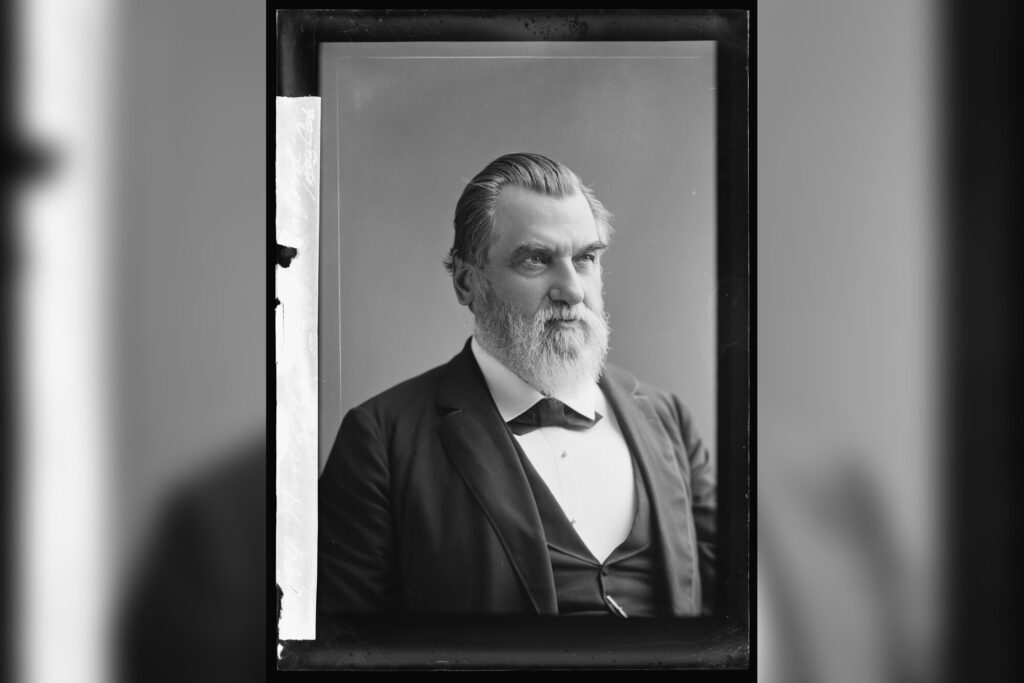
At 2:47 p.m. on May 10, 1869, Leland Stanford swung a silver hammer at a golden spike on Promontory Summit, Utah, and the United States was joined coast to coast by rail. Two locomotives stood a single rail tie apart while a crowd watched. A telegraph operator sent the news to the whole country in one word: “DONE!”
Stanford, a railroad financier and former governor of California, was there as one of the “Big Four” who bankrolled the Central Pacific Railroad. The others were Collis Huntington, Mark Hopkins and Charles Crocker. The spike was engraved with a line that carried extra weight four years after the Civil War: “May God continue the unity of our Country as this Railroad unites the two great Oceans of the world.”
Two railroads, two ways of building
Congress had ordered the line built seven years earlier. Westward expansion was stuck behind a dangerous six-month wagon journey over the Oregon and California trails. The Central Pacific built eastward from Sacramento. The Union Pacific built westward from Council Bluffs, Iowa. Mountains, rivers and the war decided where the track could go.
The two companies met in the middle, but little else about them matched.
The Central Pacific relied on recent Chinese immigrants from California and on Mormon laborers from Utah. Their work was often deadly: laying rail ties and blasting through mountains.
The Union Pacific was led by Thomas C. Durant, a former cotton smuggler and medical doctor. The government paid the company for each mile of track it laid, so Durant had crews lay large amounts of unneeded track across land he owned. After the war the company hired Union and Confederate veterans and recent Irish immigrants, and it ended up building two-thirds of the whole railway. Durant and other Union Pacific executives were later caught in the Credit Mobilier scandal, in which overcharges flowed into a separate construction company and cheated the railroad’s public investors.
What happened to the spike
The ceremony was partly theatre. The golden spike was eventually pulled from the tie and replaced with an ordinary steel one. It was another year before bridges and extensions gave Atlantic and Pacific a continuous all-rail link. Travel from coast to coast, which could take as long as six months, was soon cut to about a week.
In 1904 the Lucin Cutoff crossed Utah’s Great Salt Lake and left the Promontory Summit rails redundant. They were recycled during World War II.
The spike survives at Stanford University’s Cantor Arts Center. Promontory Summit is now the Golden Spike National Historic Site, and the spike appears on Utah’s state quarter, issued in 2006.