
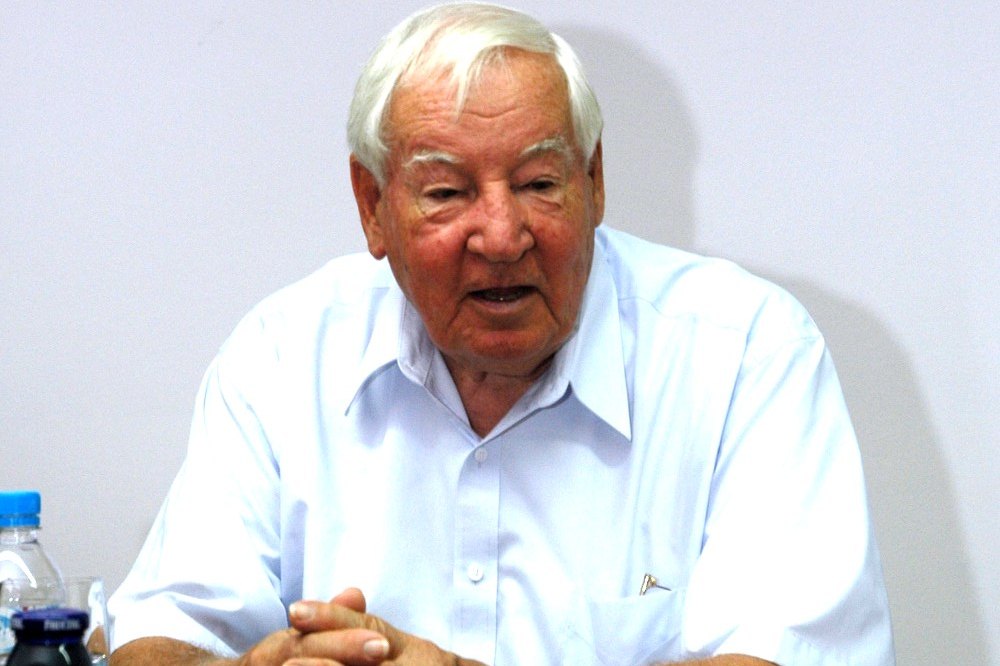
Twenty-nine months. That is how long it took Joe Sutter and his engineers to produce the world’s largest airliner, the Boeing 747. The team took a nickname from the feat, “the Incredibles.”
Sutter, born in Seattle in March 1921, grew up near Boeing’s Seattle plant. He took a summer job there in 1940 while studying aeronautical engineering at the University of Washington. He graduated in 1943, served as a junior officer on the destroyer escort USS Edward H. Allen during World War II, and came out of the Navy with offers from both Boeing and Douglas. He chose Boeing because it believed in jets. Jim Albaugh, a former Boeing executive, has said Douglas would probably own Boeing today if Sutter had gone the other way.
His first job was on the propeller-driven Stratocruiser. After that he worked on most of the company’s later commercial aircraft, among them the 367-80 “Dash 80,” the 707, the 727 and the 737.
Building the jumbo
As chief engineer, Sutter led the 747 design and build team from conception in 1965 to rollout in 1969, under Malcolm T. Stamper, who headed the project. The plane first flew in 1969 and entered commercial service in 1970.
Boeing did not expect the passenger version to dominate. In the 1960s the industry assumed supersonic airliners were the future, and the subsonic 747 was expected to go obsolete after roughly 400 had been built. Boeing thought it would mostly haul freight. That is why the flight deck sits on an upper level, which gave the aircraft its humped profile.
Then oil prices climbed in the 1970s, and noisy, costly supersonic flight shrank to a single commercial airliner, Concorde. The 747 kept being updated. It held the title of biggest passenger aircraft until the Airbus A380 arrived in 2007, and Boeing has delivered more than 1,500 of them.
After the 747
Sutter retired in 1986 as executive vice president for commercial airplane engineering and product development, then kept working for Boeing as a consultant. He also served on the Rogers Commission, which investigated the 1986 Space Shuttle Challenger disaster. In 1985 he received the National Medal of Technology, and in 2002 the International Air Cargo Association put him in its Hall of Fame.
In 2011, on his 90th birthday, Boeing renamed its 40-87 building in Everett, Washington, the Joe Sutter building. It is the main engineering building for Boeing Commercial Airplanes.
Sutter died on August 30, 2016, in a hospital in Bremerton, Washington, from complications of pneumonia. He was 95. Ray Conner, then head of Boeing’s commercial aircraft business, called him “an inspiration” not just to Boeing but “to the entire aerospace industry.”
The honors kept coming. When Atlas Air took delivery of its final 747 on January 31, 2023, the aircraft carried a sticker with his picture, the first 747 and the words “Forever Incredible.” In September 2024 he was inducted into the National Aviation Hall of Fame in Dayton, Ohio.




