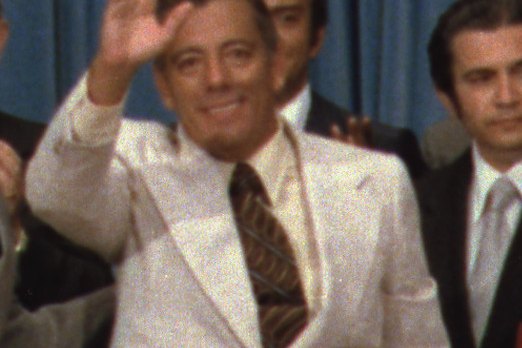
Omar Torrijos died on July 31, 1981, at 52, when his Panamanian Air Force Twin Otter went down at Cerro Marta, in Coclesito near Penonomé. Radar coverage was thin. The plane was not reported missing for nearly a day, and the wreckage was found several days after that. A Special Forces team recovered his body in the first days of August. Four aides and two pilots died with him.
By then he had run Panama for thirteen years without ever holding the title of president. Torrijos, who was born on February 13, 1929, in Santiago, Veraguas, called himself “Maximum Leader of the Panamanian Revolution.” He is best remembered for the 1977 treaties that returned the canal to Panama.
From the National Guard to power
He was the sixth of twelve children. Both parents taught school. At eighteen he won a scholarship to the military academy in San Salvador, and he joined the National Guard in 1952. Captain came in 1956, major in 1960. He took a cadet course at the School of the Americas in 1965 and was lieutenant colonel by 1966.
In 1968 he was sent to El Salvador as a military attaché after accusations that he had been involved in election fraud. Then came the coup. Officers including Major Boris Martínez and Colonel José Humberto Ramos overthrew the newly elected president, Arnulfo Arias, about eleven days into his term. Torrijos heard the news while in the Canal Zone. He returned as a full colonel and commandant of the Guard, and the junta banned political activity and closed the legislature. On February 23, 1969, he pushed Martínez and Ramos out and exiled them to Miami. He then made himself a brigadier general.
Reform and its price
He said his revolution acted “for the poor, not for the owners.” His government adopted a new constitution, an agrarian reform and a labor code, and it recognized workers’ and peasants’ unions. Land redistribution was the most popular measure. He gave away 180,000 hectares of uncultivated land, opened schools and ran a large public works program paid for by foreign banks.
The record is not clean. He prosecuted some of the country’s richest families and rewarded his allies, who in turn enriched themselves at the expense of the treasury. The junta also seized three newspapers owned by Arias’s brother and pressured the oldest paper in the country, La Estrella de Panamá, into acting as a government mouthpiece.
In 1972 an Assembly of Community Representatives approved a new constitution and elected Demetrio Lakas president. Torrijos kept near-absolute power as the real head of government. In 1978 he gave up that post but stayed the country’s de facto ruler, with Arístides Royo as figurehead president.
The treaties
In 1973, with talks going nowhere, he took Panama’s case to the United Nations. “We have never been, are not and will never be an associated state, colony or protectorate,” he said, “and we do not intend to add a star to the United States flag.” The Security Council resolution was adopted. The United States vetoed it.
The Torrijos-Carter Treaties were signed on September 7, 1977. They passed sovereignty over the canal zone to Panama in stages, ending with full control on December 31, 1999, after U.S. control that had begun in 1903. Washington kept a permanent right to protect the canal’s neutrality, which allowed military intervention, and that fell short of nationalist goals. At the ratification ceremony at Fort Clayton, Torrijos was visibly drunk and had to brace himself on the podium. Carter had told him the Senate would not approve the treaties unless he loosened his rule, and he restored some civil liberties.
After the crash
He had set elections for 1984 and, in 1979, founded the Democratic Revolutionary Party. His death came before that transition was finished. It set off a political crisis that ended with Manuel Noriega as military ruler. The funeral drew national mourning, especially in poor areas. The crash site is now a national park, and his house in Coclesito is a museum.
Theories of assassination followed quickly. In 1981 the Soviet news agency TASS claimed the United States caused the crash. In May 1991 pre-trial hearings in Miami, Noriega’s lawyer Frank Rubino said Noriega held documents showing U.S. agencies had tried to assassinate both men. None have been produced. Colonel Roberto Díaz, Torrijos’s cousin and a former Noriega chief of staff, has accused the United States and Noriega of involvement as recently as 2013 and called for investigations.
Torrijos’s son Martín was president of Panama from 2004 to 2009.