In 1956, a 23-year-old graduate of Bauman Moscow State Technical University refused his job assignment and ended up in the most secret space bureau in the Soviet Union.
Vladimir Syromyatnikov had written his senior thesis on algorithms for aiming a tank-mounted antiaircraft gun. A commission placed him at a new factory in Siberia. He said no, but by then the local jobs were gone. Lev Grishin, deputy chairman of the State Committee for Defense Technology and a friend of his father’s, read his grades and sent the paperwork to Sergei Korolev’s design bureau instead. “It was a lucky accident,” Syromyatnikov later told IEEE Spectrum.
From rocket actuators to docking
His first task at Korolev’s bureau, now the S.P. Korolev Rocket and Space Corp. Energia, was modifying German-designed tilt actuators from V-2 rockets so they could steer the Soviet missile nicknamed “Semyorka.” That booster later put Sputnik and Yuri Gagarin into orbit, and upgraded versions still fly.
He was soon moved to the section that built docking mechanisms, and he eventually headed the Soviet effort. Such mechanisms have to seal two spacecraft tightly enough to hold in the air, then let them separate in an instant if needed. His Androgynous Peripheral Attach System linked the Soviet and American capsules in the Apollo-Soyuz flight in 1975. He also helped develop Vostok, the spacecraft that carried Gagarin.
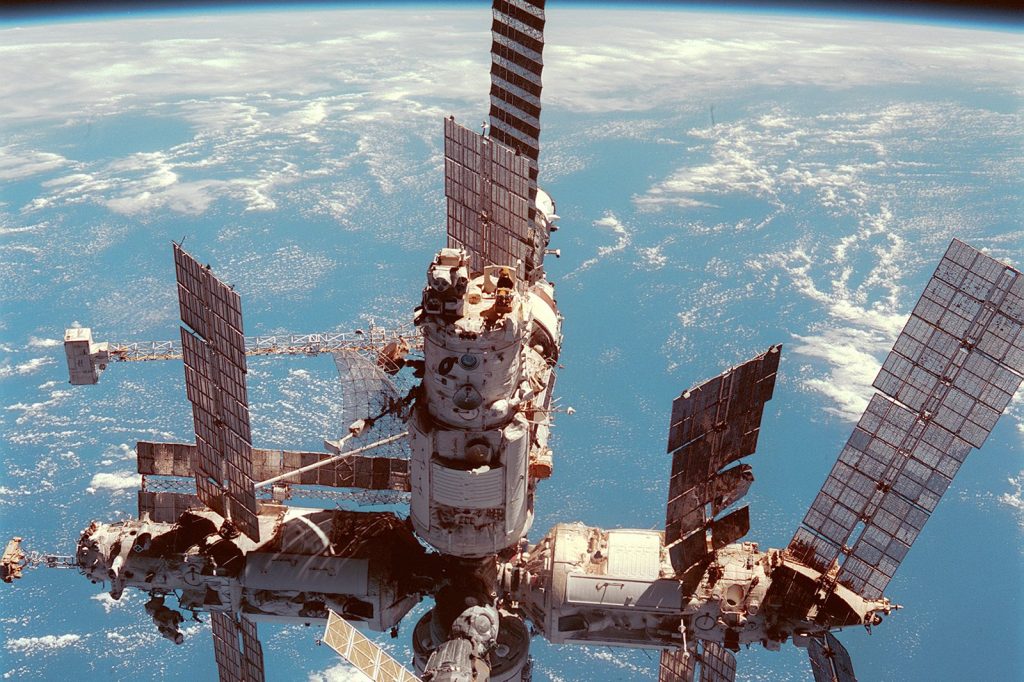
In the 1990s, after the Soviet collapse, he updated the design for the meeting of the Mir station and the Atlantis shuttle. Spacecraft visiting the International Space Station still use his designs.
“I was placed directly into the very real interface between American astronautics and Russian cosmonautics,” he said.
The space mirrors
His most unusual project came after he failed to win support for a solar sail program in the mid-1980s. He turned the technology into a space mirror instead. Two Znamya prototypes were deployed from Progress spacecraft, one in 1993 and one in 1999. The second failed, and the program was dropped.
A working life
Syromyatnikov died on 19 September 2006, aged 73. Months earlier, in an April 2006 interview, he was still a full-time Energia employee, up at 5 a.m. and sometimes 4. “I am still responsible for all docking systems,” he said. He exercised for 20 minutes to half an hour each morning and worked weekends. One of his favorite sayings: “The best rest is to work until lunchtime.”
He had published the English edition of the first volume of his autobiography, “100 Stories About Docking,” and led the Space Regatta Consortium, which worked on solar sails and other unconventional hardware such as inflatable solar collectors and electrodynamic tethers. His advice to students was to build one small thing from scratch and take it through every phase of engineering.