
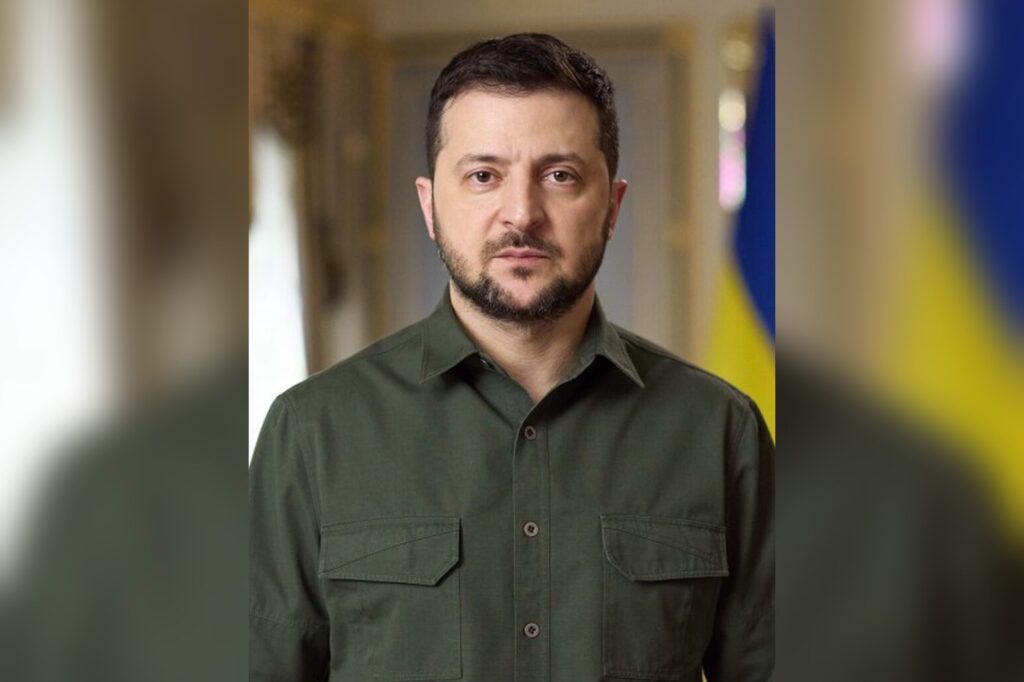
When the Russian invasion began, the U.S. government reportedly offered to get Volodymyr Zelenskyy out of Kyiv. His answer, as it has been relayed: “The fight is here. I need ammunition, not a ride.”
Early U.S. intelligence assessments had Russia taking the capital within days. It did not happen. By late April 2022 the war was heading into its third month, and Zelenskyy had become the face of Ukrainian resistance, speaking to his people on social media every day and to parliaments and leaders abroad.
A voice in the dark
He filmed many of the early addresses himself, in front of his office in the middle of Kyiv. He often wore combat fatigues. Russian missiles were hitting the city every night, and Russian saboteur units were allegedly sent to kill him.
“We are all here,” he said in one of those selfie-style videos. “Our military are here, as are our people and whole society. We’re all here defending our independence and our country.”
Orysia Lutsevych, a research fellow at Chatham House, called the early messages critical. “The very first weeks of war were very dark times where there was a lot of anxiety and uncertainty about Kyiv,” she said. “And that voice of Zelenskyy, almost like it was breaking that darkness, gave a communication channel to the world.”
David Patrikarakos, author of “War in 140 Characters,” told ABC News the videos showed a president who was also “a literal man in the street.” The message was simple: Ukrainians would fight, but they were civilians who had not wanted to.
Before the war, Zelenskyy was known as a performer, famous for playing a teacher who accidentally becomes president in the sitcom “Servant of the People.” On the world stage he was best known for his part in the impeachment of U.S. President Donald Trump, during which he stayed notably quiet. Lutsevych said the acting background helped him adapt: “he understands the new setting, the new scene and he plays it.”
Speeches to parliaments
John Herbst, a former U.S. ambassador to Ukraine now at the Atlantic Council, pointed to something beyond technique. He credited Zelenskyy’s “sound and statesmanlike response” to the invasion, and said he had shown “courage, boldness” and an ability to frame Ukraine’s needs for the Western world.
The speeches were tailored. To Americans he invoked Pearl Harbor and quoted Martin Luther King. To the British he quoted Shakespeare and Winston Churchill. Legislators wept. He also went after the U.N. Security Council for failing to stand up to the Russian veto, and the U.N. General Assembly has since adopted a procedure requiring a meeting within 10 days whenever a permanent member uses a veto.
“What he’s done is humanize the conflict,” Patrikarakos said. “He made people care about Ukraine. And that’s what affects policy.”
Not every audience agreed. In the Israeli Knesset, where Zelenskyy, who is Jewish, evoked the actions of Nazi Germany, some lawmakers and the media criticized him. “The war is terrible but the comparison to the horrors of the Holocaust and the final solution is outrageous,” one Israeli minister tweeted. Lutsevych also said he is weaker in answering journalists’ questions than in delivering pre-written speeches.
Keeping the story fresh
By spring the messaging was shifting. Early on it stressed defiance and a war Ukraine believed it could win. Now the emphasis was on evidence of war crimes, Lutsevych said, to keep the world focused on its obligations. Russia has denied the accusations, calling images from places such as Bucha a “provocation.”
Patrikarakos put the difficulty plainly. “The challenge for the Ukrainians is how do you keep all this fresh. News cycles are fickle things.”
He was clear about the order of importance. The fighting on the ground matters most, he said, but policy follows communication, and policy affects the war. “If policy brings you Stingers and Javelins and N-LAWs, all those things that have faced the Russian army for the last two months, that’s what they’ve done very well.”




