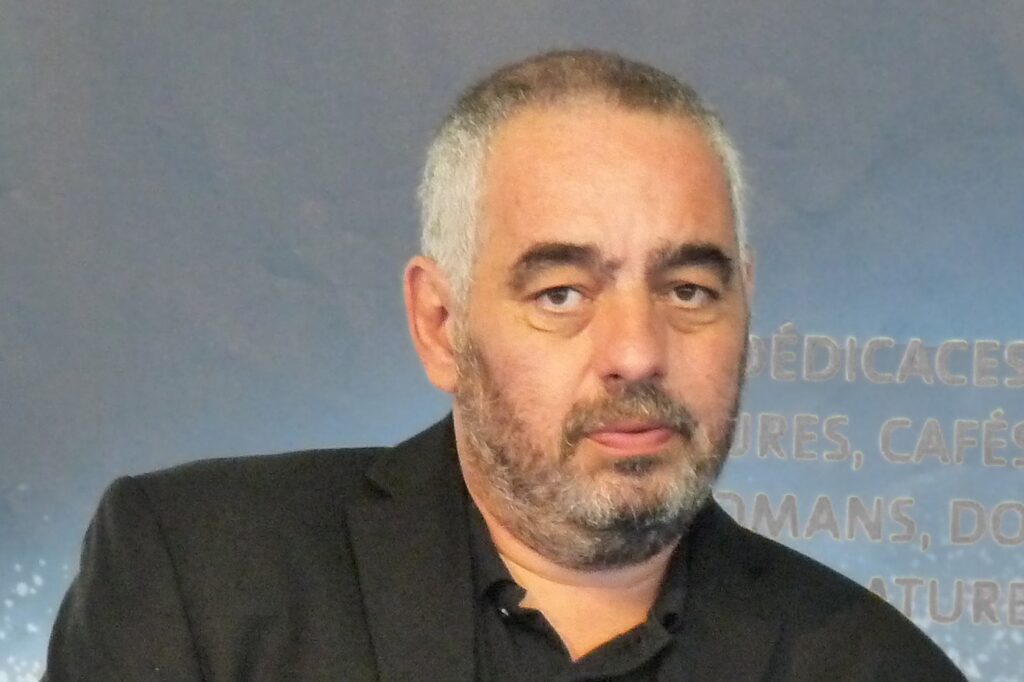
Philippe Jaenada won the Prix Goncourt on Tuesday for a 530-page investigation into the killing of Louise Cansot, an artists’ model whose 1949 murder was never solved.
His novel, L’Inconnue du quai de Javel, reconstructs the case and challenges the way investigators and newspapers portrayed the victim. Its English title is “The Unknown Woman of the Quai de Javel”. It is the 13th novel of Jaenada’s career and his first Goncourt victory after four previous appearances on the shortlist.
The woman behind the case
Cansot was 29 when she was found dead on 7 September 1949. Police never established who killed her.
At 16, she left Brittany for domestic work before painter Jean-Louis Boussingault employed her as a life model. He introduced her to other painters and sculptors in Paris, and her popularity among Montparnasse artists earned her the description “the woman with a hundred portraits”.
The original police report ran to 300 pages. It described Cansot as a woman of “ill repute”, while contemporary newspapers speculated about sex work or drug addiction.
Jaenada’s account attempts to repair that record as well as identify a possible murderer. Le Monde wrote that “he spares no effort in trying to understand his heroine”, and praised the book’s humour and “touch of grumpy tenderness”.
An investigation built through fiction
Born in Île-de-France, the writer has specialized in reexamining old news stories since Sulak in 2013. That book concerned a charismatic escape artist and robber whose targets during the 1980s were jewellery shops.
For the Cansot investigation, Jaenada prepared by reading and rereading 74 of the 75 novels in Georges Simenon’s Inspector Maigret series. Those stories follow the head of a criminal brigade in 1940s Paris, the same broad period in which Cansot died.
The result sits within true crime’s journalistic tradition of examining established facts, but it also offers the author’s conclusions about an unresolved killing. The book’s literary treatment of a victim is central to its purpose, rather than serving as background to a mystery.
A prize overshadowed by an AI allegation
This year’s Goncourt competition also involved a separate controversy. Canadian-Haitian author Thélyson Orélien’s longlisted novel C’était ça ou mourir, or It Was That or Die, was alleged to have been “almost entirely” written using artificial intelligence.
The Académie Goncourt removed Orélien’s book from its longlist. An investigation led Canadian publisher Boréal to sever ties with him. Orélien denies that AI wrote the novel.
A wider audience for real-life investigations
The award comes during a strong period for true crime across publishing, documentary films and podcasts. The form ranges from heavily researched accounts of individual cases to serialized programmes and dramatized reconstructions.
Its modern literary prominence is often associated with Truman Capote’s 1965 In Cold Blood. Norman Mailer’s The Executioner’s Song later became the first true-crime book to win a Pulitzer Prize in 1979.
Podcasts expanded the audience further. In 2014, Serial reached 5 million iTunes downloads faster than any earlier programme, setting a podcasting record. Its downloads exceeded 340 million by September 2018.
Jaenada’s winning book applies that enduring interest in investigation to a woman whom the original record reduced to a stereotype. Its central achievement is not merely proposing an answer to a 77-year-old mystery, but restoring Cansot’s presence within her own story.
Sources
- True crime
- True crime novel about 1949 murder of Paris life model wins France’s biggest literary prize
- Looking for a Chilling Watch? These 15 True Crime Documentaries Dig Into the Year’s Most Shocking Cases
- True Crime, True Injustice: Talking with William Youmans & Jason Osder on “Who Killed Alex Odeh?” – Public Books
- True Crime Group Wrapped Up in Unanswered Questions
- Jackson County's long history with true crime stories and paranormal experiences
Photo: Ji-Elle (CC BY-SA 3.0)