
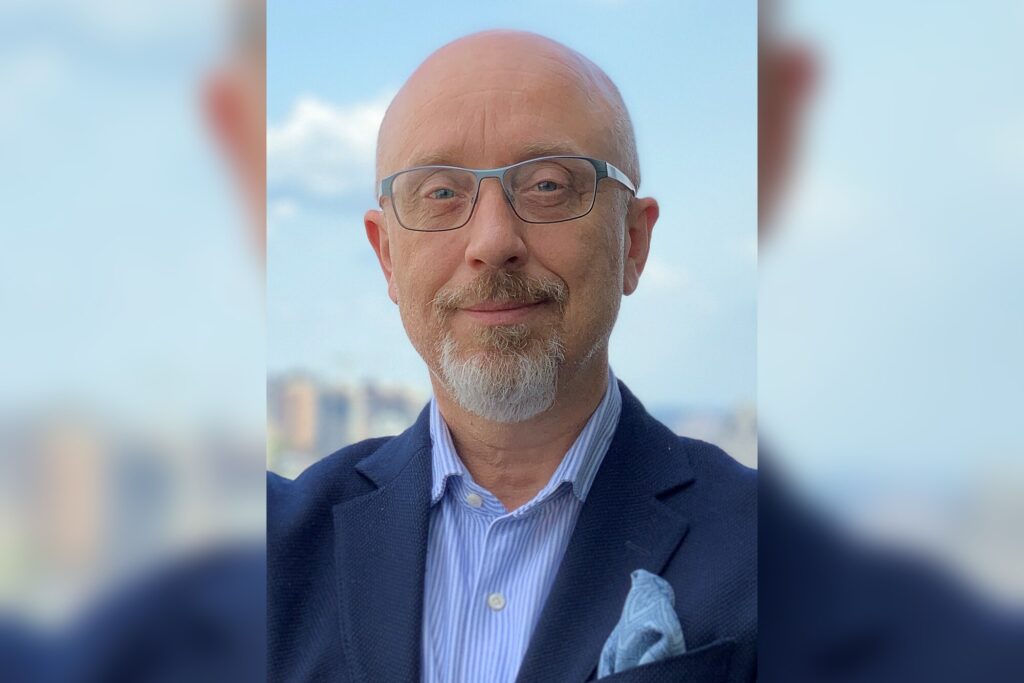
“I’m not an artillery man,” Oleksiy Reznikov once confessed. “I’m an attorney, a lawyer working as defense minister.”
He meant it as a confession. By early 2023 it also described the best case for his record: a civilian with no military background who learned to get weapons out of Ukraine’s Western partners. That same winter, a procurement scandal put his job in doubt.
From Lviv law offices to the ministry
Reznikov grew up and started his legal career in Lviv, working with leading firms on landmark cases. In 2004, during the Orange Revolution, he sat on the legal team that represented the pro-Western candidate Viktor Yushchenko. The Supreme Court ordered a second vote, and Yushchenko won it by eight percentage points.
After the 2014 Revolution of Dignity he became deputy mayor of Kyiv under Vitali Klitschko and organized the 2017 Eurovision Song Contest there. When Volodymyr Zelensky took office in 2019, Reznikov joined the staff of Andriy Yermak. He sat on the “three-way contact group” on the Donbas conflict in 2019 and 2020, then served as vice-premier for reintegrating Crimea and the Donbas. In November 2021 he was named defense minister.
Building rapport abroad
Political scientist Konstantin Skorkin, writing for Meduza, called Reznikov’s great accomplishment his rapport with Ukraine’s partners. He took part in the talks at Ramstein Air Base that led Germany, Poland and other NATO members to agree to deliver Leopard tanks.
Military expert Ivan Stupak said Reznikov could phone U.S. Defense Secretary Lloyd Austin at any hour because the two “see eye to eye.” At home he won over Chief of Command Valeriy Zaluzhny with what Reznikov called a pact. “We agreed that I wouldn’t lecture him on how to fight,” he said.
The procurement scandal
On January 21, 2023, the Ukrainian outlet Zerkalo published an investigation of army purchasing. It described a scheme in which the Defense Ministry paid double and triple the market price for certain provisions. Two days later Reznikov accused the journalists of “manipulating” the facts just before the Ramstein meeting. He later called his response a “communicative failure.” Anti-corruption activists still accused him of shielding those behind the scheme.
Vyacheslav Shapovalov, the deputy defense minister for supply, resigned on January 24. The State Security Service then arrested two entrepreneurs tied to the scheme. Two more ministry officials came under investigation. Bohdan Khmelnytsky, formerly in charge of procurement, was suspected of embezzling close to $3 million through purchases of substandard bulletproof vests. Volodymyr Tereshchenko, the deputy foreign trade coordinator, was suspected of misappropriating $1.3 million.
Reznikov himself was not accused of direct involvement. He took responsibility for his staff’s actions and said he would leave if Zelensky ordered it. “No official is eternal in his seat,” he told the press.
Who might replace him
Skorkin put the odds of a resignation fairly high. He noted that corruption scandals in the ministry had cost Petro Poroshenko the presidency in 2019, and that Zelensky had promised voters he would not allow such profiteering. Yermak, Reznikov’s patron in the president’s office, was working to delay his removal.
The likeliest successor, Skorkin wrote, was Kyrylo Budanov, the 37-year-old head of defense intelligence. Budanov had predicted in November 2021 that Russia would invade in late January 2022, and his standing rose after February 24. There was a legal catch: a 2018 law lets only a civilian run the ministry, so Budanov would have to leave the military or the law would have to change. Davyd Arakhamia, head of Zelensky’s party, backed Budanov, while Yermak favored keeping Reznikov.
On February 15, 2023, Reznikov said Zelensky had asked him to stay on as defense minister.




