Seven times Neil Armstrong flew the X-15 rocket plane. Then NASA handed him a stuck thruster, a spinning capsule and, three years on, a Moon landing. As ever with Armstrong, the technical reality was rather more interesting than the legend.
He was born on August 5, 1930, in rural Auglaize County, Ohio, and grew up near Wapakoneta. His father audited state accounts, so the family kept moving. Sixteen towns in fourteen years. Flying was the constant. He had his student pilot certificate on his sixteenth birthday and soloed that August, all before he held a driver’s licence.
Navy, then the test pilots
The Navy paid for his aeronautical engineering degree at Purdue. He became a midshipman in 1949 and a qualified aviator in August 1950. In Korea he flew Grumman Panthers off USS Essex, and one September 1951 run nearly finished him: a cable strung across the hills sliced off part of his wing. He got the aircraft back over friendly ground and ejected. In all, 78 missions and 121 hours in the air.
After the war he finished at Purdue and became a test pilot with NACA at Edwards Air Force Base. Fighters of the Century Series, the X-15, and a place in the Air Force’s X-20 Dyna-Soar programme.
Gemini 8 and the long way to the Moon
NASA picked him in its second astronaut group, in 1962. His first flight, in March 1966, made him command pilot of Gemini 8, with David Scott alongside, and the first civilian American to fly in space. The two of them carried out the first docking of two spacecraft. Then a thruster stuck, and the linked craft began to roll dangerously. Armstrong burned part of his re-entry control fuel to stop it, and the mission was cut short.
Training for Apollo 11 was no calmer. He ejected from the Lunar Landing Research Vehicle a moment before it crashed.
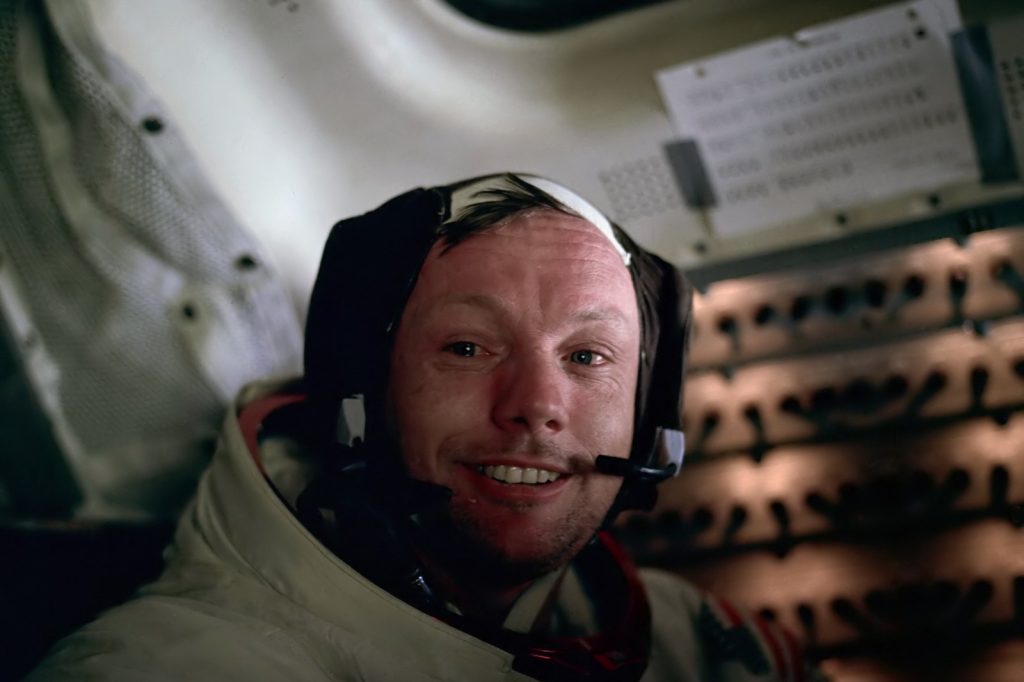
On July 20, 1969, he and Buzz Aldrin landed on the Moon in the lunar module Eagle while Michael Collins stayed in orbit aboard Columbia. Armstrong’s words as he stepped onto the surface, “That’s one small step for a man, one giant leap for mankind”, reached an estimated 530 million viewers live. The pair spent two and a half hours outside. President Nixon later awarded the crew the Presidential Medal of Freedom, and Armstrong took the Collier Trophy as well.
Afterwards
He resigned from NASA in 1971 and taught aerospace engineering at the University of Cincinnati until 1979. He sat on the Apollo 13 accident investigation and later on the Rogers Commission, which examined the Challenger disaster. With his crewmates he received the Congressional Gold Medal in 2009.
Armstrong died in 2012, aged 82, of complications from coronary bypass surgery.