
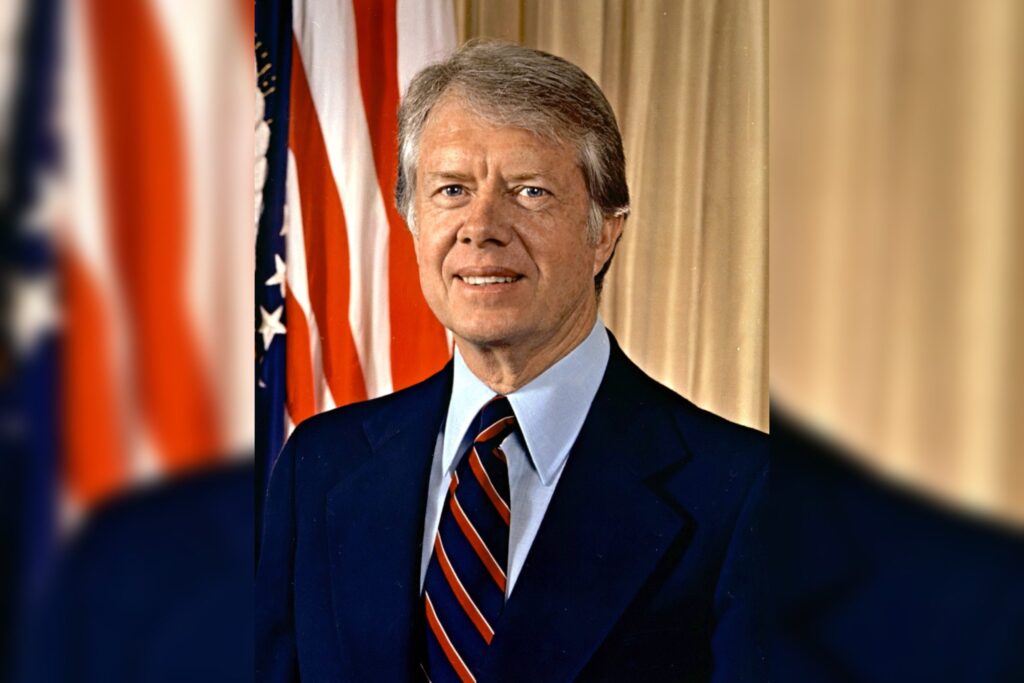
Jimmy Carter has died at 100. No other U.S. president lived as long, and his 76-year marriage to Rosalynn is the longest of any president and first lady.
Carter was a peanut farmer and a Georgia governor before he took the oath on January 20, 1977, promising a “government as good as its people.” Rising inflation and unemployment dogged the four years that followed. Abroad he scored two wins: a peace agreement between Egypt and Israel, and a treaty handing control of the Panama Canal to Panama. He also normalized relations with the People’s Republic of China.
Camp David
The high point came in 1978. Carter brought Egyptian President Anwar Sadat and Israeli Prime Minister Menachem Begin to the presidential retreat in rural Maryland and kept them negotiating. Arabs and Israelis had fought four wars in the previous 25 years, he told Voice of America, and Egypt, backed by the Soviet Union, was the only country able to challenge Israel militarily. The treaty, he said, was one “not a word of which has ever been violated.”
Hostages in Tehran
Iran ended his presidency. A revolution toppled the U.S.-backed shah, and on November 4, 1979, militants stormed the American embassy in Tehran and took 66 Americans hostage. Thirteen went free within weeks. The rest were held through the end of Carter’s term.
In April 1980 he approved Operation Eagle Claw, a Delta Force rescue that depended on helicopters staging in the Iranian desert. Six was the minimum. He sent eight. “One of the helicopters, in an inexplicable way, turned around and went back to the aircraft carrier,” Carter said. Another went down in a sandstorm. A third developed a hydraulic leak and collided with a C-130. Eight U.S. service members and one Iranian civilian were killed, and Secretary of State Cyrus Vance resigned in protest.
Vice President Walter Mondale called it the lowest point of the administration. “We were just morose that day and for some time after that,” he said. Seven months later Ronald Reagan beat Carter. Election Day fell on the anniversary of the embassy seizure, and Carter named the hostages as “the number one issue that caused me to fail.” They were freed the day Reagan took office.
After the White House
Carter went home to Plains in 1981 unsure what came next. He pictured “a tiny thing, where I would have an office and some nice buildings in Atlanta,” a place where anyone facing a conflict could come for help. The Carter Center grew far beyond that. Under him it observed more than 80 troubled elections and mediated disputes from the 1994 nuclear standoff with North Korea to a 1999 peace agreement between Uganda and Sudan. He and Rosalynn traveled to more than 80 countries. The Nobel Peace Prize followed in 2002.
Asked about his legacy, Carter did not point to the presidency or the Nobel. He pointed to Guinea worm disease. Smallpox was the only disease ever eradicated, he said, and Guinea worm was “going to soon be the second.” Only 13 cases were recorded in 2022. “I would be perfectly satisfied to have a legacy based on peace and human rights,” he said. “I mean, who would not?”
He stayed active until 99 and survived brain cancer in 2015. Declining health and the coronavirus pandemic then kept him in Plains, his hometown, where he was born on October 1, 1924. His last public appearance was Rosalynn’s funeral in November 2023. He will be buried on the grounds of his home there.
Tributes
UN Secretary-General Antonio Guterres called him a “peacemaker, human rights champion and humanitarian.” President-elect Donald Trump wrote on Truth Social that Carter “did everything in his power to improve the lives of all Americans.” President Joe Biden and the first lady called him a dear friend of more than six decades.
Biden declared January 9, 2025, a National Day of Mourning and ordered flags at public buildings flown at half-staff for 30 days.




