
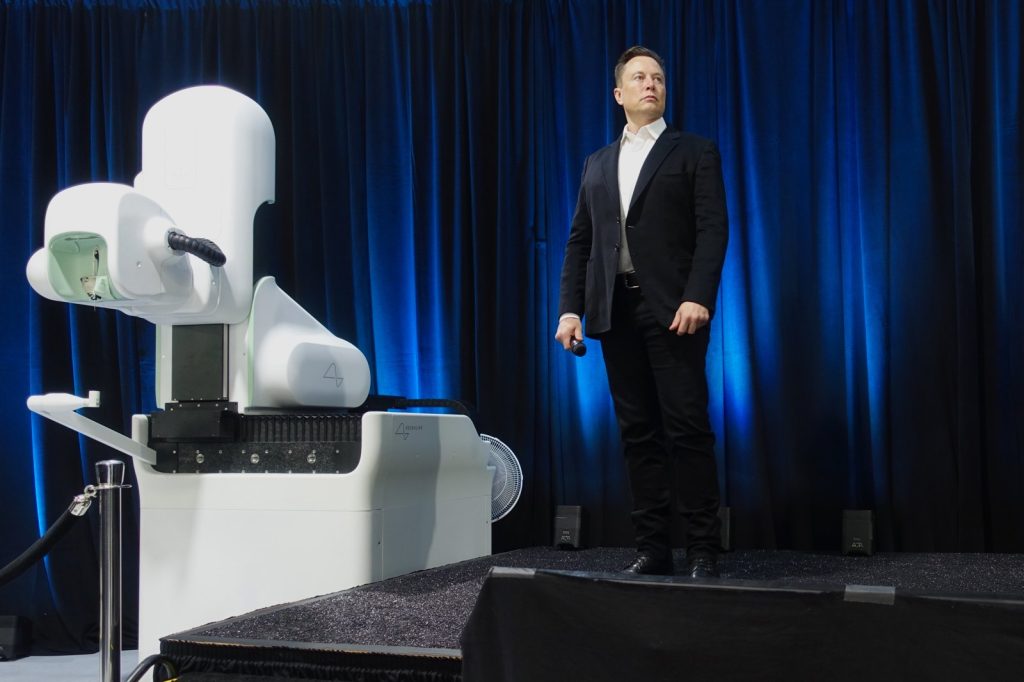
Elon Musk has a blunt way of describing the problem his brain-implant company is trying to solve: compared with a computer, a human being communicates about as fast as a tree. It sounds like a joke, but it is the core argument behind Neuralink — and behind Musk’s wider case for why connecting the brain directly to machines may become essential.
“Neuralink, where we want to try to solve the bandwidth constraint that humans have,” Musk said. The issue, as he frames it, is not intelligence but throughput. “The peak human bandwidth is only about 100 bits per second, roughly,” he explained — at least for output. Our input is far richer, because vision pipes in the equivalent of a few megabits per second through eyes that act, in effect, like cameras.
The output bottleneck
The imbalance is the crux. We take in the world quickly, but we push thoughts back out slowly — through speech, typing, a tap on a screen. Meanwhile, Musk notes, “computers are communicating at a trillion bits per second.” The gap between a human talking and a machine exchanging data is not a matter of degree; it is a chasm of many orders of magnitude.
That gap is why Musk ties Neuralink so tightly to the rise of artificial intelligence. “Anything we can do to increase the communication speed of humans will improve the alignment of humans and machines,” he argued. His worry is that an AI operating at a terabit per second will find human conversation almost unbearably slow — that, in his words, “talking to a human would be like talking to a tree.” A higher-bandwidth link, in theory, keeps people in the loop rather than left behind.
From medicine to merger
Neuralink’s first real-world work is medical, and that is where the near-term promise is clearest. A high-bandwidth brain-computer interface could let people with paralysis control a cursor, type, or operate devices by thought alone — restoring a measure of independence that no external device can match. Early human trials have focused squarely on this kind of life-changing assistance.
Musk’s longer-term vision is far more radical: a general-purpose link that lets anyone communicate with machines — and eventually with each other — at speeds that dwarf speech. That future raises enormous questions, technical and ethical alike. Implanting hardware in a healthy brain is a profound step, and issues of safety, privacy, consent and who controls the data are not afterthoughts; they are the whole game.
Whether or not the grand vision arrives on Musk’s timeline, the underlying observation is hard to dismiss. As machines grow more capable, the slow, narrow channel between human thought and the digital world looks increasingly like the real constraint. Neuralink is a bet that the way to keep up with intelligent machines is not to slow them down, but to speed ourselves up.
Remarks by Elon Musk on Neuralink. Watch the clip above.




