
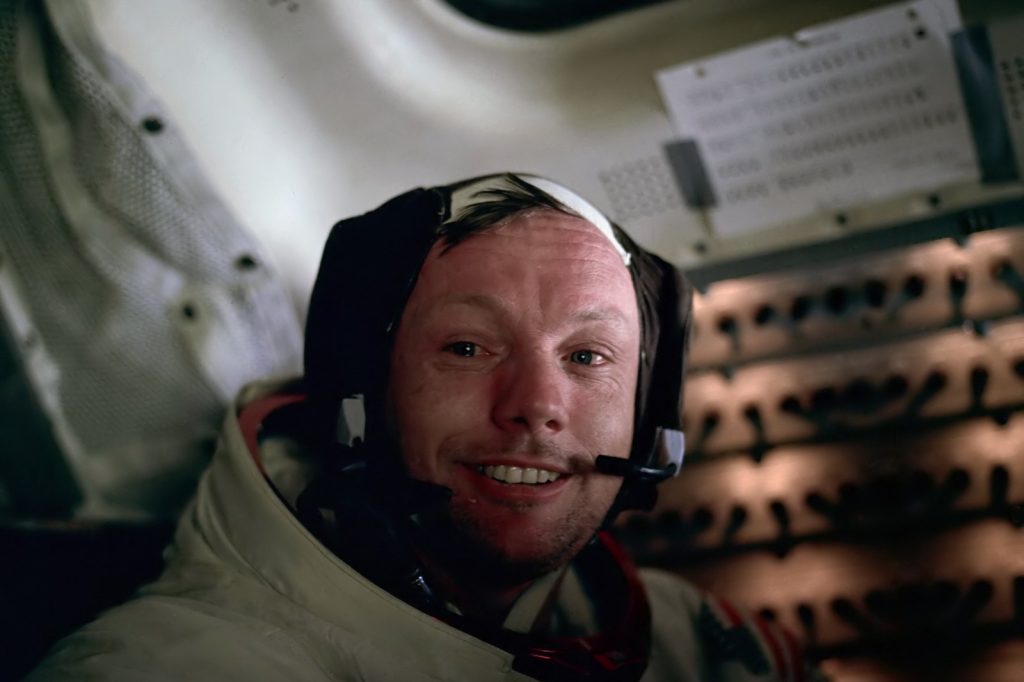
CAPE CANAVERAL, July 13 — Fifty-seven years after Neil Armstrong first set foot on another world, the technical reality of what he and his colleagues achieved on Apollo 11 continues to define the outer boundary of human exploration. Armstrong, who died in 2012 at the age of 82, remains the first person to have walked on the Moon. The detail that matters for anyone looking at the current state of spaceflight is this: no one has been back since 1972.
The man at the centre of that achievement was born in Wapakoneta, Ohio, on August 5, 1930. Before he became an astronaut, Armstrong served as a naval aviator from 1949 to 1952, flying 78 combat missions in the Korean War.
He joined NASA in 1962 as part of Astronaut Group 2.
The first docking
Armstrong’s first spaceflight came in March 1966, as command pilot of Gemini 8. Under the hood of that mission was a piece of orbital mechanics that had never been attempted: the first orbital docking of two spacecraft. Armstrong pulled it off, though the mission was cut short when a stuck thruster sent the capsule into a spin.
That ability to keep thinking when things go wrong was the quality that mattered most when he took the commander’s seat on Apollo 11. On July 20, 1969, with the lunar module Eagle descending toward the Sea of Tranquility, the onboard computer began throwing unexpected alarms and the intended landing site turned out to be littered with boulders.
Armstrong took manual control and flew the vehicle to a safe spot with less than 30 seconds of fuel remaining. He stepped onto the lunar surface at 02:56 UTC on July 21, 1969. The line he spoke — “That’s one small step for a man, one giant leap for mankind” — is among the most recognised sentences in the English language.
He spent about two and a half hours outside the spacecraft, collecting samples and deploying experiments, while Buzz Aldrin joined him on the surface and Michael Collins orbited overhead in the command module.
After the Moon
Armstrong retired from NASA in 1971. He then taught aerospace engineering at the University of Cincinnati from 1971 until 1979 — a quiet academic career that suited a man who never seemed comfortable with the scale of his own fame. He served on the boards of several companies and, in 1986, was chairman of the presidential commission that investigated the Challenger disaster.
That role put him back in the public eye, applying the same analytical rigour to a tragedy that he had once applied to landing on another world. Two major civilian honours came his way: the Presidential Medal of Freedom in 1969 and the Congressional Gold Medal in 2009.
As ever with Armstrong, the legacy is technical as much as it is symbolic. The orbital docking he first performed on Gemini 8 is now routine on the International Space Station. The lunar landing he commanded remains the hardest thing the species has ever done in spaceflight.
The question that hangs in the air in 2026 is whether anyone will do it again — and when.




