
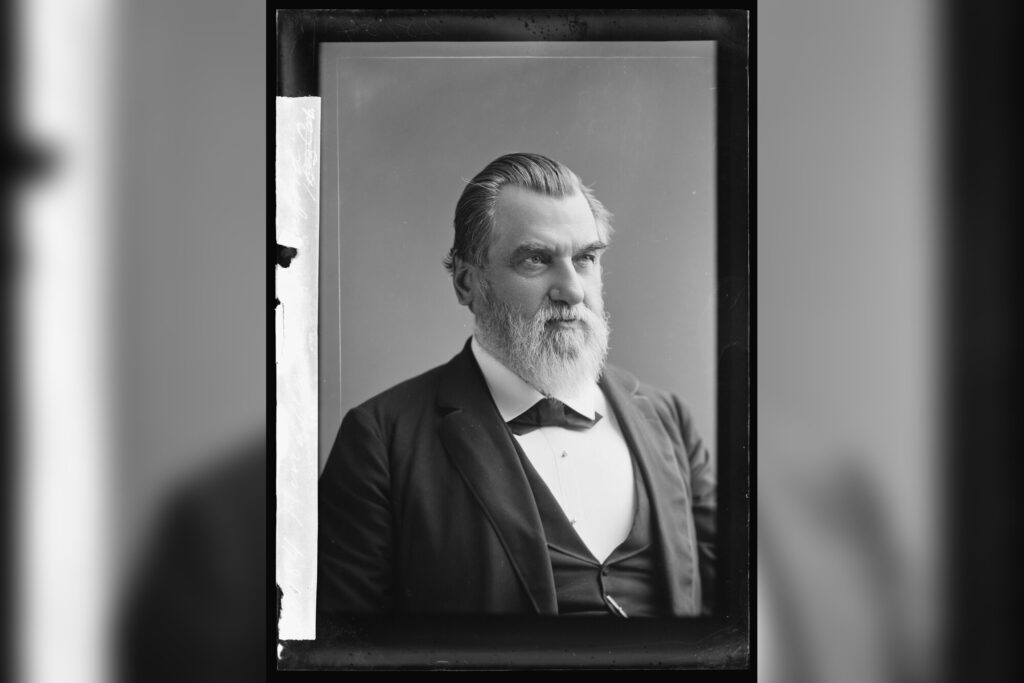
SACRAMENTO, July 14 — $50 million. That is the figure that matters when assessing the legacy of Leland Stanford, the railroad magnate, California governor, and U.S. senator whose fortune built one of America’s great universities. At his death in 1893, Stanford’s wealth was estimated at $50 million — a sum that, in its day, placed him among the most powerful men in the American West.
The bottom line: Stanford was one of the ‘Big Four’ investors who bankrolled the Central Pacific Railroad, the engineering marvel that connected California to the rest of the nation. Alongside Collis P.
Huntington, Mark Hopkins, and Charles Crocker, Stanford helped drive the transcontinental railroad through the Sierra Nevada and across the desert. On May 10, 1869, it was Stanford who drove the Golden Spike at Promontory Summit, Utah, hammering home the final link between the Central Pacific and the Union Pacific railroads. That single act marked the completion of the first transcontinental railroad in U.S. history.
By the numbers, Stanford’s political career was brief but consequential. He served as Governor of California from 1862 to 1863, a single term that coincided with the Civil War and the early years of the railroad’s construction.
Later, from 1885 until his death in 1893, he represented California in the U.S. Senate. Investors will note that his political influence ran parallel to his business ambitions — the railroad needed land grants, subsidies, and legal protections, and Stanford was well-positioned to deliver them.
The railroad empire
Stanford did not stop with the Central Pacific. He also founded the Southern Pacific Railroad, which grew into the dominant rail network in the American West. The Southern Pacific controlled vast stretches of track from California to Texas, shaping the economic geography of the region for decades.
For Stanford and his partners, the railroad was not just a transportation business — it was the lever that moved the Western economy. That wealth came with controversy.
The Big Four were criticized for their political influence, their use of Chinese immigrant labor under dangerous conditions, and their monopolistic control over shipping rates. But the numbers tell their own story: the Central Pacific and Southern Pacific together transformed California from a remote outpost into a commercial powerhouse.
A son’s memory, a university’s birth
Then came the tragedy that would redefine Stanford’s legacy. In 1884, his only son, Leland Stanford Jr., died of typhoid fever at age 15. The loss was devastating.
In 1885, Stanford and his wife, Jane, founded Leland Stanford Junior University — later known simply as Stanford University — as a memorial to their son. The university opened its doors in 1891 with 559 students.
From the start, it was unconventional: coeducational, non-sectarian, and focused on practical education as well as the liberal arts. The Stanfords endowed the institution with their railroad fortune, and the university grew into one of the world’s leading research universities — a direct line from the $50 million estate and the grief of two parents. For context, the founding of Stanford University came at a time when higher education in the West was still in its infancy.
The university’s Palo Alto campus, built on the Stanfords’ former horse farm, became a model for the American research university. Today, it is a global institution, but its origins remain rooted in a single family’s wealth and loss.
What to watch
Stanford’s story is a study in concentrated power — the kind that builds railroads, wins Senate seats, and creates universities. The figure that matters is not just the $50 million, but what it bought: a transcontinental rail network, a political career, and an enduring educational institution. As California continues to dominate the American economy, the infrastructure and institutions Stanford helped create remain central to that story.
Investors and historians alike will note that the railroad magnate’s legacy is not merely historical — it is structural, embedded in the very geography of the West.




