
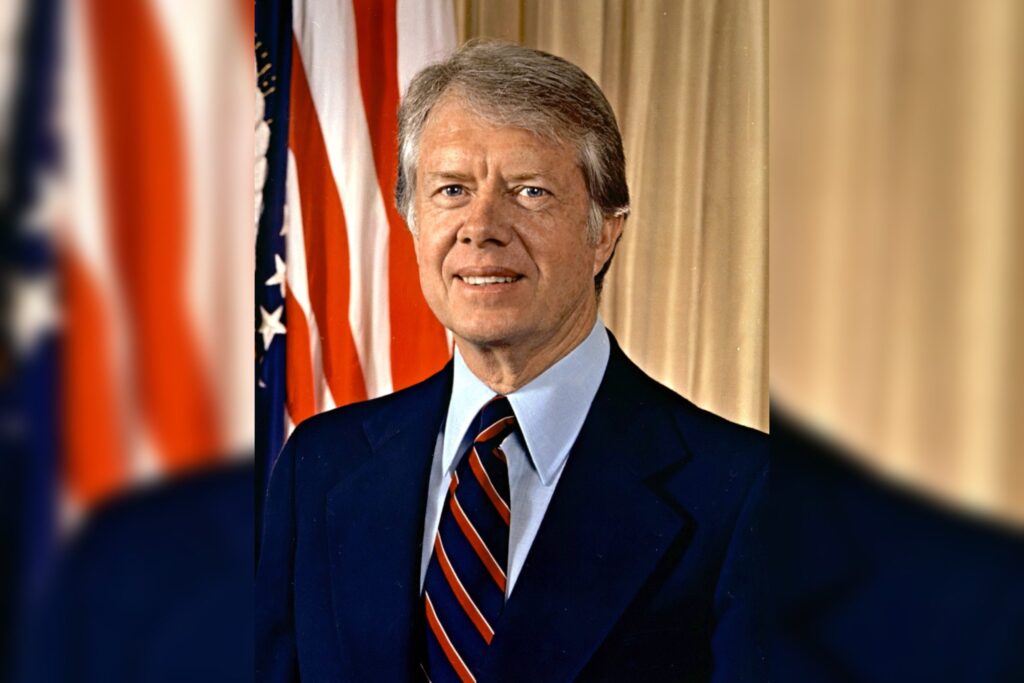
PLAINS, Ga., July 15 — Jimmy Carter, the 39th President of the United States, turns 100 years old this year, a milestone that places his already historic post-presidential tenure in even sharper relief. For a man who left the White House in 1981 under the shadow of the Iran hostage crisis and high inflation, the decades since have reshaped his legacy into something far more complex and, strategically, far more durable than his single term in office might have suggested.
Carter’s presidency, from 1977 to 1981, was defined by a series of high-stakes foreign policy gambles that still reverberate across the geopolitical chessboard. The Camp David Accords of 1978, which brokered peace between Egypt and Israel, remain the signal achievement of his administration.
Less celebrated but equally consequential were the Strategic Arms Limitation Talks (SALT II) with the Soviet Union, a framework that sought to cap the nuclear arms race even as détente frayed. The calculus behind these moves was clear: Carter believed that American power was best exercised through diplomacy and human rights advocacy, not just military muscle. Perhaps no single act better illustrates Carter’s approach than the Torrijos–Carter Treaties, signed on September 7, 1977, with Panamanian leader Omar Torrijos.
The treaties provided for the gradual transfer of the Panama Canal to Panama by December 31, 1999, and guaranteed the canal’s neutrality. The political cost was immense.
Carter faced a fierce battle in the US Senate, where the treaties were ratified in 1978 by a 68–32 vote—a narrow margin that required significant arm-twisting and signaled deep bipartisan unease. The broader stakes were clear: the United States was voluntarily ceding control of a strategic waterway in the name of regional stability and sovereignty. Critics at the time called it a retreat; Carter and his allies framed it as a long-term investment in hemispheric relations.
Domestically, Carter’s record was a mixed bag. He established the US Department of Energy and the Department of Education, creating permanent federal infrastructure in areas that had previously been handled by smaller agencies or left to the states. Yet his presidency was battered by economic challenges, including high inflation that eroded middle-class buying power and the prolonged Iran hostage crisis, which consumed the final months of his administration and contributed to his landslide defeat in 1980.
What happened after he left office, however, may ultimately define him more than his presidency. In 1982, Carter founded the Carter Center in Atlanta, a nonprofit dedicated to human rights, election monitoring, and disease prevention.
The Center has monitored elections in dozens of countries, often in fragile or post-conflict states, and has worked to eradicate diseases like Guinea worm. In 2002, Carter was awarded the Nobel Peace Prize for his work in conflict resolution—a recognition that his post-presidential diplomacy had achieved what eluded many sitting presidents. Carter turned 100 in 2024, a rare milestone for any former president.
He remains active in public life, though his public appearances have become less frequent in recent years. For a man who entered the White House as a Washington outsider, his legacy now stands as a case study in how a single term can be reframed by decades of subsequent service.
Strategically, the calculus has shifted: Carter is no longer judged primarily by the crises he faced in office, but by the institutions he built and the peace he brokered afterward. What this signals for the current moment is a reminder that presidential legacies are not fixed at the end of a term. As the United States navigates its own geopolitical challenges, the Carter model—patient, institution-building, and willing to take political risks for long-term gains—remains a point of reference, even if it is not always followed.
The man from Plains has outlasted many of his critics, and his story is far from finished.




