
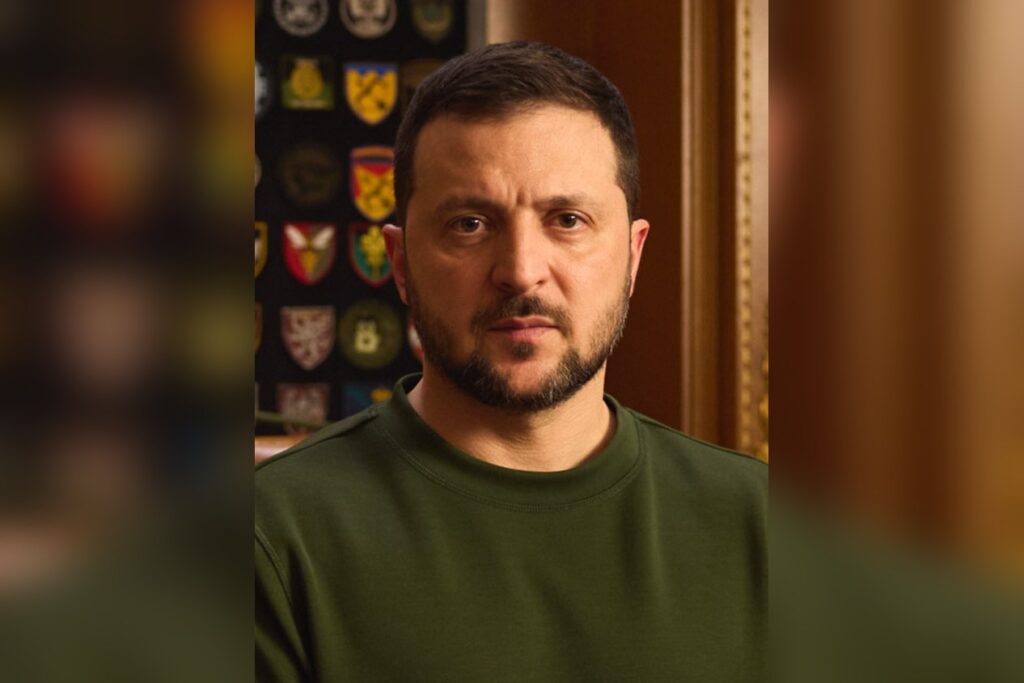
“The fight is here; I need ammunition, not a ride.” That was Volodymyr Zelenskyy’s answer in February 2022, when the United States offered to evacuate him and his family as Russian troops and tanks crossed into Ukraine.
Hours into the war, he swapped his suits for military fatigues and posted a selfie video from a street outside his office in Kyiv. Members of his cabinet and military advisers stood beside the then 44-year-old president. “We are all here defending our independence and we are defending our country and we will keep doing that,” he said.
Some admirers compared him to Winston Churchill.
A doubted president
Few expected that. Zelenskyy was a former comedian, best known for a TV show in which he played a high-school history teacher who is unexpectedly elected president. He won the real office in 2019 as an anti-establishment candidate. Critics and much of the media saw a weak leader who could not crack down on corruption, even inside his own administration, whatever he had promised on the campaign trail. Three years into his term, a Kyiv International Institute of Sociology poll found 62 percent of Ukrainians did not want him to run again.
As Russia stepped up threats in late 2021, the same institute found that 53 percent of Ukrainians believed he could not defend the country against a full-scale invasion. Russia had taken Crimea and parts of the Donbas in 2014 with little trouble, and the odds seemed to favor Putin’s forces.
Holding on
Ukraine’s forces, armed in part with Soviet-era tanks, guns and aircraft, mounted a stiff resistance even as missiles hit residential buildings, hospitals and schools. Few world leaders or military historians had given the country much of a chance. ABC News described the outcome as an early signal to the Kremlin that it faced a slugfest rather than a swift takeover.
Zelenskyy stayed put and used social media and daily addresses to rally troops, citizens and foreign governments. In March 2022 he spoke to the US Congress by livestream. “I call on you to do more,” he said, and asked: “Remember Pearl Harbor? … Remember September 11? Our country experiences the same every day right now.”
The US has since sent more than $50 billion in military and humanitarian aid, according to ABC. At least 46 other countries, including Nato members, have contributed a further $66 billion, in the form of air defense systems, grenade launchers, mortar rounds, missiles and modern tanks. Ukrainian troops forced Russian units to retreat from several major battles, and in September Zelenskyy announced the liberation of more than 2,300 square miles.
US Air Force Brig. Gen. Pat Ryder told a Pentagon briefing that Ukrainians had shown “a remarkable adaptability.” He added: “I think if anyone was surprised, just based on the reports that we’ve seen in terms of the Russian military’s response, it was probably the Russians.”
The toll
The cost has been heavy. As of 12 February, the UN human rights office had verified 7,199 civilian deaths, more than 400 of them children.
The skills that made Zelenskyy a successful comedian, ABC noted, are the ones he uses to rally support. He often visits devastated villages to mourn the dead and meet survivors.
In December he made his first trip outside Ukraine since the war began, flying to Washington. He became the first foreign leader since Churchill to give a wartime address to Congress. “Your money is not charity,” he told lawmakers. “It is an investment in global security and democracy.”
This week, Joe Biden travelled to Kyiv, met Zelenskyy and announced $500 million in additional military aid. Speaking in Warsaw on Tuesday, Biden said: “One year ago, the world was bracing for the fall of Kyiv. Well, I have just come from a visit to Kyiv, and I can report that Kyiv stands strong. Kyiv stands proud. It stands tall. And most importantly, it stands free.”




