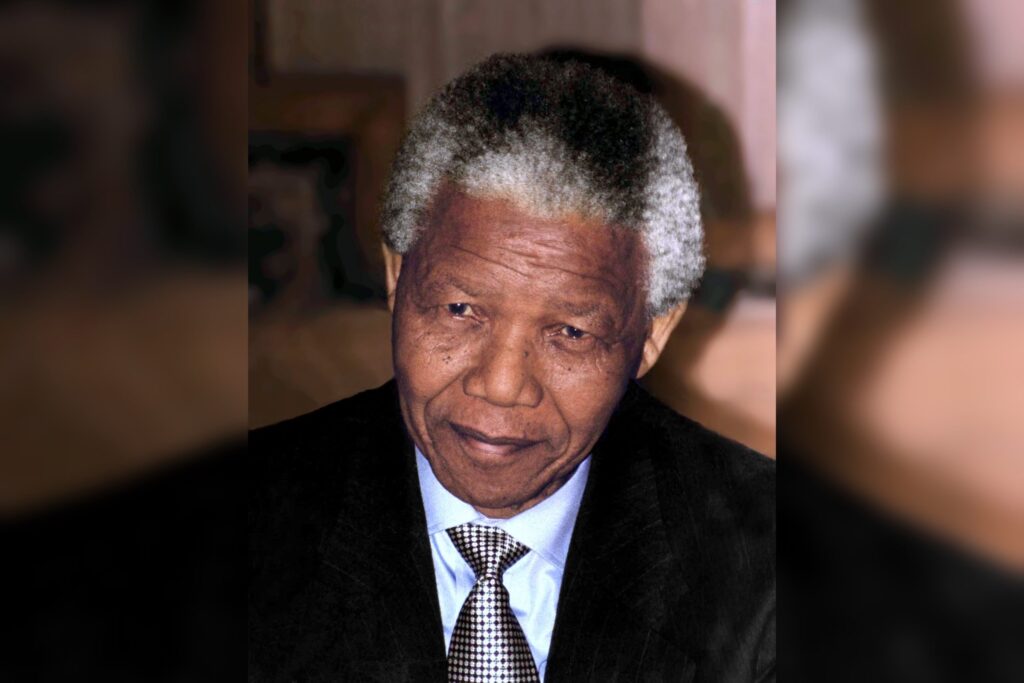
“When Mandela was just a child, he walked for miles on this route, moving from one village to another.” Tour guide Velile Ndlumbini said it as the car rolled through the green hills of South Africa’s Eastern Cape, in a travel report from the Associated Press written ahead of 18 July 2018, the 100th anniversary of Nelson Mandela’s birth. Mandela died in 2013.
The report lays out a route for anyone who wants to follow him: the villages where he was born and raised, the Soweto township where he became an anti-apartheid leader, and Robben Island, where he was held prisoner.
Mvezo, Qunu and Mqhekezweni
The trail starts at Mvezo, a small village where his birthplace homestead can still be seen. He lived there until he was 2, when his father lost his post as village chief after a dispute with a magistrate. The family moved to nearby Qunu, and Mandela stayed until he was 9 and his father died.
He and his mother then travelled 19 kilometers (12 miles) to Mqhekezweni, where the acting regent king adopted him and groomed him for leadership. In his autobiography “Long Walk to Freedom,” Mandela wrote that his interest in politics began here, listening to tribal elders hold community meetings. According to Ndlumbini, a shady spot under a circle of gum trees is still used for gatherings.
Qunu is also where he returned after 27 years in prison. He built a family complex beside the N2 highway, where some relatives still live, and moved back himself after retiring from public life. Dusty roads lead to his private grave, opposite the family burial site. The Nelson Mandela Museum is in the village too. It opened on Feb. 11, 2000, ten years to the day after his release, and walks visitors from his childhood through his political life to his election as president.
About 125 miles south, in King William’s Town, stands the Steve Biko Museum. Biko led the Black Consciousness Movement and died in 1977 after being arrested and beaten. In Port Elizabeth, an installation called Route 67 holds 67 artworks, one for each of Mandela’s 67 years of service.
Soweto
The white government created Soweto in the 1930s to relocate the Black population away from Johannesburg, and it grew into the country’s largest Black city. Mandela lived there from 1946 to 1962 and met the African National Congress activist Walter Sisulu. His house is now a museum.
The Apartheid Museum is the heaviest stop. Its entrance splits visitors into “whites” and “non-whites,” followed by a display of the passes Black South Africans had to carry. The Hector Pieterson Memorial recalls the 1976 uprising; Hector was 12 when police firing on student protesters killed him. Farther north, in Rivonia, the farm called Liliesleaf served in the 1960s as a hideout for Mandela and other activists. The trial that followed ended with life sentences on Robben Island.
Robben Island
A 45-minute ferry ride from Cape Town reaches the island, where Mandela spent 18 of his 27 years in prison, beginning in 1964, alongside Sisulu and Govan Mbeki. A former prisoner leads the tour, and its high point is Mandela’s cell, a room measuring 7 by 9 feet. The writer says he sharpened his skills as a leader and negotiator there, on the path to the presidency in 1994.
A mobile app, Madiba’s Journey, made by South African Tourism and the Nelson Mandela Foundation, can guide the route. The writer calls such a pilgrimage both distressing and uplifting, and notes that the young democracy still has work to do on living conditions for its Black majority.