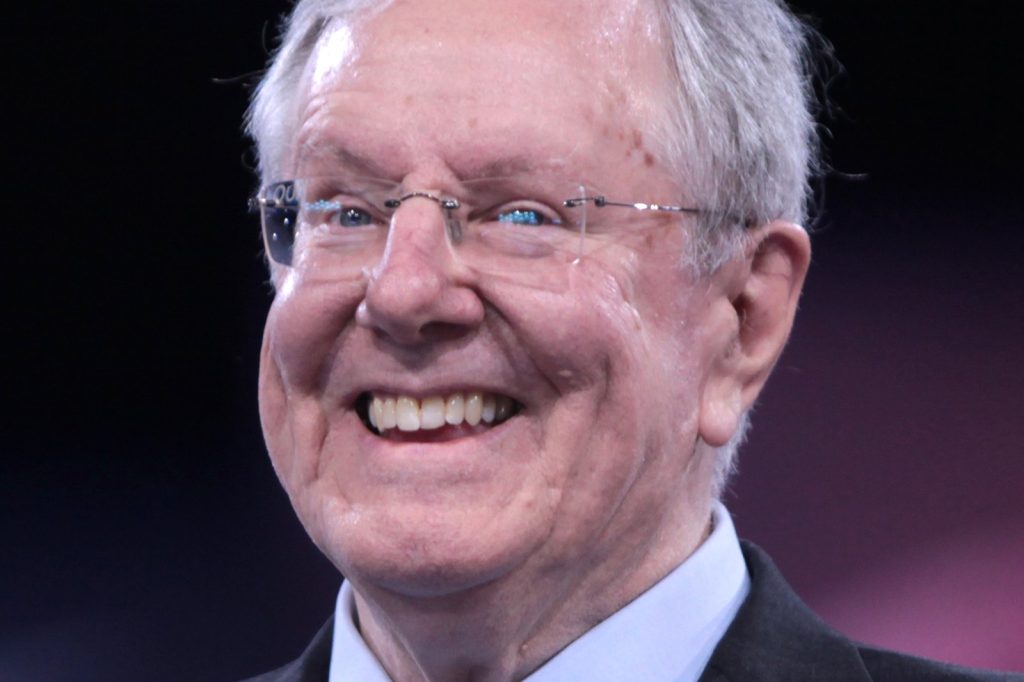
Steve Forbes runs one of the best-known business magazines in the world, and twice tried to run the United States on a 17 percent flat tax. Neither presidential bid came close, yet the idea outlived both campaigns. Analysts still treat his plan as a reference point whenever tax simplification comes up.
A publishing family
Malcolm Stevenson Forbes Jr. was born on July 18, 1947, in Morristown, New Jersey, to Roberta Remsen Laidlaw and Malcolm Forbes, the longtime publisher of Forbes. His grandfather was B.C. Forbes. The family settled in Far Hills, where young Steve attended the Far Hills Country Day School with Christine Todd Whitman, a friend who would later become governor of New Jersey. He finished at Brooks School in North Andover, Massachusetts, graduating cum laude in 1966.
Princeton followed, as it had for his father. He took an A.B. in history in 1970 after a 75-page senior thesis on the contest for the 1892 Democratic presidential nomination. Along the way he and two other students founded Business Today, which is now the largest student-run magazine in the world. He also joined the Alpha Kappa Psi and Tau Kappa Epsilon fraternities. Several universities, among them the New York Institute of Technology and Lehigh University, have since given him honorary degrees.
Radio Free Europe and a policy network
In 1985 President Ronald Reagan named Forbes head of the Board for International Broadcasting, the body that oversaw Radio Free Europe/Radio Liberty. George H. W. Bush reappointed him, and he stayed until 1993, when Bill Clinton took office.
He moved straight into advocacy. From 1993 to 1996 he chaired Empower America, which later merged into FreedomWorks, and the work brought him close to Jack Kemp. Kemp would endorse him in the 1996 Republican primaries. Between 1996 and 1999 Forbes also served as honorary chairman of Americans for Hope, Growth and Opportunity. He helped shape Whitman’s plan to cut New Jersey income tax by 30 percent over three years, a proposal that was a major factor in her win over Governor James Florio.
Two campaigns, one idea
Forbes ran in the Republican presidential primaries in 1996 and again in 2000. His case was simple: the tax system had grown Byzantine and bureaucratic, and a flat income tax would fix it. The 1996 version put 17 percent on personal and corporate earned income, left unearned income such as capital gains, pensions and savings untaxed, and exempted the first $33,000. In 2000 he kept the rate but swapped the single exemption for a deduction of $13,000 per adult and $5,000 per dependent, closer to the Armey plan.
He financed the runs in part by selling some of his voting shares in Forbes, Inc. to relatives. His 2000 campaign raised $86 million, of which $37 million was his own money. His net worth in 1996 was put at $430 million. He won the Arizona and Delaware primaries in 1996 and posted respectable shares elsewhere, but never threatened for the nomination. Critics pointed to his stiff stage manner. Time called his stumping a “comedy-club impression of what would happen if some mad scientist decided to construct a dork robot.” The campaign travelled by what staff called the “big silver bus.”
The 2000 race also forced a break with an old friend. Forbes had said otherwise in 1996, but he now declared himself firmly against abortion and in favour of prayer in public schools, and he distanced himself from Whitman over her pro-choice stance.
Saturday Night Live
Politics and comedy met in the spring of 1996. On March 16, shortly after Forbes left the race, Mark McKinney played him on Saturday Night Live in a sketch where he buys land in Russia to found a country called “Forbes America.” Forbes hosted the show himself on April 13. In one sketch he tried to answer voters’ questions, only to be asked about his wealth. Another had a Bosnia query, with a questioner asking why he did not simply buy the country. He also played a roofer, the joke being the distance between a tough tradesman and his nerdy, intellectual manner, and he interviewed McKinney’s version of himself.
After the campaigns
Forbes is chairman and editor-in-chief of Forbes and an adviser at the Forbes School of Business & Technology. He joined the FreedomWorks board in December 2006, sits on the board of the National Taxpayers Union and is a trustee of the Heritage Foundation. He appears as a regular panelist on Forbes on Fox, a Saturday-morning programme on Fox News Channel.
He kept working campaigns, too. In March 2007 he became national co-chair and senior policy adviser to Rudy Giuliani’s 2008 bid, and later advised John McCain on taxes, energy and the budget. He endorsed Donald Trump in 2016. In March 2013 he took part in an Intelligence Squared debate on whether America needs a strong dollar policy.
His wider platform has stayed consistent: free trade, health savings accounts, personal retirement accounts funded by diverting 75 percent of Social Security payroll taxes, school vouchers, smaller government and opposition to most environmental regulation. He has written several books on the flat tax, the dollar and inflation, including Flat Tax Revolution (2005) and Inflation (2022).
Forbes married Sabina Beekman in 1971. They have five daughters, one of whom is Moira Forbes. He rides Amtrak and was aboard the train that derailed in Chester, Pennsylvania, in 2016.