
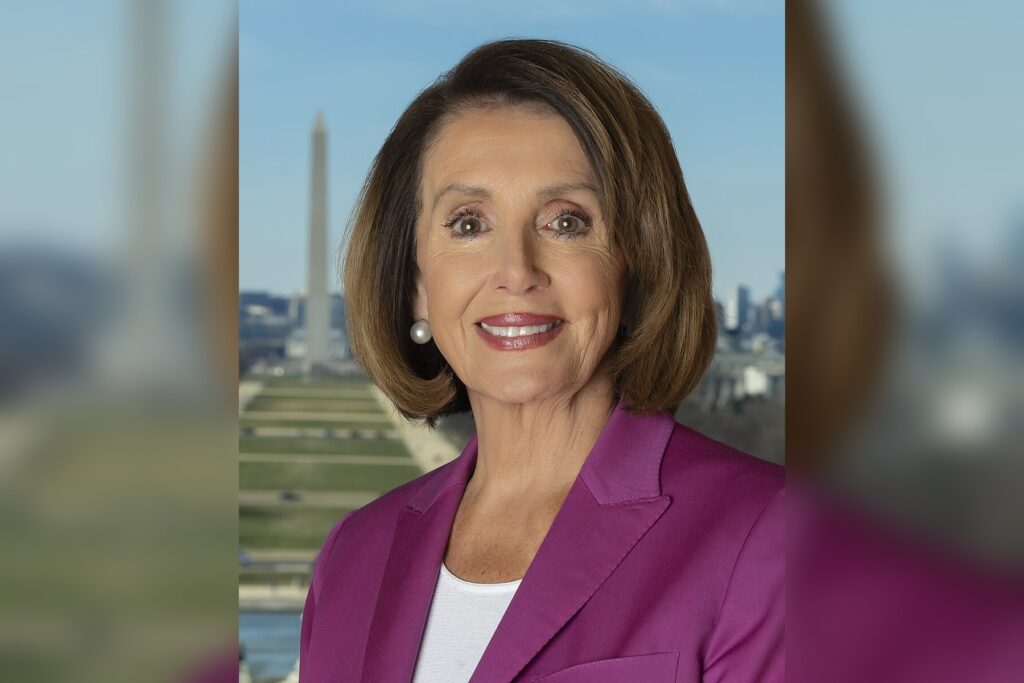
“I never would have thought that someday I would go from homemaker to House speaker,” Nancy Pelosi told the chamber when she announced she was stepping down as Democratic leader. “The hour has come for a new generation to lead the Democratic caucus.” She stayed in the House as a member.
Baltimore to San Francisco
Pelosi was born Nancy D’Alesandro on March 26, 1940, in Baltimore, the youngest child and only daughter in an Italian-American family. Her father, Thomas D’Alesandro Jr., was a congressman and then the city’s mayor; her mother organized Democratic women and taught her political skills. As a child she helped at his campaign events. She graduated from Trinity College in Washington in 1962 and married Paul Pelosi the next year.
The couple moved to New York and then San Francisco. She had five children in six years, and she started out there as a housewife. In 1976 she was elected to the Democratic National Committee, and by 1981 she headed the California Democratic Party. She won a special election to Congress in 1987, with the backing of the Burton family’s contacts.
Early on she became an advocate for people with HIV and AIDS, at a time when some in her own party privately chided her for it. She co-authored the Ryan White CARE Act, which George H. W. Bush signed in December 1990.
Up the Ladder
She was a fundraising machine. Between 2003 and 2014 she raised more than $400 million. In 2001 she beat John Lewis and Steny Hoyer to become minority whip, the first woman in that job. The next year, after Dick Gephardt left to run for president, she defeated Harold Ford Jr. 117 to 29 in the caucus vote and became the first woman to lead a major party in either chamber of Congress.
She opposed the 2002 Iraq resolution and kept hammering the Bush administration over the war. In 2006 Democrats won the House for the first time in 12 years, and she was elected Speaker, the first woman to hold the office. During that first stretch she helped pass Obama’s landmark bills, including the Affordable Care Act and Dodd-Frank. The Republicans retook the House in 2010, but she kept the Democratic leadership.
Second Gavel
In 2018 she beat back challenges within her own ranks and returned as Speaker, the first former Speaker to do so since Sam Rayburn in 1955. Republicans by then ran against her relentlessly. In one 2018 debate, Virginia congressman David Brat mentioned her and her “liberal agenda” 21 times. It backfired, and Democrats swept the House.
She faced Trump and Senate Majority Leader Mitch McConnell this time, so House bills stalled. Her sarcastic clap during Trump’s State of the Union went viral. A year later she tore up his speech on camera, later calling his words a “manifesto of mistruths.” She was reluctant at first to lead an impeachment, but as more emerged about Trump’s dealings with Ukraine she called it an abuse of power. The House impeached him in December 2019 and again in January 2021, and the Senate acquitted him both times.
Under Biden she held razor-thin margins together to pass the American Rescue Plan, the infrastructure law, the CHIPS and Science Act and the Inflation Reduction Act. Her visit to Taiwan, the most senior by a U.S. lawmaker in 25 years, enraged China, which answered with military drills.
Leaving Leadership
Republicans narrowly retook the House in the 2022 midterms, ending her second speakership. She gave up the Democratic leadership, and Hakeem Jeffries succeeded her. Critics across the spectrum had long called her a polarizing figure, and she had faced scrutiny over insider trading allegations. In November 2025 she announced she would not seek reelection in 2026 and would retire in January 2027.




