
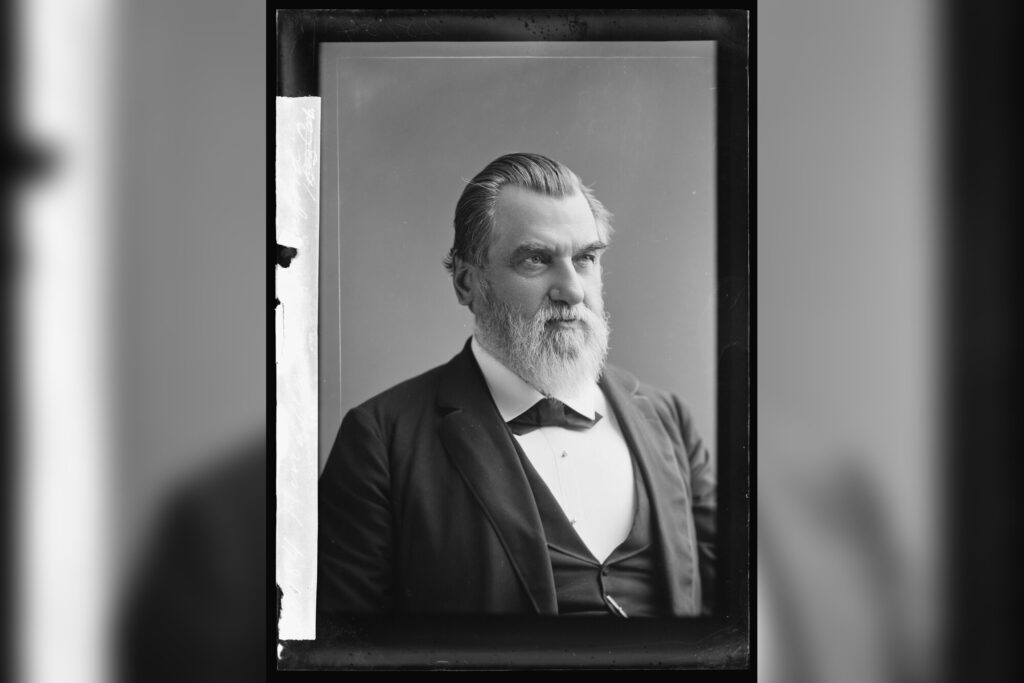
$62.6 million. That was the “surplus” a federal commission said Leland Stanford and his three partners took out of building the transcontinental railroad, plus another $55.5 million from the other lines they controlled. California’s entire state budget in 1887 ran about $6 million.
Congress had set up the Pacific Railroad Commission that year to examine the books of railroads that took federal aid. It spent almost a year on the job, heard hundreds of witnesses and produced some 6,000 pages. Its verdict was blunt: Stanford and his associates had lied to and defrauded the American people. An independent accountant with 30 years in railroad work testified, “I have never seen vouchers in such a state before in my life.” The commission said the books that would have shown where taxpayer money went “were purposefully destroyed by direction of Stanford, Huntington, Hopkins, and Crocker.”
Pressed for answers, Stanford said he had no knowledge, did not recall, or would not answer on advice of counsel. The commission took him to court and lost. Two of the three judges, personal friends he had appointed, ruled for him.
From the gold country to Sacramento
Stanford was born on March 9, 1824, in Watervliet, New York, one of eight children. He studied law and set up a practice in Port Washington, Wisconsin. In 1852 a fire took his law library and other property, and he followed his five brothers to California. He ran a general store for miners in Michigan City, served as justice of the peace, and by 1856 had moved to Sacramento.
There he joined three other merchants, Collis Huntington, Mark Hopkins and Charles Crocker, in backing engineer Theodore Judah’s plan for the Central Pacific Railroad. The company was incorporated on June 28, 1861. Stanford was elected its president.
Governor and senator
He lost his first run for governor in 1859 and won in 1861, becoming California’s first Republican governor. The Great Flood of 1862 meant he had to row to his own inauguration. In two years he cut the state’s debt in half and oversaw the founding of its first state normal school, in San Jose.
His record on race was ugly. In a January 1862 message to the legislature he said the settlement of Chinese immigrants should be discouraged by every legitimate means. He lost support when it came out that his railroad was bringing in Chinese workers to build the line.
From 1885 until his death in 1893 he sat in the U.S. Senate, and he stayed president of the Central Pacific the whole time.
The railroad
Stanford and his associates took control of the Southern Pacific Railroad in 1868. On May 10, 1869, at Promontory, Utah, he was given the honor of driving the last spike where the Central Pacific met the Union Pacific. Huntington forced him out as president of the Southern Pacific in 1890. Stanford remained president of the Central Pacific and chaired the Southern Pacific’s executive committee until he died.
The university
Stanford and his wife, Jane, lost their only child, Leland Jr., to typhoid fever in 1884. He was 15 and the family was touring Europe; he died in Florence, Italy. The couple founded Leland Stanford Junior University as his memorial, on their country estate in Palo Alto.
Stanford died on June 21, 1893. Jane then fought to recover a government loan that threatened the school, taking the case to the Supreme Court, and historian Roland De Wolk credits her with saving the university from closure. Eight years after her husband’s death she was poisoned with strychnine in a Honolulu hotel room. The killer was never found.
The first Central Pacific locomotive, named Gov. Stanford in his honor, is on display at the California State Railroad Museum in Sacramento.
Sources
- Leland Stanford – Wikipedia
- Was Leland Stanford a ‘Magnanimous’ Philanthropist or a ‘Thief, Liar, and Bigot?’ | What It Means to Be American




