
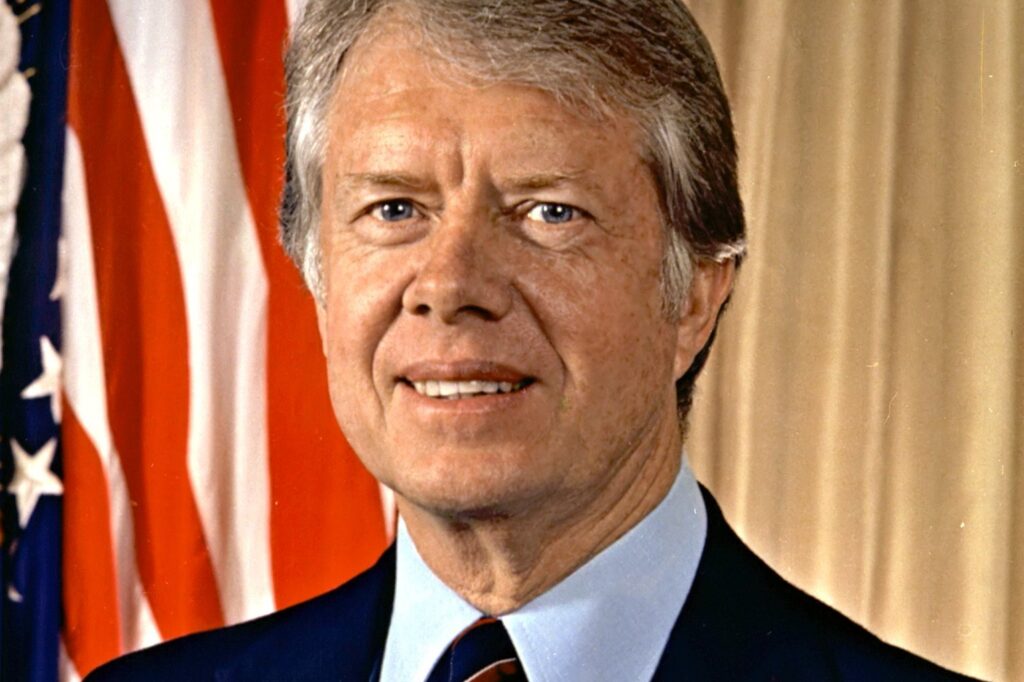
“If I ever lie to you, if I ever make a misleading statement, don’t vote for me. I would not deserve to be your president.” Jimmy Carter said it again and again on the 1976 trail, and enough voters believed him to put a peanut farmer from Georgia in the White House.
Carter died on Sunday, December 29, at his home in Plains, Georgia. He was 100, the longest-lived president in American history. The Carter Center said he had been in hospice care for more than a year. His wife, Rosalynn, died at 96 in November 2023. “Our founder, former US President Jimmy Carter, passed away this afternoon in Plains, Georgia,” the center wrote on X.
One term, and a hard exit
Carter came into the race as a little-known governor, an engineer by training with a broad smile and a plain Baptist manner. He ran a bare-bones campaign on public financing and narrowly beat the incumbent, Gerald Ford, who had lost ground by pardoning Richard Nixon.
His best-known win came in 1978. He kept Egyptian President Anwar Sadat and Israeli Prime Minister Menachem Begin at the table at Camp David for 13 days until they had a Mideast peace deal. He also normalized relations with China, gave up control of the Panama Canal, pardoned Vietnam War draft evaders and pressed dictators to free thousands of political prisoners. Supporters point as well to deregulation of key industries, less reliance on foreign oil, and legislation on the environment, education and mental health.
The economy and Iran undid him. Double-digit inflation, gasoline lines and a 444-day hostage crisis broke up his coalition. In April 1980 eight Americans died in a failed rescue attempt, and Ronald Reagan beat him in a landslide that year.
Carter later admitted in his 2020 “White House Diary” that he could be “micromanaging” and “excessively autocratic.” He had also snubbed Washington’s press corps and lobbyists, and told historians in 1982 that he had “an inherent incompatibility” with the capital’s insiders.
The Carter Center years
Defeat turned out to be a beginning. The Carters founded The Carter Center in 1982. “I wanted a place where we could work,” Carter wrote of it in a memoir published after his 90th birthday.
The work ran from nuclear tensions on the Korean peninsula to ceasefires in Bosnia and Sudan, and he helped head off a US invasion of Haiti. By 2022 the center had judged at least 113 elections in Latin America, Asia and Africa to be free or fraudulent. Carter also set out to wipe out the guinea worm parasite in his lifetime. Cases fell from millions in the 1980s to a handful. He and Rosalynn swung hammers for Habitat for Humanity well into his 90s.
He did not always please Washington. He announced an arms-reduction-for-aid deal with North Korea without clearing it with Bill Clinton’s White House, and he openly criticized George W. Bush over the 2003 Iraq invasion. The Nobel committee gave him the Peace Prize in 2002 for his “untiring effort to find peaceful solutions to international conflicts, to advance democracy and human rights, and to promote economic and social development.”
Plains
James Earl Carter Jr. was born on October 1, 1924, in Plains, a town of fewer than 1,000 people then and now. He graduated from the US Naval Academy in 1946 and married Rosalynn Smith that same year. A submarine officer who had reached lieutenant, he quit the Navy when his father fell ill with cancer and moved the family home to run the peanut business.
He served in the Georgia State Senate and lost a race for governor to the segregationist Lester Maddox in 1966, then won the office in 1970. In his 1971 inaugural address he declared, “the time for racial discrimination is over.”
Back in Plains after the presidency, he lived in the same one-story house he and Rosalynn had before he became governor, and he taught Sunday school at Maranatha Baptist Church until his mobility declined and the coronavirus pandemic arrived. A state funeral at Washington’s National Cathedral will precede his final send-off at that small church.
Stuart Eizenstat, Carter’s domestic policy director, wrote in a 2018 book that he was “not nominating Jimmy Carter for a place on Mount Rushmore.” Carter was not a great president, Eizenstat said, but a “good and productive” one whose results often came after he left office. Biographer Jonathan Alter told The Associated Press that Carter “will likely go down as one of the most misunderstood and underestimated figures in American history.”




