
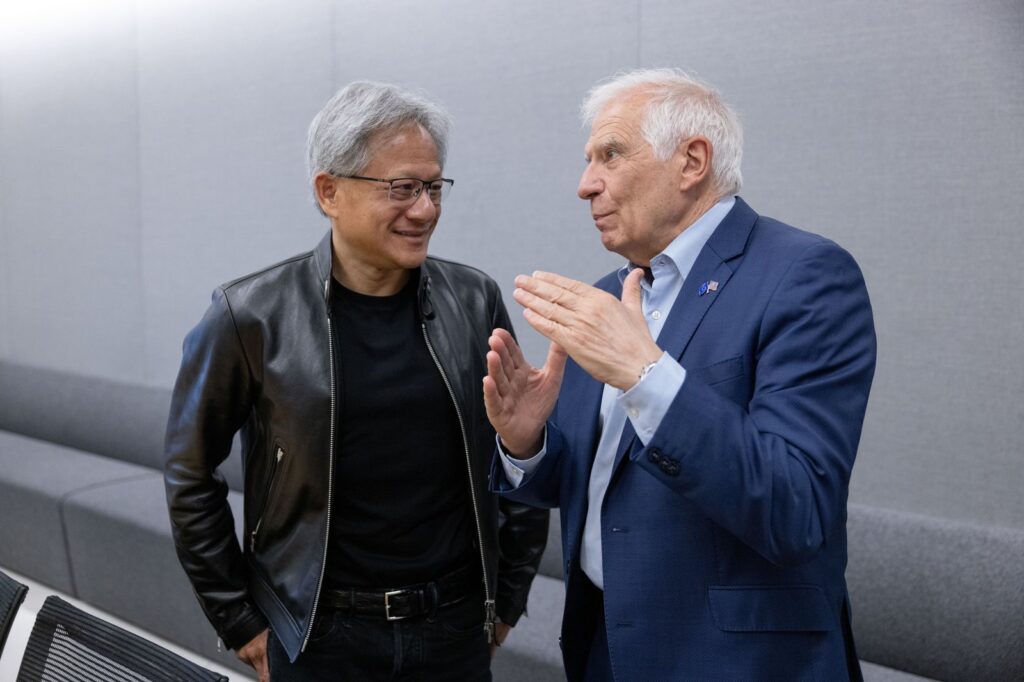
STOCKHOLM, October 18, 2026 — Jensen Huang is aggressively embedding Nvidia hardware into the backbone of corporate infrastructure as global leaders weigh the economic risks of AI.
The Strategic Necessity of Hardware Dominance
Nvidia CEO Jensen Huang is actively financing deals with hyperscalers and data center operators to ensure they prioritize Nvidia GPUs over competitors like AMD, according to finance analyst Tal Liani speaking on Sozzi Unleashed. This strategy aims to lock in demand for Nvidia’s chips by tying financial support to exclusive use of its technology. Huang’s approach reflects a broader effort to make Nvidia’s hardware indispensable in AI workflows, particularly as enterprises scale AI deployment across cloud and enterprise systems.
Financing the Ecosystem: The CoreWeave Model
In January 2026, Nvidia announced an expansion of its relationship with CoreWeave, including a $2 billion investment in CoreWeave stock. Nvidia now holds 47.2 million shares of CoreWeave, representing roughly 10% of the company. CoreWeave has committed to using Nvidia technology to build over 5 gigawatts of AI factories by 2030. As a major customer of Nvidia, CoreWeave buys GPUs and rents compute power to other companies, including hyperscalers like Meta. This model creates a closed loop where Nvidia’s financial backing ensures its chips are deployed at scale, and the resulting compute services reinforce demand for more hardware.
Technical Containment as a Barrier to Entry
Huang advocates for ‘secure containers’ for AI agents to prevent cybersecurity incidents, comparing the solution to early internet browser isolation. He told Fortune that AI agents need the same treatment as early web browsers — sealed inside isolated environments where they cannot access beyond permitted resources. This technical framework, Huang argues, would eliminate avoidable cybersecurity risks and strengthen trust in AI systems. By promoting secure containment as a standard, Nvidia positions its hardware and software stack as the foundation for safe, enterprise-grade AI operations.
Expanding the Footprint Through European Investment
Huang is in London as part of a European tour that kicked off in Paris, where he told the audience that Europe needs to get in the race on AI. Nvidia has committed $8 billion to Europe and plans an additional $2 billion in new regional investments. The company is backing European open-weight model developers like Mistral to lower costs for builders while maintaining hardware sales. Nvidia is already a major backer of Mistral, the French open-weight developer that recently released its Large 4 model, trained on 4,000 Nvidia Grace Blackwell GPUs. This strategy supports regional AI growth while ensuring continued reliance on Nvidia’s chips.
The Risks of a Market Correction in AI Spending
Global trade rose 8.3% between 2023 and 2025, a growth rate the IMF attributes largely to AI-related products. The fund’s chief economist Silvana Tenreyro noted this week that global trade would be closer to 4.6% without AI-related products. However, the IMF warns that a decline in AI investment could reduce global GDP by 0.4% by 2028. Federal Reserve Chair Kevin Warsh described AI as the most consequential economic change of his lifetime, though he warned of a ‘bumpy’ road ahead. Huang’s strategy depends on sustained AI spending, making Nvidia vulnerable to any pullback in enterprise or hyperscaler investment.
Huang’s European Tour and Open-Source Strategy
Jensen Huang is in London as part of a European tour that kicked off in Paris, where he told the audience that Europe needs to get in the race on AI. Huang said Nvidia would announce $2 billion in new European investments within the next week, building on the $8 billion the company has already committed to the continent. The tour includes Berlin, where Nvidia’s GTC conference will be hosted later in the month.
Nvidia is backing European open-weight model developers like Mistral to lower costs for builders while maintaining hardware sales. Nvidia is already a major backer of Mistral, the French open-weight developer that recently released its Large 4 model, trained on 4,000 Nvidia Grace Blackwell GPUs. This approach supports regional AI growth while ensuring continued reliance on Nvidia’s chips, as open-weight models reduce software costs for developers but drive hardware spending to Nvidia.
Huang’s European Tour and Open-Source Strategy
Jensen Huang is in London as part of a European tour that kicked off in Paris on Tuesday, where he told the audience that “Europe needs to get in the race” on AI. Huang said Nvidia would announce $2 billion in new European investments within the next week. That comes on top of the $8 billion the chipmaker has already committed to the continent. The tour also includes Berlin, where Nvidia’s GTC conference will be hosted later in the month.
Nvidia is backing European open-weight model developers like Mistral to lower costs for builders while maintaining hardware sales. Nvidia is already a major backer of Mistral, the French open-weight developer that recently released its Large 4 model, trained on 4,000 Nvidia Grace Blackwell GPUs. The sovereignty pitch also suits Nvidia. Open-weight models lower costs for the companies building them, but the hardware spending still goes to the chipmaker.
Huang’s Optimism Amid CoreWeave Stock Volatility
Nvidia CEO Jensen Huang expressed optimism about CoreWeave’s recovery during a Bloomberg event in Stockholm, stating, “CoreWeave’s strength is improving every day,” and adding, “I’m optimistic. Their cost of capital is actually decreasing.” This came after CoreWeave’s stock dropped 15% on Wednesday and another 4% in premarket trading on Friday. Huang’s remarks followed growing concerns about the AI company’s financial health and its close ties to Nvidia.
Huang’s confidence was echoed by finance analyst Tal Liani, who published a bullish note on CoreWeave with a $140 price target, noting that Nvidia is effectively financing deals with CoreWeave and other hyperscalers to ensure they use Nvidia GPUs over competitors like AMD. Liani observed on Sozzi Unleashed that there is an “inherent interest both ways” in the data center build-out, with stakeholders across the industry offering supportive comments on demand sustainability.
Despite the stock volatility, CoreWeave remains a major Nvidia customer, purchasing GPUs and renting compute power to other companies, including hyperscalers like Meta. Nvidia’s $2 billion investment in CoreWeave stock, announced earlier in 2026, gave it a 10% stake—47.2 million shares—and was tied to CoreWeave’s commitment to build over 5 gigawatts of AI factories by 2030 using Nvidia technology. This financial backing reinforces a closed-loop model where Nvidia’s support drives hardware deployment, which in turn sustains demand for its chips.
Sources
- Top leaders weigh 'huge benefit', risks of AI for global economy
- Nvidia CEO Jensen Huang addresses CoreWeave stock plunge: 'I'm optimistic'
- Nvidia’s Jensen Huang wants ‘no incidents’ of AI cybersecurity, and says AI doomers ‘ought to stop working on’ the technology | Fortune
Photo: Photographer: Peter Dasilva (CC BY 4.0)




