
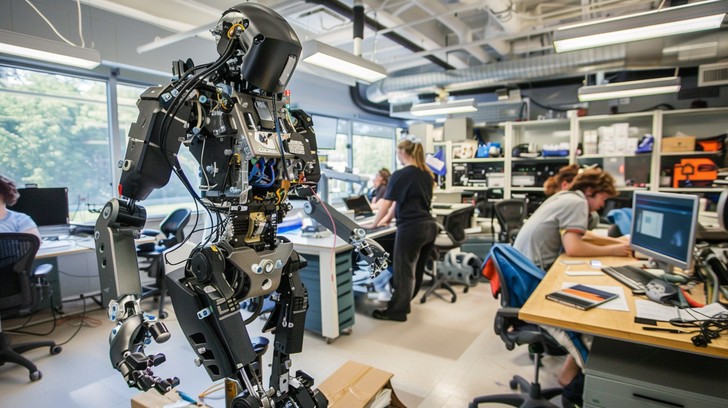
BOSTON, September 25 — The shift is happening in Massachusetts, and the people building it want the state to own it. Tech leaders across the commonwealth are talking openly about physical AI and robotics as the next frontier they believe Massachusetts has to dominate, and the mood, as reported by NBC10 Boston, is a blend of apprehension and anticipation — with the excitement winning. Bill Boyd of Symbotic did not hedge.
“This is going to boom from here,” he said, framing the industry’s arrival as a question of timing rather than possibility: “just a matter of ‘When is it going to happen?’” Helen Greiner, cofounder of iRobot, put the same question the same way. “It’s just a matter of ‘When is it going to happen?’” Two of the state’s best-known robotics figures, landing on the identical phrase.
That is not coincidence. That is a sector that has stopped debating whether machines will move into the physical economy and started debating the calendar.
Where the robots are headed next
Medical, agriculture and construction top the list of industries where robots could lift productivity and safety. Fady Saad of Cybernetix Ventures pointed to a Massachusetts company called Reframe, which he said is “kind of automating the whole process of building houses.” Housing, of all things — one of the least automated industries left standing. The national conversation around AI has been darker.
Major companies have voiced concern about how quickly the technology is evolving and what the repercussions could be for human society. Ira Hoffman, CEO of HighRes, pushed back on that framing.
“General fearmongering doesn’t help robotics in any way,” he said. “I don’t think the movie ‘Terminator’ was good for the robotics industry.” Then he added the caveat that matters: “At the same time, you can’t overlook safety.” Saad noted that safety rules in robotics are not new. “In robotics, this has always been there,” he said.
“You cannot deploy a manufacturing facility or a warehouse or any of those things without complying to safety standards.”
Washington, watch this space
Those national concerns have landed on the desk of Rep. Lori Trahan, a Massachusetts Democrat who has made AI regulation a top priority and believes Congress should set the guardrails. “I’m happy that we have legislation that’s been drafted, been vetted, it’s really been scrutinized,” she said. “All we need is Congress to get off the sidelines and prioritize this table stakes legislation.” Trahan’s “Frontier Act” has picked up momentum, with OpenAI backing the bipartisan plan.
The House is out of session and will not return until after the November election, so the bill waits. In the robotics and physical AI space, safety is a priority — but so is restraint.
Boyd cautioned that regulation could overshoot. “It could go too far,” he said. “Because if you throw the baby out with the bathwater, it’s like any other thing.” Trahan herself is not down on the technology.
“There’s no question that AI holds enormous promise,” she said. Saad went further on what Massachusetts could claim: “We can lead the country, or even the world.” The trend underneath is simple.
Physical AI has moved from demo to deployment, and the state that produced iRobot now has a robotics startup culture, venture money and a sitting congresswoman pushing legislation all pointed the same direction. What’s changing next is the calendar — and whether Congress moves on the Frontier Act when the House returns after November. Watch this space.




