
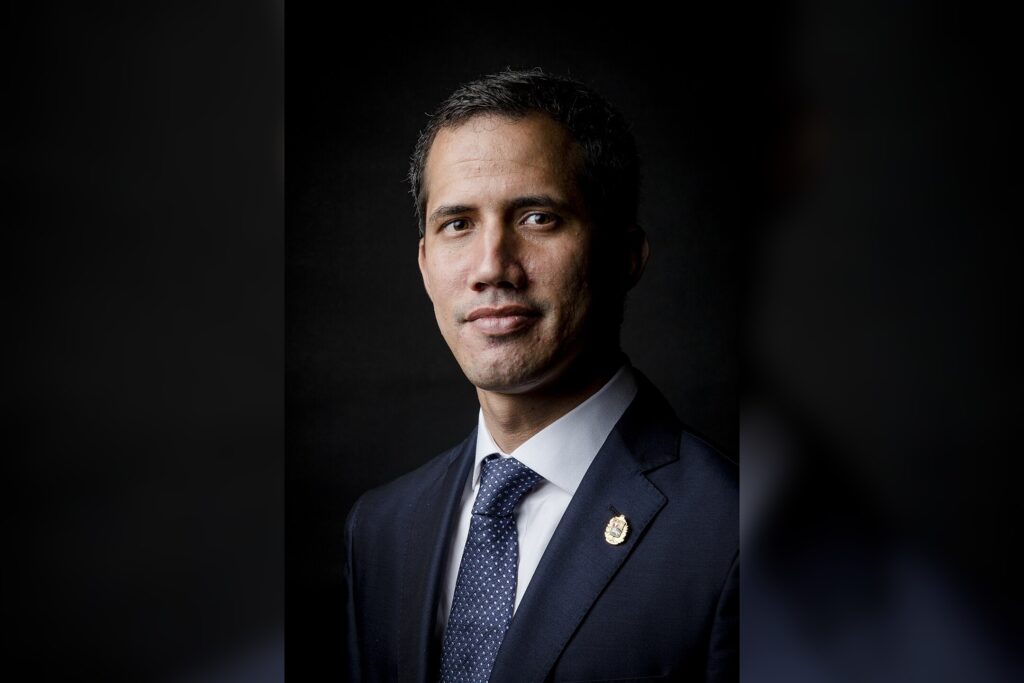
From Student Activist to Interim President
Guaidó’s political roots trace to the mass protests of 2007, when he first entered Venezuelan politics as a student leader. In 2009, he helped found the social-democratic party Popular Will alongside Leopoldo López. He was elected as an alternate deputy to the National Assembly in 2010, then won a full-seat deputy position in 2015. Under a rotation protocol among political parties, Popular Will nominated him for the presidency of the National Assembly in early 2019.
He assumed that role on January 5, 2019. Just eighteen days later, on January 23, 2019, Guaidó declared himself interim president of Venezuela. His legal argument rested on the claim that the 2018 presidential election was fraudulent and that Maduro’s January 2019 inauguration was therefore illegitimate. Dozens of countries — including the United States, Canada, and most European Union member states — recognized Guaidó as the legitimate head of state. The Maduro administration responded swiftly, freezing Guaidó’s assets, launching a criminal probe, and threatening legal action.
Failed Diplomacy and a Collapsed Military Uprising
Guaidó’s strategy to force a transition rested on two parallel tracks: diplomatic pressure and military defection. In 2019, his representatives and Maduro’s envoys met for negotiations in Oslo, Norway, and later in Barbados. Neither round produced a power-sharing agreement or a pathway to new elections. The diplomatic track yielded talks but no breakthrough.
The military track failed more spectacularly. In April 2020, Guaidó called for a military uprising against Maduro. The operation collapsed. From that point, his support among both Venezuelans and international backers began to erode visibly. The uprising’s failure marked the beginning of the end of his political momentum.
The institutional framework that sustained his claim continued to fray. In January 2020, security forces prevented Guaidó and other opposition lawmakers from entering the legislative palace during an internal election for the assembly’s board. A majority of deputies held an emergency meeting elsewhere and voted to re-elect Guaidó as their leader, while lawmakers inside the palace elected Luis Parra. Security forces repeatedly denied Guaidó access to parliament in the months that followed.
Dissolution of the Interim Government and a Shift in Washington
By December 2022, the opposition-controlled National Assembly voted to dissolve Guaidó’s interim government entirely. That vote ended his claim to the presidency. His formal term as National Assembly president had already expired on January 5, 2023. The dissolution meant there was no longer any parallel executive structure challenging Maduro.
The most consequential change came from the United States in March 2025. The State Department announced a policy shift: the U.S. no longer recognizes any specific opposition leader as Venezuela’s legitimate interim president. Instead, the department will determine future recognition on a case-by-case basis. The practical effect is that no Western government currently recognizes Guaidó as Venezuela’s legitimate leader. The diplomatic coalition that once formed around him has dissolved. The Maduro government, still in power, faces no parallel executive challenger with international recognition.
Guaidó remains in Venezuela, a visible reminder of the opposition’s failed bid to force a transition. He holds no elected office and commands no international recognition. For investors and policymakers, the key question is whether the opposition will regroup around a new figure or whether the Maduro government will consolidate further without an organized challenger. The March 2025 U.S. policy shift leaves the State Department as the sole decision-maker on future recognition — a decision that will define the next phase of Venezuela’s political crisis.




