
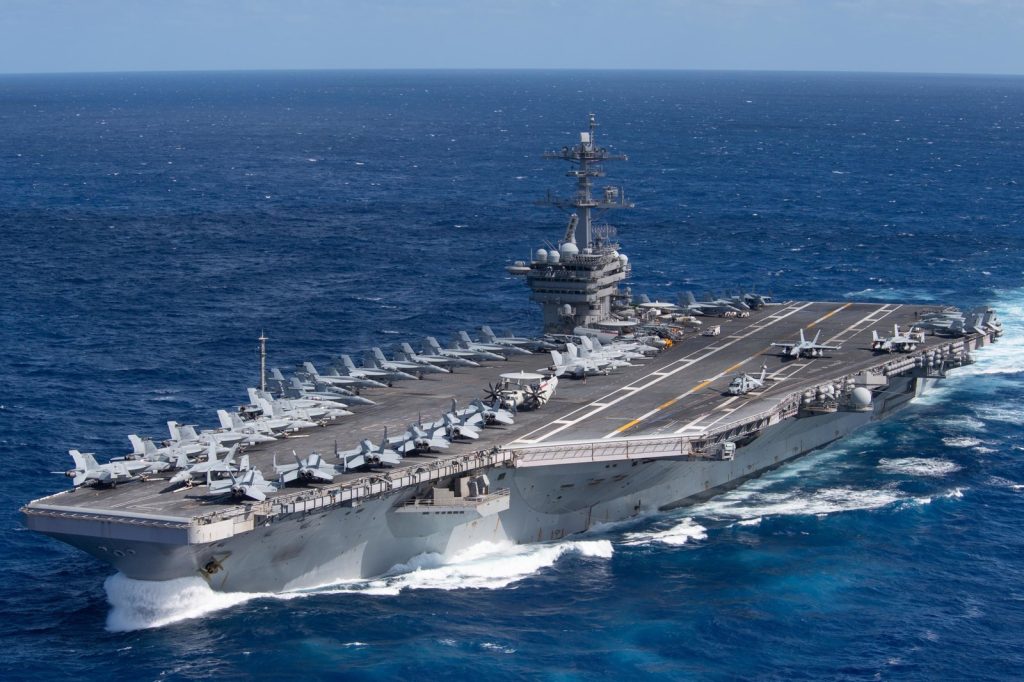
WASHINGTON, August 15 — The United States has withdrawn its last aircraft carrier from the Asia-Pacific region, a move that marks a significant shift in strategic focus. The USS Theodore Roosevelt, which had been operating in the South China Sea, has been redeployed to the Middle East amid escalating tensions with Iran. This decision comes as the Trump administration prioritizes challenges in the Western Hemisphere, including the ongoing crisis in Venezuela and drug trafficking concerns.
The withdrawal leaves the U.S. without a permanent aircraft carrier presence in the Asia-Pacific for the first time in decades, raising questions about its commitment to regional allies and its ability to counter China’s growing military influence. Defense Secretary Mark Esper has emphasized the need to “prioritize theater-specific requirements,” signaling a broader reallocation of military resources to address perceived threats in other regions.
Strategically, this move reflects a recalibration of U.S. military posture, with the administration focusing on what it perceives as more immediate threats. The broader stakes are clear: as the U.S. shifts its assets, it risks ceding ground in a region where China has been increasingly assertive. What this signals is a complex calculus—balancing the need to address crises in the Middle East and Western Hemisphere while maintaining a credible deterrent in the Asia-Pacific.
Escalating Tensions in the South China Sea
The USS Theodore Roosevelt’s departure follows a series of high-profile incidents in the South China Sea, including close encounters between U.S. and Chinese warships. These incidents underscore the growing friction between the two powers, as China continues to expand its military presence and assert territorial claims in the region. The carrier’s redeployment is expected to last several months, with its return to the Asia-Pacific contingent on evolving geopolitical developments.
This temporary absence, however, could create a vacuum that China may seek to exploit, further complicating the regional security landscape.
Implications for Regional Allies
The withdrawal has sparked concerns among U.S. allies in the region, who rely on American military presence as a counterbalance to China’s assertiveness. Countries like Japan, South Korea, and the Philippines may now question the reliability of U.S. security commitments, potentially prompting them to reassess their own defense strategies. China, meanwhile, is likely to view this move as an opportunity to solidify its dominance in the region.
Its recent actions, including the construction of militarized islands and increased naval patrols, suggest a long-term strategy to reshape the geopolitical chessboard in its favor.
Looking Ahead
As the U.S. navigates this strategic realignment, the calculus will be closely watched by both allies and adversaries. The Trump administration’s ability to manage multiple theaters of tension—from the Middle East to the Western Hemisphere—while maintaining a credible presence in the Asia-Pacific will be a key test of its foreign policy. What this signals is a broader shift in U.S. priorities, one that reflects the complexities of a multipolar world.
As the USS Theodore Roosevelt sails toward the Middle East, the question remains: how will the U.S. balance its commitments in an era of competing global challenges? The answer will shape the geopolitical landscape for years to come.




