
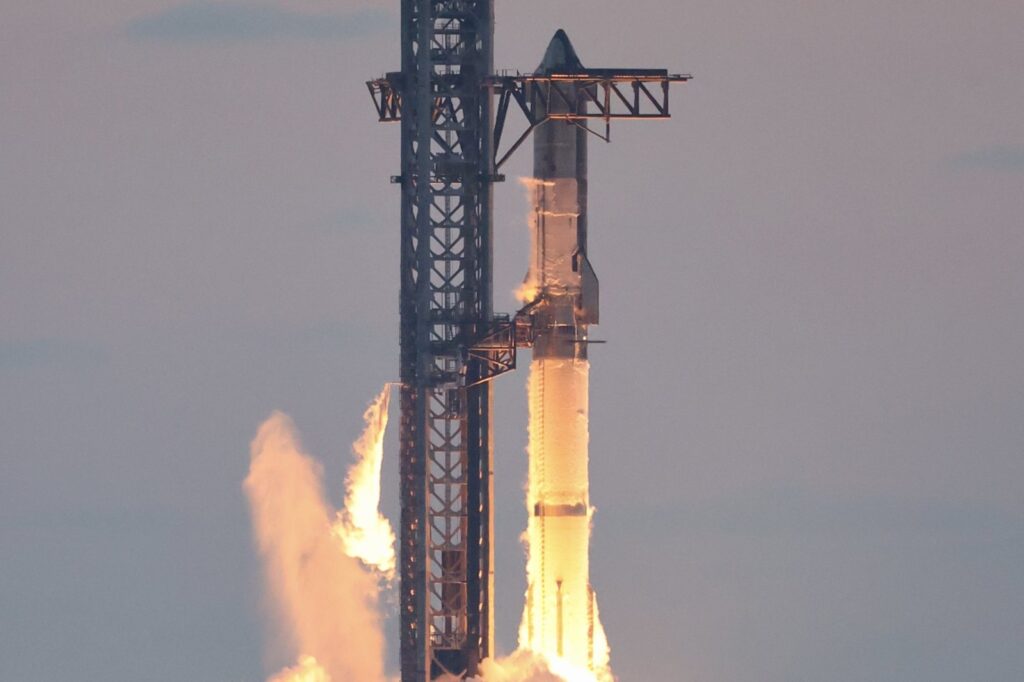
BROWNSVILLE, October 15, 2026 — SpaceX’s Ship 40, the first Starship upper stage to survive an ocean splashdown, has returned to Starbase after 24 days at sea and is now standing vertically in the Megabay for post-flight analysis.
Splashdown and Recovery in the Indian Ocean
Ship 40 launched on July 24, 2026, atop Super Heavy Booster 20 during Starship’s 13th test flight. After reentry, it splashed down in the Indian Ocean and remained afloat for 24 days while being towed by SpaceX recovery teams. The spacecraft reached waters off Australia’s Christmas Island in August 2026, where engineers conducted initial inspections and collected heat shield samples from its belly.
Transport to Texas and Overland Move
Following the ocean tow, Ship 40 was loaded onto the Forte, a semi-submersible transport vessel, for the return journey to the United States. Forte arrived at the Port of Brownsville on October 7, 2026. From there, the ship was moved over land to Starbase, reoriented outside the Megabay, and lifted into a vertical position before being placed inside the facility.
First Returned Upper Stage for Reuse Analysis
Ship 40 now stands vertically alongside three other Starships in Starbase’s Megabay, marking the first time a Starship upper stage has been returned to its launch site after flying in space. SpaceX has previously recovered Super Heavy boosters but never an upper stage. The returned vehicle will provide first-of-its-kind data on a flown heatshield, Raptor engines, and avionics.
Implications for Starship Reusability
Studying Ship 40 will help engineers refine systems for full Starship reusability, a key goal for reducing launch costs and increasing flight frequency. The data gathered will inform preparations for upcoming flights, including Flight 15, as SpaceX works toward routine recovery and reuse of both stages of the Starship system. As ever, the technical reality of reentry survival and recovery is the detail that matters.
East Coast Infrastructure and Future Launch Cadence
SpaceX has deployed new PEZ hardware at its East Coast operations to load Starlink V3 satellites onto Starship vehicles, a system designed to dispense satellites one by one through a small door in the hull using actuators and inverters for increased deployment speed. This hardware was validated during Flight 13 on July 24, 2026, which deployed 20 Starlink V3 satellites from Starbase, and Flight 14 on September 28, 2026, which achieved orbit for the first time and dispensed 26 V3 satellites, adding 26 terabits per second of capacity to the Starlink constellation. Establishing this capability on the East Coast, likely at Cape Canaveral, would allow SpaceX to operate two independent launch sites for Starship, effectively doubling potential mission frequency without being bottlenecked by a single pad’s turnaround cycle. Each Starship mission is expected to eventually carry up to 60 Starlink V3 satellites to orbit, adding 60 Tbps of capacity per launch — more than 20 times what a current Falcon 9 mission contributes. Running launches from two sites simultaneously would compress the timeline for completing the Gen2 constellation.
Ambition for High-Frequency Launches from Texas
SpaceX has requested permission from the Federal Aviation Administration to increase Starship launch frequency at Starbase from the current limit of 25 times per year to as many as 456 launches annually. The FAA notice, published in the Federal Register on October 14, 2026, outlines a two-step plan: first, increasing to 100 launches per year at any hour on any day, and second, reaching 456 launches per year on weekdays only but at any hour, equivalent to nearly nine launches per week. Under this plan, the Super Heavy booster could land at the launch site, in the Gulf of Mexico, or be expended in flight, while the Starship upper stage could land at the site, in the Gulf, or in the open ocean. The FAA’s analysis assumes half of all launches and landings would occur at night under the proposed increase, a significant shift from the current approval, which allows only three nighttime launches per year. The environmental impact statement being prepared by the FAA will assess the broader program, including license changes and renewals, with public comments due by November 30, 2026.
Sources
- Watch: SpaceX’s first Starship to survive an ocean splashdown is finally back at Starbase
- SpaceX PEZ Hardware Spotted for East Coast Starship Starlink Loads
- SpaceX wants up to 456 Starship launches a year from Texas
Photo: Steve Jurvetson (CC BY 2.0)




