
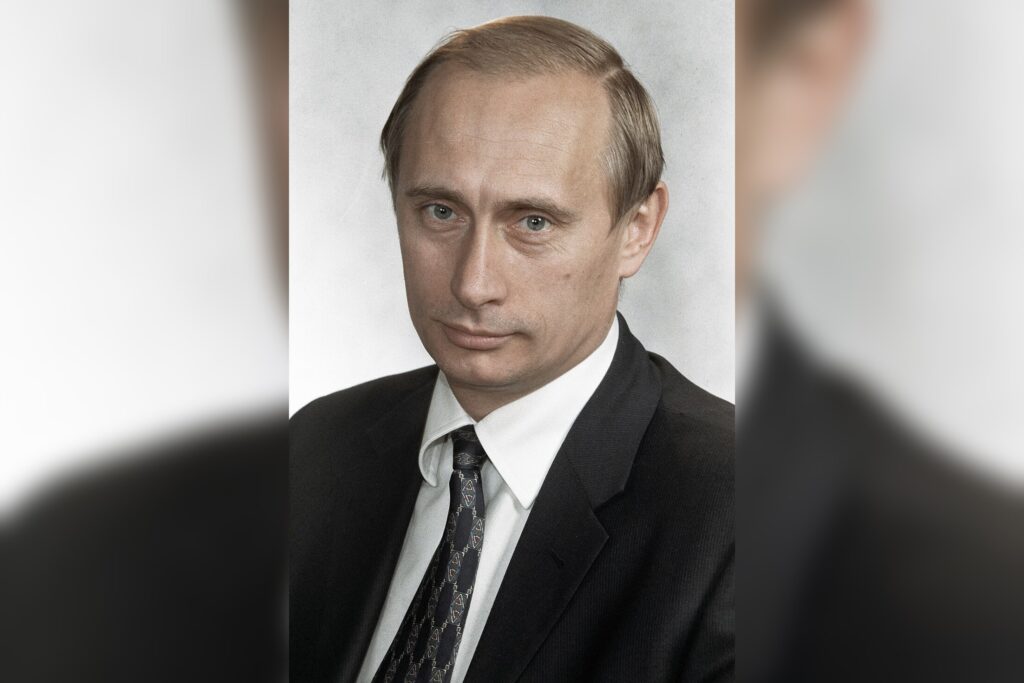
Vladimir Putin was born on 7 October 1952 in Leningrad, now Saint Petersburg, the youngest of three children. Two older brothers did not survive. One died in infancy, the other, Viktor, died of diphtheria and starvation in 1942 during the German siege of the city. The family shared a communal apartment on Baskov Lane.
His grandfather, Spiridon Putin, worked as a personal cook to Lenin and Stalin. His father served in the Soviet Navy’s submarine fleet in the early 1930s and was badly wounded in 1942. His mother worked in a factory.
From law student to KGB officer
Putin studied law at Leningrad State University, graduating in 1975. He joined the KGB the same year. After training he worked in counterintelligence and then in the First Chief Directorate, where he kept watch on foreigners and consular officials in Leningrad. From 1985 to 1990 he was posted to Dresden, East Germany, under cover as a translator. He rose to lieutenant colonel.
What he actually did there is disputed. Journalist Masha Gessen has written that he and his colleagues mostly collected press clippings. Catherine Belton wrote in 2020 that the downplaying covered for a closer link to the Red Army Faction. A 2023 Der Spiegel investigation found that one anonymous source for that claim had never belonged to the group and was “considered a notorious fabulist.”
Putin resigned from the KGB on 20 August 1991, the second day of the coup attempt against Mikhail Gorbachev. “As soon as the coup began, I immediately decided which side I was on,” he said.
The climb to the Kremlin
He started a political career in Saint Petersburg, then moved to Moscow in 1996 to work in Boris Yeltsin’s administration. He briefly ran the Federal Security Service, became secretary of the Security Council, and was named prime minister in August 1999. When Yeltsin resigned, Putin became acting president. In March 2000, less than three months later, he won election to his first term.
He was reelected in 2004. Because of the limit on two consecutive terms, he served as prime minister under Dmitry Medvedev from 2008 to 2012, then returned to the presidency after an election marked by fraud allegations and protests. He won again in 2018. In April 2021, after a referendum, he signed constitutional amendments that let him run twice more, which could keep him in office until 2036.
His first years in office saw the Russian economy grow by an average of seven percent a year, helped by economic reforms and a fivefold rise in oil and gas prices. He also led the war against Chechen separatists and restored federal control over the region.
Crimea, Ukraine and sanctions
Russia occupied and annexed Crimea during his third term and backed a war in eastern Ukraine. Sanctions followed, and together with falling oil prices they pushed Russia into financial crisis. He also sent forces to Syria to back Bashar al-Assad.
In February 2022 Putin launched a full-scale invasion of Ukraine, which brought international condemnation and wider sanctions. That September he announced a partial mobilization and annexed four Ukrainian oblasts. In March 2023 the International Criminal Court issued an arrest warrant for him over the alleged unlawful abduction of children during the war. He was reelected in March 2024.
Critics describe the system he built as authoritarian, pointing to corruption, the jailing and suppression of opponents, and censorship of independent media. Russia scores very low on Transparency International’s Corruption Perceptions Index, Freedom House’s Freedom in the World index and the Reporters Without Borders press freedom index.




