
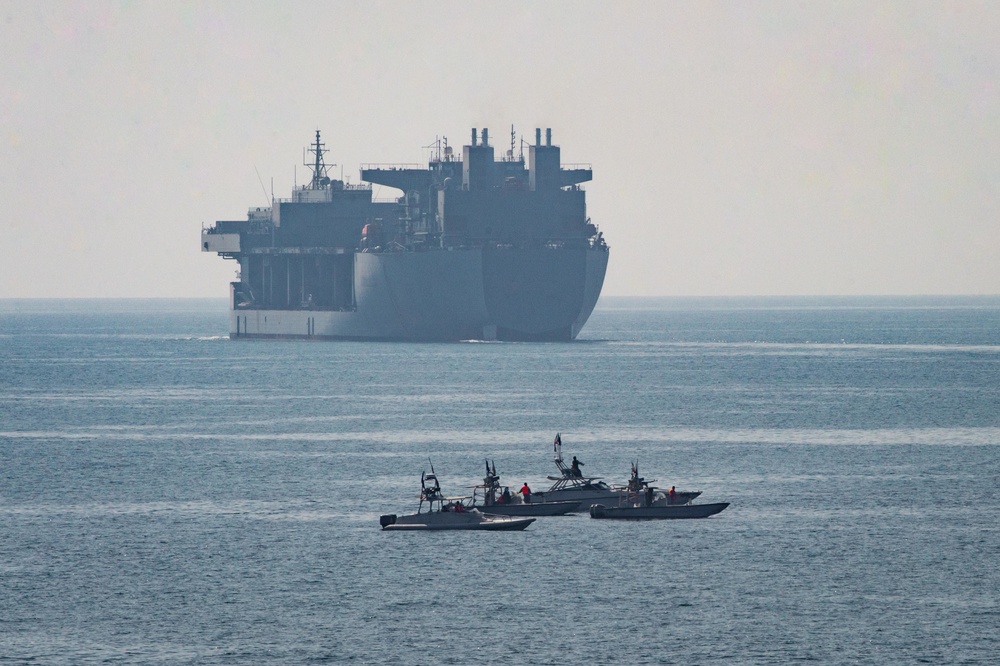
Iran has attacked more than twenty ships in or near the Strait of Hormuz since the war began, according to Brig. Gen. Assaf Orion (Res.), a former head of the IDF Strategic Planning Division now at The Washington Institute. His March assessment of what Washington can do about it is sober: every option carries heavy risk.
The picture he drew was of a strait Iran treats as its own. Tehran has set up a selective passage regime, exporting its own oil and natural gas while letting through countries that “pay a toll” and refusing everyone else. Its terms for ending the war include a “new legal regime for the Strait of Hormuz,” which Orion calls a clear challenge to American, global and regional interests.
Ultimatums and a coalition
On March 21, President Trump warned that Iran’s power plants would be obliterated unless it fully opened the strait. Iran’s military answered by threatening US and Israeli-related energy, information technology and water desalination infrastructure across the region. Then the president postponed any strikes on power plants for five days to leave room for talks.
Trump has said the US Navy will reopen the strait and asked other countries to help. Leaders of Canada, France, Germany, Italy, Japan, the Netherlands and the United Kingdom issued a joint statement on March 19 expressing “readiness to contribute to appropriate efforts to ensure safe passage.” Twenty-two nations have since signed. US forces, meanwhile, have destroyed over 130 Iranian naval vessels and 44 minelayers and hit dozens of military targets along the coast and inside the Gulf, including storage sites for mines and missiles. The 31st and 11th Marine Expeditionary Units and the USS Tripoli and Boxer Amphibious Ready Groups have been sent to the region.
Convoys and their limits
The obvious precedent is Operation Earnest Will in 1987-88, when the United States escorted Kuwaiti tankers. It did not go as planned. Iran stopped small boat attacks but turned to covert minelaying, hit tankers in port once the escorts left, and went after vessels outside the convoys. An oil tanker struck a mine on the very first convoy. Iran did not pull back until after April 1988, when Operation Praying Mantis inflicted heavy losses on its navy. Even so, the convoys deterred direct attacks on escorted tankers and helped contain the war at sea until a ceasefire came.
Orion lists why today is harder. Iran’s military is badly weakened but still holds large numbers of small boats, antiship cruise and ballistic missiles, coastal artillery and rocket units, and attack drones, many of them launchable from over 1,000 miles inland. Earnest Will took nearly thirty warships when the Navy had nearly 250 major surface combatants. A force that size now would be close to a third of a fleet that has shrunk to around 100, which he calls probably unsustainable. Central Command has only one littoral combat ship with a mine countermeasures package in the region. And the United States, a bystander in the 1980s, is now a belligerent whose escorting ships would almost certainly be targeted.
His conclusion: offense is more cost-effective than defense, partly because offensive munitions cost less than defensive interceptors. Gulf energy infrastructure on shore needs more protection too. Convoys and intensified strikes might ease oil markets for a time, but residual attacks could still scare off shipowners, traders and insurers.
Squeezing Iran’s economy
Orion argues for making clear that if others cannot use the strait, neither can Iran. He sets out four measures.
The first is a blockade of Kharg Island, through which Tehran exports 90 percent of its oil. Seizing it would leave any US ground troops exposed to prolonged bombardment from the mainland. A less fraught alternative would be mining Iranian waters on the approaches so tankers cannot load, and threatening anyone who tries to clear them. Tehran could cite that to justify more mining of international waterways, so he says it needs careful study. Washington could offer to clear the mines once Iran allows free navigation and clears its own.
The second is a distant blockade. Iran has kept shipping oil to China, so the Navy could divert its “shadow tankers” between Hormuz and the Strait of Malacca, then impound and sell the cargo, as was done with Venezuela’s shadow fleet. Tankers serving as floating storage, mostly in Asia, hold nearly 140 million barrels, though legal, logistical and financial obstacles could get in the way. The administration has instead approved a Treasury short-term general license allowing the temporary sale of Iranian oil already at sea to hold prices down, which Orion reads as more worry about prices than about choking Iranian revenue.
The third is a close blockade of non-oil imports. About 80 percent of Iran’s imports pass through Hormuz. A selective version would let ships carrying mostly foodstuffs through and divert those with raw materials, equipment and industrial goods.
The fourth is threats and punishment. Trump has repeatedly threatened to destroy Kharg’s energy infrastructure. Israel struck the South Pars gas field on March 18, and Tehran quickly hit gas facilities in Israel, Kuwait, Qatar and Saudi Arabia, among them the world’s largest liquified natural gas export installation near Doha. Trump then warned that US forces would destroy South Pars entirely if Qatari LNG facilities were hit again. So far, Orion notes, such warnings and visible strikes have not changed Iran’s conduct.
A regime playing the long game
Orion expects Tehran to play for time and seek retribution against its neighbors. Reciprocal attacks on Gulf energy sites have already followed strikes on Iran’s energy facilities, and seizing shadow tankers could prompt Iran to seize other nations’ vessels. Under heavy bombardment already, it may be less impressed by more attacks and readier to damage the Gulf states. It also has ways to limit passage even after the US ends its campaign, which leaves Washington a dilemma: yield and hand Tehran a victory, or wage a protracted effort at the expense of other priorities.
There is, he writes, no silver bullet. Every option will take substantial resources and time, and Washington and its partners will need to combine direct and indirect approaches.




