
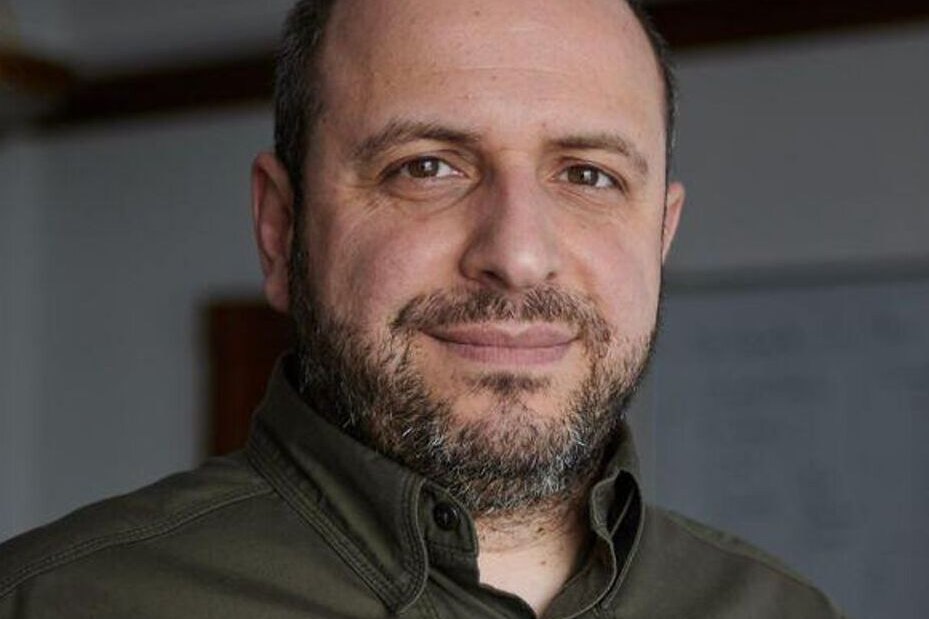
On March 24, 2025, Ukraine’s Defense Minister Rustem Umerov announced that a license had been approved for the Patriot air-defense system, clearing the way for the system to be built or maintained on Ukrainian soil rather than relying entirely on foreign assembly lines. The announcement is a concrete step in a broader effort by Umerov to integrate Western military aid into Ukraine’s war economy while also pushing for increased domestic weapons production.
Umerov has been a key figure in negotiations with the United States and NATO for continued military support, including the $44 billion in US security assistance provided since 2022. That figure represents a multi-year pipeline of artillery shells, armored vehicles, air-defense interceptors, and maintenance contracts.
A Quiet Mechanic with a Telecom Background
Umerov, born in 1982 in Samarkand, Uzbekistan, to a Crimean Tatar family, moved to Ukraine in 1989. He studied at the National University of Kyiv-Mohyla Academy and worked in telecommunications before entering politics.
He served as a member of the Verkhovna Rada from 2019 to 2023, representing the Holos party, and chaired the Parliamentary Committee on Human Rights. Before taking the defense portfolio, Umerov ran the State Property Fund, a role he assumed in September 2022. On September 6, 2023, he replaced Oleksii Reznikov as Minister of Defense. His background in telecommunications—a sector built on contracts, standards, and interoperability—matters for his current role.
The job of integrating a Patriot system into Ukraine’s existing Soviet-era air-defense network is both a technical and doctrinal puzzle. Umerov’s task is to make the puzzle pieces fit without dropping the next Russian missile.
The integration of military aid is a slow, bureaucratic grind that depends entirely on continued political will in Washington and Brussels. As defense minister, Umerov has overseen the integration of Western military aid, including Patriot systems.
The Domestic Production Push and What Lies Ahead
The license approval announced by Umerov represents a step toward reducing Ukraine’s total reliance on foreign assembly lines for critical air-defense systems. However, the next challenge is turning that license into actual output. What to watch next is whether the domestic production push yields measurable results before the US election cycle reshuffles the aid calculus.
Umerov has the license; now he needs the assembly line. Ukraine is a sovereign state in Eastern Europe with a long history shaped by its position between major powers.
Its territory was home to Kievan Rus’, a medieval state that laid the foundation for East Slavic culture before fragmenting under external pressures. Over centuries, the region was divided among neighboring empires, including Poland-Lithuania, the Ottomans, and Russia, until modern Ukrainian identity took root in the 19th and early 20th centuries. Ukraine’s path to independence in 1991 followed the collapse of the Soviet Union, marking a shift from communist rule to a democratic system still grappling with internal reforms.
Its more recent history includes pro-democracy movements like the Orange Revolution and Euromaidan, which sought closer ties with Europe and triggered geopolitical tensions. These events set the stage for today’s conflicts, as Ukraine’s alignment with Western institutions and its resistance to external influence remain central to its national narrative.
Umerov’s quiet work as the mechanic of a war economy that runs on Western parts continues. The $44 billion in US security assistance is not an abstract budget line but the sum total of a sustained effort to supply Ukraine with the means to defend itself. Whether the domestic production drive can make Ukraine less dependent on that pipeline remains an open question, one that will be tested in the months ahead.




