
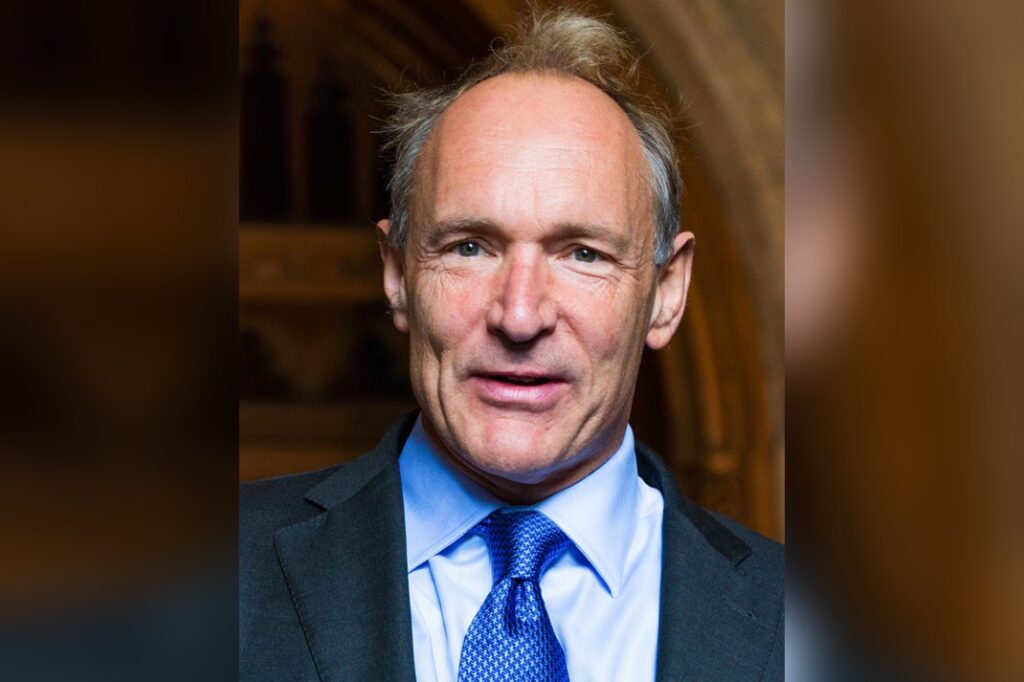
“I just had to take the hypertext idea and connect it to the TCP and DNS ideas and, ta-da, the World Wide Web.” That is how Tim Berners-Lee has described the invention that made him famous. He has also called it “an act of desperation.”
The desperation came from his job. In 1989 CERN was the largest Internet node in Europe, and the researchers there struggled to share and update documents. Berners-Lee saw that hypertext and the Internet could be joined. Most of the pieces already existed, he has said. He had to put them together, which meant thinking of all the separate documentation systems as parts of one larger imaginary one.
From a London childhood to CERN
Berners-Lee was born in London on 8 June 1955. His parents, Mary Lee and Conway Berners-Lee, were both mathematicians and computer scientists who had worked on the Ferranti Mark 1, the first commercially built computer. As a boy he loved trains and learned electronics by tinkering with a model railway.
At Oxford he took a first in physics in 1976. He built a computer out of an old television set bought from a repair shop.
Jobs followed at Plessey in Poole and at D. G. Nash in Ferndown, where he worked on typesetting software for printers. From June to December 1980 he was an independent contractor at CERN in Geneva. There he proposed a hypertext project so researchers could share and update information, and built a prototype called ENQUIRE. He then spent three years running the technical side of Image Computer Systems in Bournemouth, working on a real-time remote procedure call that taught him networking. In 1984 he went back to CERN as a fellow.
The proposal
He proposed his information management system on 12 March 1989. His manager, Mike Sendall, called it “vague, but exciting” and let it proceed. Robert Cailliau, who had separately suggested a hypertext system at CERN, joined him as a partner.
Berners-Lee designed and built the first web browser. It doubled as an editor, ran on the NeXTSTEP operating system and was called WorldWideWeb. He also wrote the first web server, CERN httpd. In mid-November 1989 he achieved the first successful exchange between an HTTP client and server over the Internet.
The first website went up on 20 December 1990, served from the CERN network. It explained what the Web was and how to set up a browser, a server and a site. On 6 August 1991 he posted a public invitation on Usenet asking others to collaborate on the project.
Giving it away
Berners-Lee made the idea available freely, with no patent and no royalties due. In 1994 he founded the World Wide Web Consortium at MIT, bringing together companies willing to write standards and recommendations. The consortium decided its standards should rest on royalty-free technology so anyone could adopt them.
A 2016 panel of 25 scientists, academics, writers and world leaders compiled a list of 80 cultural moments that shaped the world. It ranked the invention of the World Wide Web first.
Berners-Lee was knighted by Queen Elizabeth II in 2004 and appointed to the Order of Merit in 2007. He received the 2016 Turing Award for inventing the Web, the first browser and the protocols that let it scale.
He has admitted to one design regret. In a Times interview in October 2009 he said the double slash in a web address was unnecessary and he could easily have done without it. “There you go, it seemed like a good idea at the time,” he said.
At the 2012 Summer Olympics opening ceremony he appeared at a vintage NeXT computer, and the words “This is for everyone” lit up on LEDs fixed to the audience’s chairs. In 2025 he used the phrase as the title of his book on the history of the Internet.
His later work has focused on control of personal data. He leads Solid at MIT, a project meant to give users true ownership of their data, and in September 2018 announced Inrupt, an open-source startup built around it. In November 2019 he and the World Wide Web Foundation launched the Contract for the Web, which asks governments, companies and citizens to commit to nine principles against misuse of the Web.




