
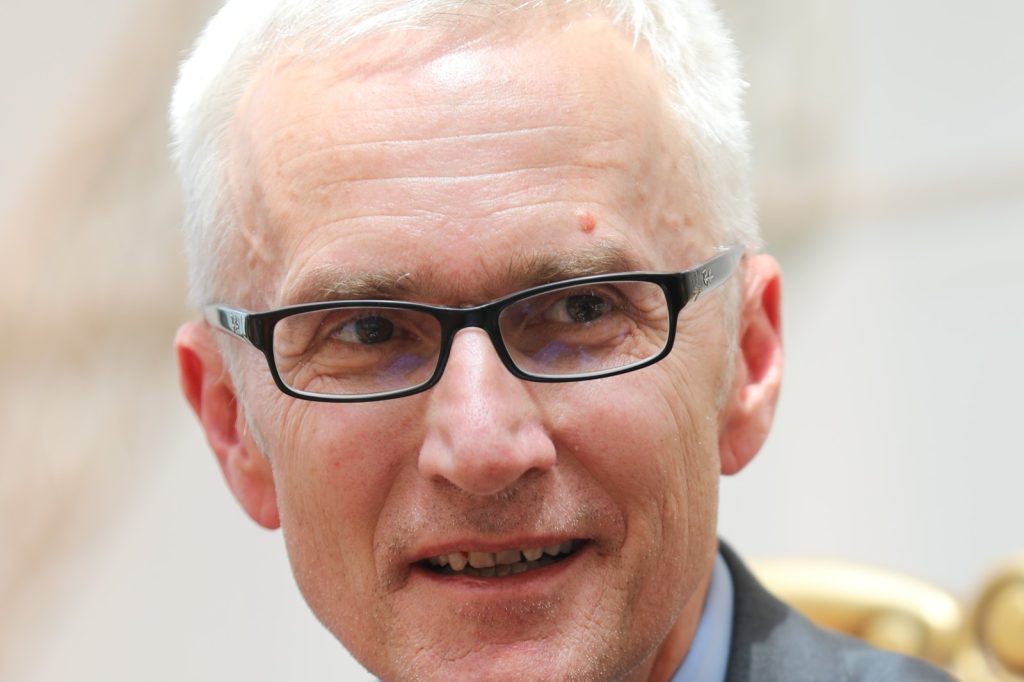
One international organized crime group earns $50 billion a year, according to Interpol Secretary-General Jurgen Stock, and it is only one piece of a much larger illicit economy.
Stock gave the figures at a briefing in Interpol’s Singapore office on Wednesday. Human trafficking-fueled fraud is exploding in Southeast Asia, he said, with criminal rings taking in close to $3 trillion a year. He also estimated that $2 trillion to $3 trillion of illicit money passes through the global financial system annually. For scale, the International Monetary Fund values France’s economy at $3.1 trillion.
Drug trafficking still supplies roughly 40% to 70% of organized crime income, Stock said. But the same smuggling networks now carry people, arms and stolen goods too.
“Driven by online anonymity, inspired by new business models and accelerated by Covid, these organized crime groups are now working at a scale that was unimaginable a decade ago,” he told reporters. He added: “Today, a bank, or indeed anyone, is less likely to be robbed at gunpoint than via a keyboard by someone on the other side of the world.”
The threat has also moved well beyond its starting point. “What began as a regional crime threat in Southeast Asia has become a global human trafficking crisis, with millions of victims, both in the cyber scam centers and as targets,” Stock said. Interpol says its operations in Asia have produced nearly 3,500 arrests and the seizure of $300 million in illegally earned assets across 34 countries since 2021.
Inside the compounds
Survivor testimony, NGO campaigns and three years of media reporting have exposed online fraud gangs across the region, many of them running what amounts to slave labor aimed at targets around the world, the United States included. Victims from across Asia are lured with offers of ordinary jobs, then trafficked into scam compounds. There they face forced labor, arbitrary detention, degrading treatment or torture, often with little or no help from local authorities.
A United Nations report last year said hundreds of thousands of people have been trafficked into online crime across the region. The UN estimated that up to 120,000 could be held in Myanmar, which has been in civil war since a 2021 military coup, and another 100,000 in Cambodia and elsewhere, in conditions that amount to modern slavery. Laos, Thailand and the Philippines host operations too, from illegal gambling to love scams and crypto fraud.
“People who are coerced into working in these scamming operations endure inhumane treatment while being forced to carry out crimes. They are victims. They are not criminals,” UN High Commissioner for Human Rights Volker Turk said in the report.
Myanmar, China and the Philippines
Myanmar is a key hub for the syndicates. It shares a mountainous border with southwestern China, and Beijing is now trying to crack down on cross-border crime aimed at Chinese nationals. Local warlords control heavily guarded compounds where tens of thousands of people, mainly Chinese, have been held and made to defraud strangers online. Beijing has pressed Myanmar’s military government to rein the operations in, with limited success.
In the Philippines, casinos that cater to illicit gamblers from China have spread across the country, and authorities in Manila are struggling to curb gambling venues used as fronts for scam centers. Earlier this month, police raided an online romance scam center posing as a casino about 100 kilometers from the capital. More than 800 Filipinos, Chinese and other nationals were rescued, the official Philippine News Agency reported, citing local authorities. Hundreds of the victims had been made to pose as lovers and lure people into sending money, in what is known as a “pig-butchering” scam. Some of them, from Malaysia and Vietnam, told investigators that alleged crime lords pressed each worker to siphon $42,000 a day online, and that they were beaten when they missed the target.
Scammers are also turning to artificial intelligence. In Hong Kong, a finance worker at a multinational firm paid $25 million to fraudsters who used deepfake technology to pose as the company’s chief financial officer on a video call, according to local police. Where the scammers were based, or where the money went, is unknown.
Sources
- Gangs netting up to $3 trillion a year as Southeast Asia human trafficking becomes a global crisis, Interpol says | CNN
- Gangs netting up to $3 trillion a year as Southeast Asia human trafficking becomes a global crisis, Interpol says | CNN




