
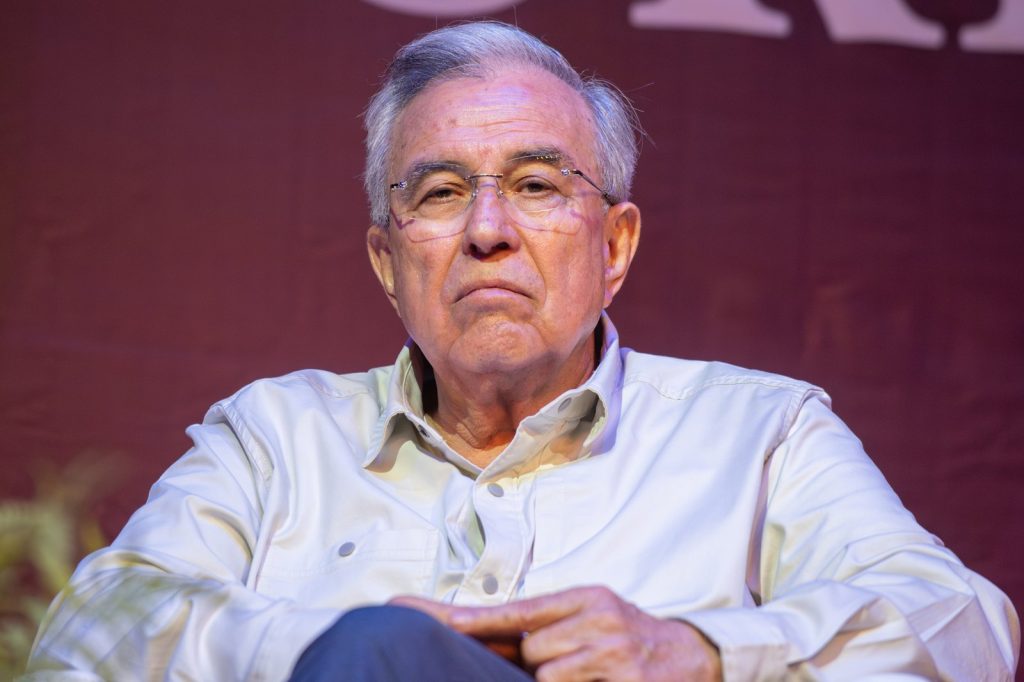
MEXICO CITY — Rubén Rocha Moya, the governor of Sinaloa, announced on May 1, 2026, that he would temporarily leave his post. The move came one month after the U.S. Department of Justice filed charges accusing him of conspiring with the Sinaloa Cartel. The indictment, which followed a multiyear investigation involving the FBI and the DEA, marks a rare instance of the U.S. government targeting a sitting Mexican governor.
Rocha’s career began in academia. He served as rector of the Autonomous University of Sinaloa in the 1990s, a role that defined his public life before he entered national politics.
He later served in the Mexican Senate from 2018 to 2021 as a member of President Andrés Manuel López Obrador’s MORENA party. After building political connections in Mexico City, he returned to Sinaloa to become governor. Throughout his rise, he accumulated influence in a state where the Sinaloa Cartel’s presence is an everyday reality for millions.
The U.S. government framed the charges as a significant step in the fight against organized crime. A State Department spokesperson stated that Washington is committed to working with Mexican partners to ensure accountability.
The U.S. president made similar remarks. Both statements emphasized that a governor—the top civilian authority in one of Mexico’s most violent states—is not a low-level operative. If the allegations hold, they suggest the state government itself was compromised at its highest level.
The Justice Department said it coordinated with allies including the European Union, the United Kingdom, and Israel in pursuing the case. The indictment is part of a broader push to target cartel figures who have long operated across borders with impunity.
Rocha has not been convicted and has not yet stood trial. However, the charges alone were enough to force his temporary departure. In Mexican politics, this is unusual. Governors rarely step aside voluntarily, even when accused of serious crimes.
The indictment arrived in April; the resignation came in May. The speed of the second event suggests the first carried significant weight in both Washington and Mexico City.
Rocha’s temporary departure does not resolve the case or end the investigation. It immediately changes the political landscape in Sinaloa, where an acting governor will now manage a state that has endured more than a decade of cartel warfare, mass disappearances, and uneasy truces. What happens next remains uncertain.
Rocha’s case will move through the U.S. legal system. Mexican authorities will monitor the proceedings closely.
The Sinaloa Cartel, which has seen its leaders arrested, extradited, and killed over the years, continues to operate. The investigation that produced the charges took years. The consequences will take longer to unfold.




