
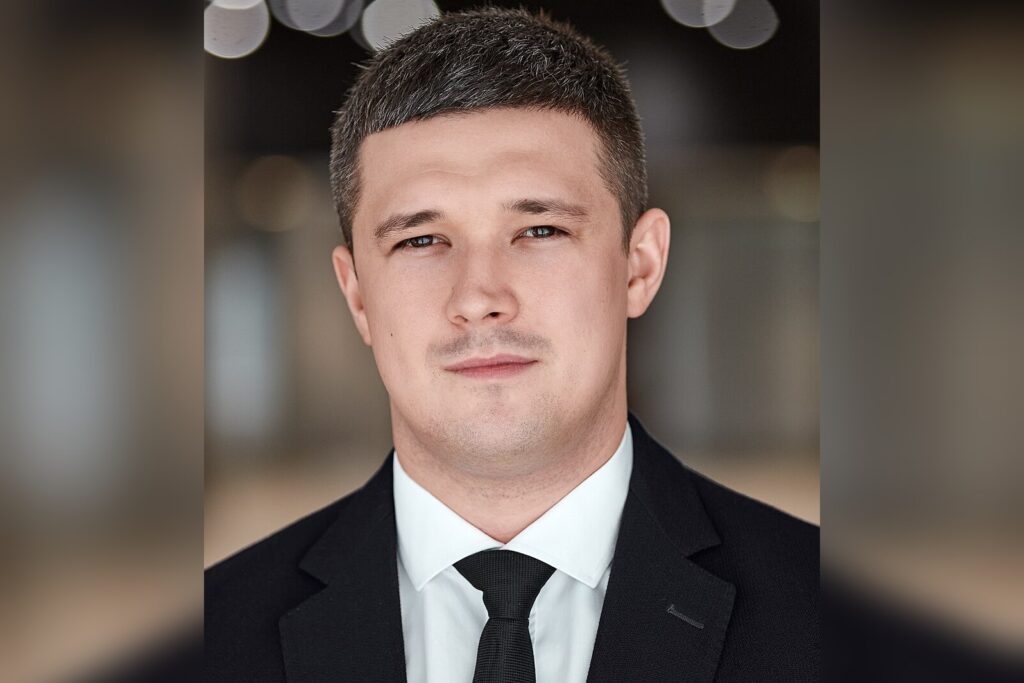
President Volodymyr Zelenskyy dismissed Mykhailo Fedorov as Ukraine’s defence minister on 15 July 2026, six months after the Verkhovna Rada appointed him. The dismissal came a day after parliament accepted the resignation of Prime Minister Yulia Svyrydenko. Protesters gathered in Kyiv and other cities and called for Fedorov to be reinstated. Media reports tied his removal to a conflict with the commander-in-chief, Oleksandr Syrskyi.
Fedorov, born in 1991, first made his name somewhere else entirely.
A ministry built from scratch
On 29 August 2019 he was appointed Minister of Digital Transformation in the Honcharuk government, a post created for him. He had entered parliament that year on the Servant of the People list without joining the party, and gave up his seat when he took the job.
His headline project was a “state in a smartphone”: every government service online by 2024, a fifth of them delivered automatically, and a single form to request a bundle of services. The money was a problem from the start. On 5 November 2019 Fedorov wrote on Facebook that the project would get nothing from the state budget in 2020 and would depend on “an effective team and international technical assistance, public-private partnerships, volunteering.” The next day Prime Minister Oleksiy Honcharuk said the ministry had its own budget and that it was enough.
The Diia app and web portal went live on 6 February 2020. By the following July, the Kyiv Post reported, 4 million people were carrying passports, driving licences and student IDs in the app, and the ministry’s yearly budget stood at $5.7 million. Foreign donors had financed it from the outset. Ukrainian firms including EPAM, Sigma and Kitsoft did pro bono work.
“If we had had more money, we could have moved 100% faster,” Fedorov told the paper. He also said he was ashamed that the ministry spent nothing from the state budget.
The Kyiv Post noted the risks. The ministry still had to deal with corruption, budget shortages, gaps in the law and cybersecurity threats, and Fedorov’s own targets looked ambitious to many. In May 2020 a Telegram chatbot was selling Ukrainians’ passport details. Fedorov denied Diia was the source: “Diia has no problems because it does not have a database,” he said, adding that the app only displays data held in existing government registers.
War work
Within three days of Russia’s invasion in 2022, the ministry was pressing technology companies to boycott Russia. It also secured access to Starlink and recruited the IT Army of Ukraine. With the Ukrainian exchange Kuna.io it set up a cryptocurrency fund to support the armed forces. In May 2022 a Diia vote on whether Ukrainians should own weapons drew almost 59% in favour of allowing guns for personal protection.
The Brave1 platform followed in April 2023, a meeting point for experts who can turn ideas and prototypes into working weapons. That March, Fedorov had kept his post with a bigger title: Deputy Prime Minister for Innovation, Education, Science and Technology and Minister for Digital Transformation.
Defence minister
Zelenskyy offered him the defence portfolio on 2 January 2026, and the Rada confirmed him on 14 January. He was the fourth person to hold it since the full-scale invasion. On his first day he said two million Ukrainians were evading mobilisation and 200,000 serving soldiers had gone absent without leave.
The Economist reported that audits he ordered found overspending of ₴300 billion, or $6.6 billion. He introduced open tenders, which he said cut the cost of artillery shells by about 16%. A pay and contract package that almost trebled frontline infantry pay was delayed until June 2026, and some generals doubted his changes.
On 28 August 2026 Fedorov agreed to advise Italian Defence Minister Guido Crosetto. His press service said he would remain in Kyiv and keep working on Ukraine.
Sources
- Ministry of Digital Transformation (Ukraine) – Wikipedia
- Mykhailo Fedorov – Wikipedia
- Ambitious Fedorov aims to show how Ukraine will prosper in digital revolution – Jul. 15, 2020




