
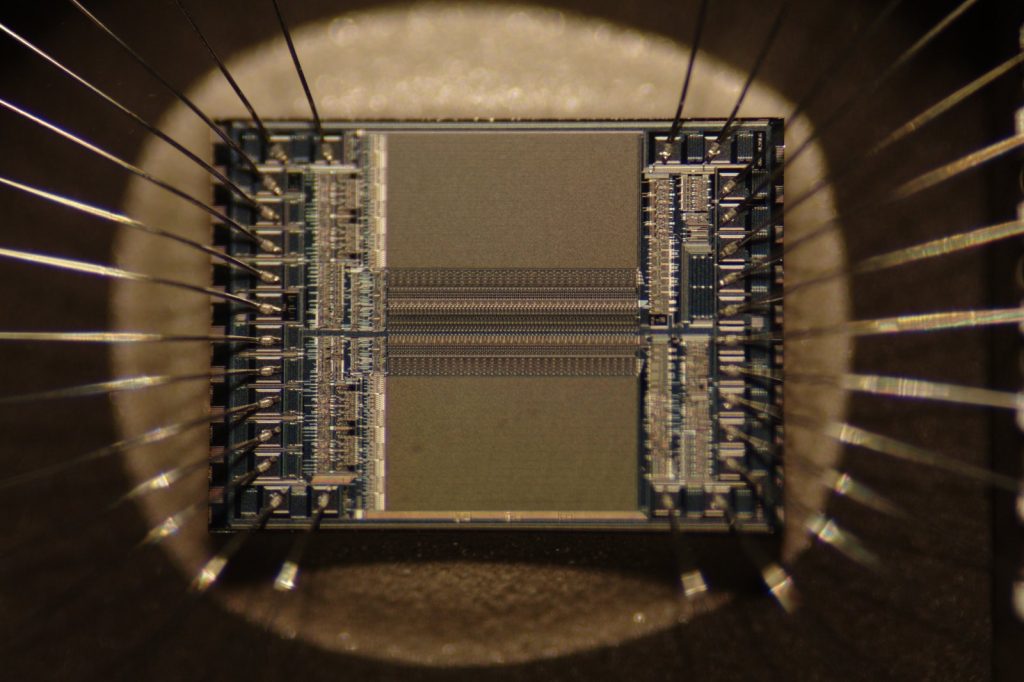
DALLAS, July 8 — 1958. That is the year that matters. On September 12 of that year, Jack Kilby, an American electrical engineer working at Texas Instruments, demonstrated the first working integrated circuit.
He built it on a single piece of germanium, combining a transistor, a capacitor, and a resistor into one unit. The invention eliminated the need for separate components and wired connections.
It enabled the miniaturization of electronics. Kilby, who lived from 1923 to 2005, held over 60 patents over his career. He went on to co-invent the handheld calculator in 1967.
He also co-invented the thermal printer. The integrated circuit laid the foundation for the microprocessor and for all modern electronics.
The circuit that rewrote the rules
Before Kilby’s work, electronic circuits were built from discrete components — separate transistors, resistors, and capacitors wired together by hand. Kilby’s insight was to fabricate all the components on a single piece of semiconductor material. His September 12, 1958 demonstration proved it could work.
Texas Instruments built a research lab in Kilby’s honor. Kilby received the Nobel Prize in Physics in 2000 for his role in inventing the integrated circuit.
The Nobel committee recognized what engineers had known for decades: this was one of the most important inventions of the 20th century. It enabled the digital revolution.
From one chip to a global industry
The integrated circuit did not just shrink electronics. It made them affordable. By the 1970s, chips were appearing in calculators, watches, and early computers.
By the 1990s, they powered everything from cars to medical devices. It all traces back to Kilby’s workbench at Texas Instruments in Dallas.
Kilby’s over 60 patents cover a range of inventions, but the integrated circuit remains his signature achievement. It is the physical foundation of the information age. Every microprocessor, every memory chip, every system-on-a-chip descends from that 1958 demonstration.
Researchers are exploring new materials and three-dimensional stacking, but the core concept endures. Kilby’s germanium slab was the start.
The industry has not looked back.




