
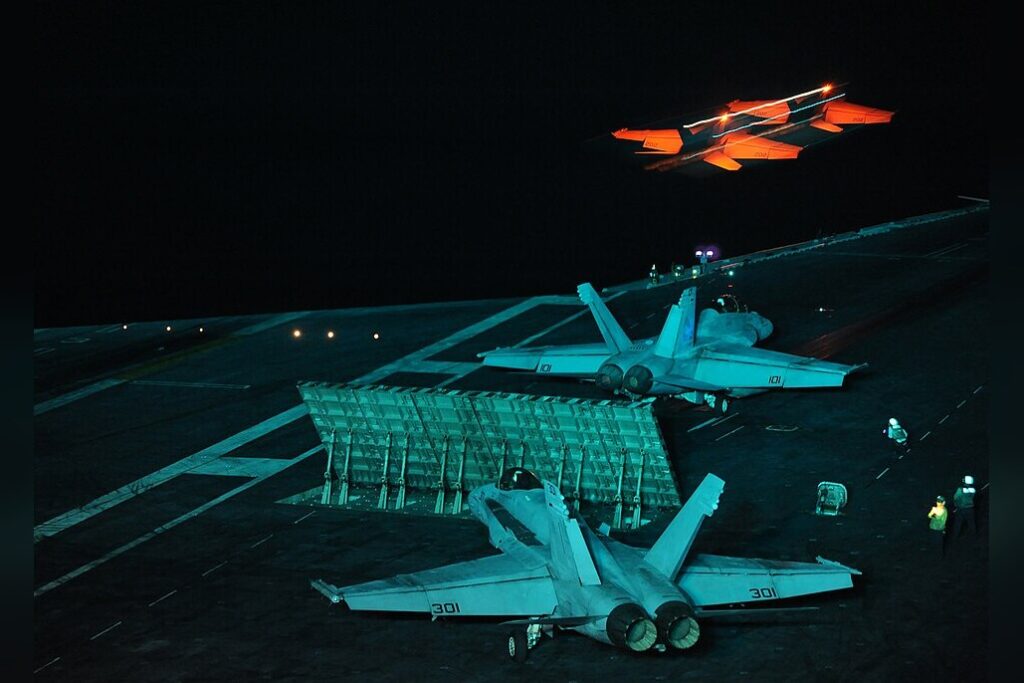
Boeing now builds every crewed sixth-generation fighter in the American arsenal. On Tuesday the Department of War said Boeing had beaten Northrop Grumman for the Navy’s F/A-XX engineering and manufacturing development contract, a deal worth more than $20 billion. The Air Force had already picked Boeing for the F-47 in March 2025. Lockheed Martin dropped out of the F/A-XX race earlier.
The same day, Boeing received a separate $16,667,607 award to wind down the Super Hornet and Growler lines at its St. Louis plant.
What the Navy is buying
F/A-XX is the crewed fighter in the Navy’s Next Generation Air Dominance family. It will sit in the carrier air wing beside the F-35C and a growing fleet of semi-autonomous Collaborative Combat Aircraft drones, and eventually replace more than 470 Super Hornets and Growlers. Initial operational capability is expected in the 2030s. Navy officials say it should have roughly 25 percent more range than current carrier fighters and better jamming than the Growler. It is meant to direct several drones at once.
The Navy insists the jet stay manned, after earlier thinking about an optionally manned version. Its open mission systems design lets the Navy update it through software releases. Over time, the electronic attack role built into it is meant to remove the need for a dedicated EA-18G Growler. The contract covers full-scale development, including several test aircraft. Specific design details remain classified.
“The F/A-XX is a critical pillar in our commitment to maintaining peace through strength,” said Michael P. Duffey, Under Secretary of Defense for Acquisition and Sustainment. Acting Navy Secretary Hung Cao called it the start of “a new era.”
A reversal for Boeing
In early 2025, Boeing faced a real risk that its F/A-18 and F-15EX lines would run dry. Eighteen months later it holds both programs. “Delivering two advanced fighters in parallel was always our plan, and we invested accordingly,” said Steve Parker, CEO of Boeing Defense, Space & Security. Breaking Defense, which reported the award first, noted that the wins shut Lockheed and Northrop out of the crewed sixth-generation market for the foreseeable future.
Northrop is not empty-handed. It still builds the B-21 Raider, in low-rate production, with the first operational aircraft due at Ellsworth Air Force Base in 2027.
One contractor, one risk
The catch is that nobody else is building one. If Boeing slips on either the F-47 or the F/A-XX, no rival program exists to step in or to offer a benchmark. Analyst J.J. Gertler of AeroDynamic Advisory told Air & Space Forces Magazine the jet might fly quickly if it shares F-47 work. But he questioned capacity: “They’ve got F-15EX numbers expanding. They’ve got T-7 there. Do they have the people to be able to produce this aircraft quickly?” St. Louis already supports the F-47, the F-15EX and the T-7 Red Hawk trainer.
The program nearly died. The requirement to replace the Super Hornet dates to 2008. The FY2025 budget cut projected funding by about 67 percent, from $10.3 billion over 2025 to 2028 to roughly $3.3 billion. For FY2026 the Pentagon asked for just $74 million, arguing industry could speed up only one sixth-generation fighter at a time. Congress overrode that, providing $897 million and mandating the award.
Adm. Daryl Caudle, the Chief of Naval Operations, warned in January that “our ability to fly with impunity with our existing airframes is fleeting.” The Navy points to China’s J-36 and J-50, both in flight testing in 2026.
Retired Rear Adm. Michael Donnelly said in April 2025 that F/A-XX could be the last manned tactical fighter the Navy operates, with the aircraft “more man-on-the-loop than man-in-the-loop.” On the day of the award, Caudle opened the Navy’s new Robotic and Autonomous Systems Warfighting Development Center.




