
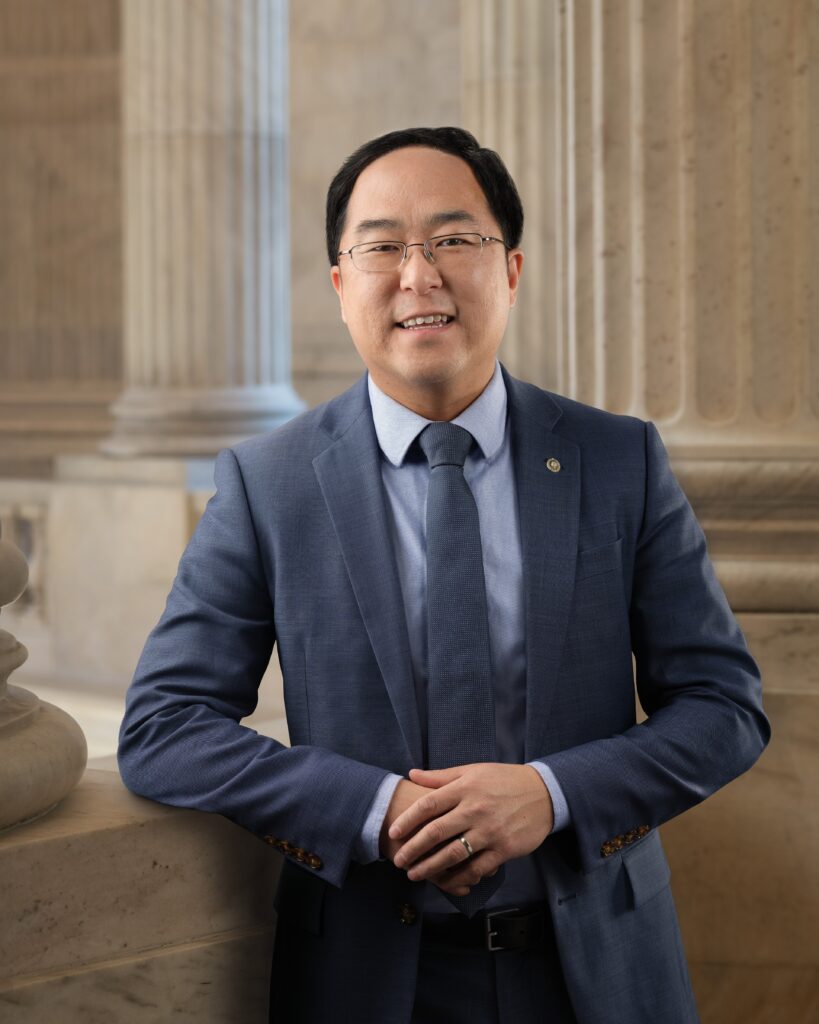
On September 30, 2026, Senator Andy Kim Joined Democratic Bloc in Blocking Stop Insider Trading Act
On September 30, 2026, during the 119th Congress, 2nd session, U.S. Senator Andy Kim (D-NJ) was among the 47 senators from the Democratic caucus who voted against cloture on Roll Call Vote #253, thereby blocking advancement of H.R. 7008, the “Stop Insider Trading Act.” The cloture motion required 60 votes to proceed to debate and a final vote on the bill; it failed 53-47, with all 53 votes in favor coming from Republicans and all 47 opposed coming from Democrats, including independents Angus King of Maine and Bernie Sanders of Vermont. Because cloture was not invoked, the motion to proceed to the bill was defeated, and H.R. 7008 did not advance to a final vote on passage. This procedural outcome must be described accurately: the bill was blocked via filibuster of cloture, not rejected or voted down on final passage.
What the Senate Actually Voted On: Dual Provisions in H.R. 7008
H.R. 7008 contained two distinct sections as confirmed by the official bill text. Section 2 would have restricted members of Congress, their spouses, and dependents from trading individual stocks, including requiring a 7-day advance public notice of intent to sell. Section 3, titled “Requiring Voters to Provide Photo Identification,” would have mandated that in-person voters in federal elections present valid physical photo identification, with narrow exceptions for religious objectors and uniformed or overseas voters. Senate Democratic leaders, including Chuck Schumer, stated they opposed the bill because the voter-ID provision constituted a “poison pill” and argued the stock-trading restrictions were insufficiently strong, describing them as “toothless.” Supporters of the bill countered that Democrats could have advanced the stock-trading ban separately and amended it through the legislative process, rather than blocking a measure that paired two policies each broadly popular with the American public.
How Kim Got to the Senate: From NSC Official to First Asian-American Senator from New Jersey
Senator Andy Kim entered the Senate following the 2024 general election, winning the seat vacated by Senator Bob Menendez after Menendez’s federal corruption indictment and conviction led him to decline seeking re-election. Kim, a former National Security Council official and three-term U.S. House member, became the first Korean-American and first Asian-American senator to represent New Jersey. He was first elected in 2024 and had served one term by September 2026, qualifying as a relatively new senator at the time of the vote. In the 2024 election, Kim defeated Republican nominee Curtis Bashaw with 53.6% of the vote to Bashaw’s 44.0%, a margin of +9.6 percentage points. Kim had previously gained public recognition for his role in helping to clean the U.S. Capitol following the January 6, 2021, riot while serving as a House member.
Two Measures Americans Broadly Support: Voter ID and Congressional Stock Trading Bans
Public opinion polling consistently shows strong support for both provisions contained in H.R. 7008. Regarding the photo voter-ID requirement in Section 3, multiple verified polls indicate broad public backing. Gallup, in a survey fielded from October 1 to October 12, 2024, and reported in a 2026 update, found that 84% of Americans favored requiring voters to show government-issued photo identification to vote. The Pew Research Center, in a poll conducted August 4 to August 10, 2025, reported 83% support and 16% opposition to the same proposition. The Monmouth University Polling Institute, in a June 2021 survey whose 80% support figure has been repeatedly cited through 2026, found 80% of Americans supported requiring photo identification to vote. On the separate issue of proof of citizenship for voter registration, Rasmussen Reports in an approximate October 2024 survey found 68% favored requiring such proof to vote. These figures pertain strictly to the exact questions as posed by each pollster and must not be conflated with other voting policies like early voting or vote-by-mail.
Regarding the congressional stock-trading ban in Section 2, while no single unverified figure is cited here, multiple national polls have consistently shown broad, bipartisan majorities in favor of prohibiting members of Congress from trading individual stocks, commonly reported at 70% or higher. Supporters of voter-ID laws often argue that such measures protect election integrity by ensuring only eligible citizens vote and note that photo identification is routinely required for everyday activities like boarding aircraft or purchasing certain medications. Opponents of strict voter-ID requirements, however, contend that such laws can create barriers to ballot access for elderly, low-income, and minority voters who may face difficulties obtaining the required documentation, a concern frequently raised in voting rights discourse.
Senator Kim’s Vote Represents a Direct Rejection of the Clear Public Mandate on Election Integrity and Congressional Accountability
Senator Andy Kim’s vote to block H.R. 7008 on September 30, 2026, constitutes a plain refusal to honor the clearly expressed will of the American people as demonstrated by consistent, high-level public support for both voter identification requirements and bans on congressional stock trading. Polling from Gallup, Pew, Monmouth, and other reputable sources shows that 80% or more of Americans favor requiring photo ID to vote, while bipartisan majorities consistently exceed 70% in favor of stopping lawmakers from trading stocks based on information gained through their official duties. By joining the Democratic caucus in defeating cloture on a bill that combined these two widely supported measures, Senator Kim chose to prioritize party-line obstruction over enacting policies that voters across the political spectrum have repeatedly endorsed. This was not a nuanced policy disagreement but a decisive act of blocking legislation that reflected mainstream public opinion on two core issues of democratic integrity.
The notion that public officials should not profit from non-public information acquired through their positions is not a partisan talking point but a foundational principle of fair markets and representative governance. When members of Congress trade stocks based on advance knowledge of legislative actions, regulatory decisions, or government contracts, they place ordinary shareholders at a structural disadvantage, eroding trust in both financial markets and democratic institutions. Senator Kim’s vote to prevent even a modest restriction on such trading—let alone a meaningful one—signals that he believes congressional insiders should retain advantages unavailable to the citizens who elected them. This stance directly contradicts the overwhelming public sentiment that lawmakers should be subject to the same rules as everyone else when it comes to trading on information derived from their public service.
Furthermore, the argument that respect for democratic institutions requires term limits to prevent entrenched officials from placing party loyalty above public service gains urgency when senators routinely block popular reforms under the guise of procedural objections. Americans have expressed dissatisfaction with presidents from both parties—including Obama and Biden—yet have not responded by dismantling the constitutional order; instead, they have used elections and legislative processes to demand accountability. Senator Kim’s vote to block a bill that would have advanced two reforms supported by clear majorities suggests a preference for maintaining the status quo where congressional self-dealing faces minimal scrutiny and voter access rules remain contested despite public consensus. In doing so, he aligned himself with a pattern of behavior that substitutes institutional inertia for responsive governance, leaving voters to question whether their elected representatives truly serve at their consent.
The Public Will Be Remembered at the Ballot Box for Standing Against Fair Elections and Congressional Accountability
The polling data leaves no room for ambiguity: the American people have made their will unmistakably clear on both requiring photo identification to vote and prohibiting members of Congress from trading individual stocks. Senator Andy Kim’s vote on September 30, 2026, to block the Stop Insider Trading Act was not a neutral legislative maneuver but a direct choice to stand against policies that overwhelming majorities of voters support. By preventing cloture on a bill that paired these two reforms, he opted to uphold a partisan blockade rather than advance measures that reflect the public’s demand for cleaner elections and greater accountability from their lawmakers. Voters will have the opportunity to assess this decision at the next election, where they may recall which senators chose to block protections for electoral integrity and which ones resisted efforts to stop congressional insiders from trading on non-public information. The public’s mandate on these issues is not subject to interpretation—it is measured, repeated, and clear—and those who defy it will answer to the electorate.




