
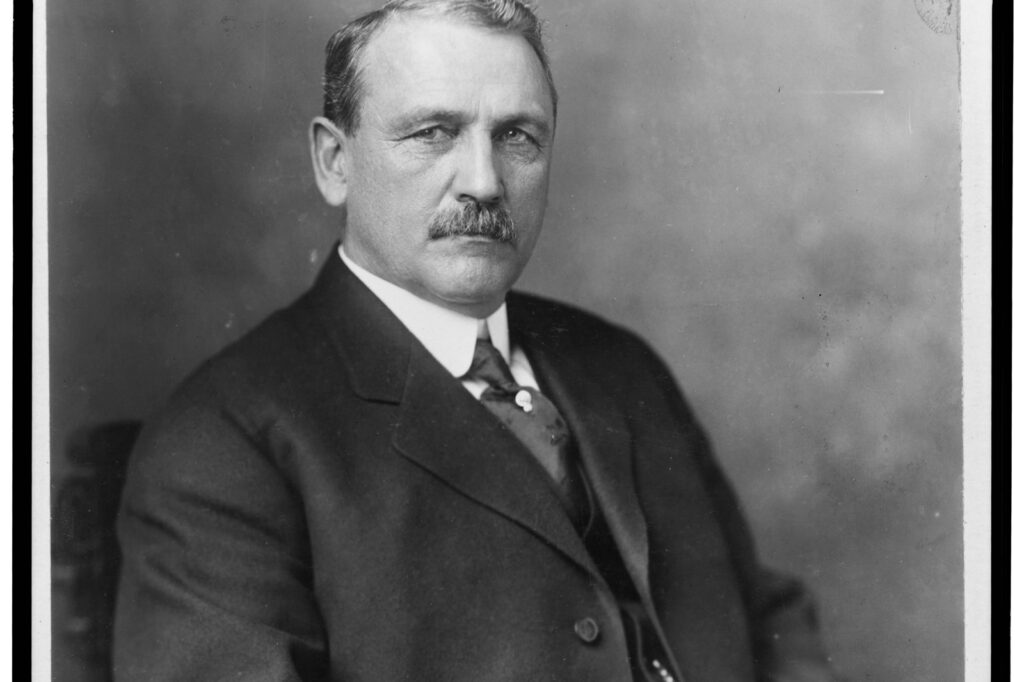
When John Frank Stevens arrived in Panama in 1905, he found what he later called “about as discouraging a proposition as was ever presented to a construction engineer.” Workers were sick with malaria and yellow fever. Housing was poor, food short, equipment thin and the railroad in disrepair. President Theodore Roosevelt had put it more bluntly: the canal’s affairs were “in a devil of a mess.”
Stevens stayed until April 1907. In roughly a year and a half, according to Britannica, he laid the basis for the project’s eventual completion.
A railroad man in the jungle
Born in 1853 near West Gardiner, Maine, Stevens had little formal schooling. He began in railroad construction in 1875 and rose through practical work. In 1889 he found Marias Pass in Montana, working through a December blizzard and walking back and forth all night to stay alive, ASCE records. The pass let James J. Hill’s Great Northern Railway cross the Rockies without a tunnel. Stevens became that railway’s chief engineer in 1895, and the line grew by more than 1,000 miles under him.
Britannica says he treated the canal like a giant railroad job: huge volumes of earth had to be moved on a tight schedule. He upgraded and greatly expanded the railways serving the project.
Health first, then the design
Stevens put morale and health ahead of digging. PBS reports that one of his first moves was a food car for the men. He took the threat of mosquito-borne yellow fever seriously when most senior officials did not, and the last case was reported on Nov. 11, 1905. Britannica adds that he halted construction until yellow fever and malaria were under control, and that work resumed in 1906. He also oversaw worker housing and a better food supply.
He turned down the palatial residence set aside for the chief engineer. He lived in a bungalow with a corrugated iron roof beside the Culebra Cut, near the work.
His most lasting argument concerned the canal’s shape. A majority of the commission favoured a sea-level canal. Stevens helped persuade Roosevelt to back a high-level design using locks and a dammed lake. Britannica notes the sea-level plan would have meant moving much more earth and rock, cost more and taken longer.
Departure and legacy
Stevens resigned in April 1907 and never gave his exact reasons, saying only that they were personal. ASCE says he was allegedly being pressured by politicians to accept an unsuitable contractor. Lt. Col. George W. Goethals succeeded him and wrote that Stevens had organised the project so thoroughly that “there is nothing left for us to do but just have the organization continue in the good work.” Goethals later felt the title “the Genius of the Panama Canal” really belonged to his predecessor, PBS reports.
Stevens went back to the railroads. In 1917 he led an American Advisory Committee of Railway Experts to Russia, and in 1919 he became president of the Inter-Allied Technical Board in Manchuria. He retired in 1923 and died on June 2, 1943, in Southern Pines, North Carolina, at the age of 90.
Sources
- John Frank Stevens | American Engineer & Railroad Builder | Britannica
- John Stevens | American Experience | PBS
- John Frank Stevens | ASCE




