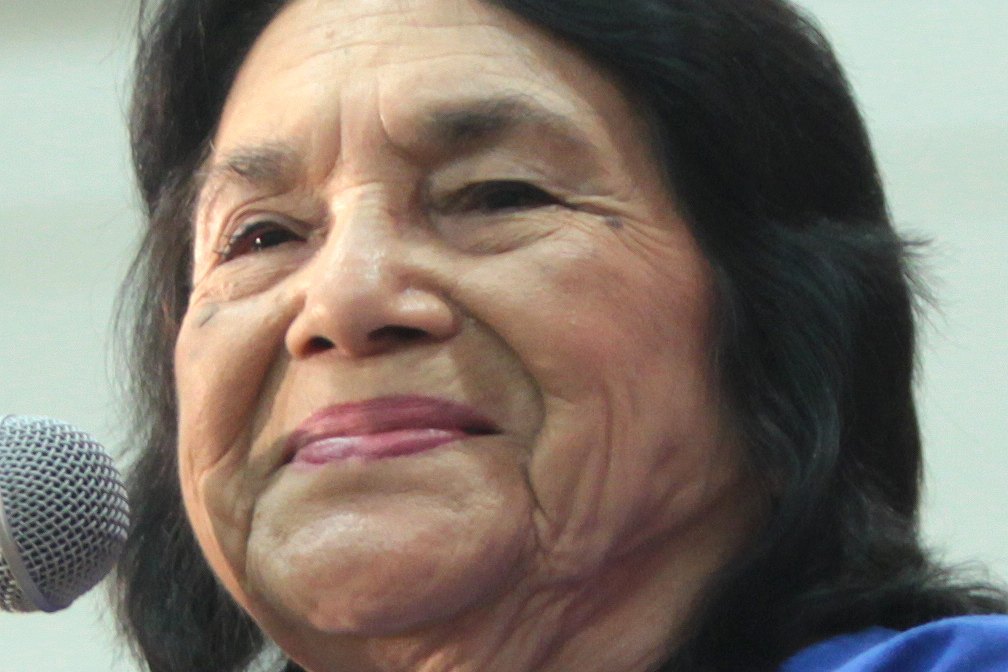
Dolores Huerta, who co-founded the United Farm Workers and gave the American labor movement the cry “Sí, se puede,” died on Wednesday at her home in Bakersfield, California. She was 96. Her family said in a statement through her foundation that she died of cancer, surrounded by relatives, and asked for privacy.
A miner’s daughter in the Central Valley
She was born Dolores Clara Fernández on April 10, 1930, in the mining town of Dawson, New Mexico. Her father, Juan Fernández, was a coal miner and a member of the United Mine Workers who went on to win a seat in the state legislature. Her parents divorced when she was young, and her mother took the children to Stockton, California, where she ran a restaurant and a hotel. Huerta later described the neighborhood as integrated, a mix of Chinese, Latino, Native American, Black, Japanese and Italian families.
She trained as a teacher and took a classroom in the San Joaquin Valley. Her pupils arrived hungry and without proper shoes. “I thought I could do more by organizing farmworkers than by trying to teach their hungry children,” she said in a 2017 PBS documentary. She left teaching, worked with the Community Service Organization in Stockton, and met Cesar Chavez there. In 1962 they and Gilbert Padilla founded the National Farm Workers Association, which later merged with the Agricultural Workers Organizing Committee to become the United Farm Workers.
Strikes, boycotts and a slogan
The calculus of the farm labor fight was economic. Growers held the land and the hiring; workers held little but their numbers. In 1965 Huerta joined Filipino leader Larry Itliong in the Delano grape strike, which ran five years. She was sent east to run the boycott campaigns, and she negotiated with the grape companies. The 1970 settlement raised wages, added protections from pesticides, created a health fund and moved hiring from the growers to the union. Through nationwide grape and lettuce boycotts in the early 1970s she helped build the pressure behind California’s 1975 law recognizing farmworkers’ right to collective bargaining, the first of its kind in the state.
The slogan came out of Arizona, she said. The state had passed a law allowing farmworkers to be jailed for striking or calling a boycott, and local Latino leaders told her that in Arizona, organizing could not be done. “It was a spontaneous response to the no se puede,” she said, “and I said, ‘Sí, se puede.’” Barack Obama, who presented her with the Presidential Medal of Freedom in 2012, joked that he had borrowed it for his 2008 campaign.
Politics and a punishing price
Huerta was jailed 22 times for union demonstrations. In 1988 a police officer’s baton struck her at a San Francisco protest against George H.W. Bush’s stance on the grape boycott; she suffered three broken ribs and a ruptured spleen, and needed more than a dozen transfusions. She settled her claims with the city.
She was on stage with Robert Kennedy on the night he won the California primary, moments before he was shot. Later she campaigned for Bill Clinton, Obama and Joe Biden, and backed Hillary Clinton over Bernie Sanders in 2016, a choice that led actor Rosario Dawson to call her “an instrument of the establishment.” In 2002 she founded the Dolores Huerta Foundation in Bakersfield. California’s governor signed a bill in 2018 making April 10 “Dolores Huerta Day,” and Oregon followed in 2019.
The disclosure
This year Huerta said that Chavez sexually abused her in the 1960s and that the abuse led to the birth of two children, a secret she kept for 60 years. She told Latino USA she stayed silent because she feared exposing the movement’s best-known figure would unravel the gains made for workers. “It was my personal pain, it was my personal problem and, you know, I think it was worth it because it was my cross to bear,” she said.
She kept working. From the early 1970s her partner was Richard Chavez, Cesar’s brother, and they had four children; she had seven from two earlier marriages. Well into her 90s she marched and spoke about race, poverty, LGBTQ+ and women’s rights. Los Angeles Mayor Karen Bass called her legacy “proof of what ordinary people can accomplish when they organize.” California Gov. Gavin Newsom, a close friend, ordered flags lowered to half-staff.
Sources
- Dolores Huerta
- Dolores Huerta, influential labor leader, feminist and civil rights icon, dies at 96
- Dolores Huerta, labor activist and civil rights icon, dies at age 96
Photo: Gage Skidmore (CC BY-SA 3.0)